


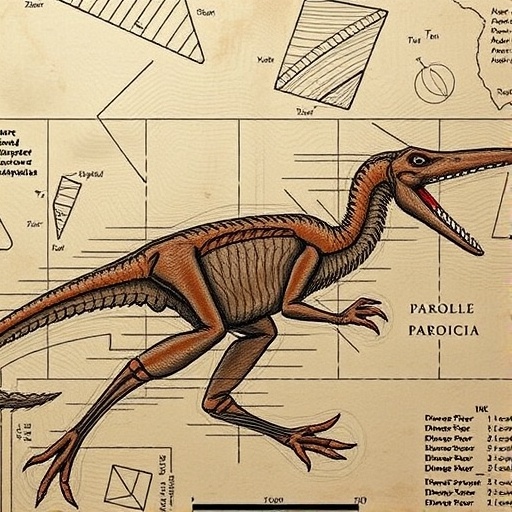
A remarkable discovery from the Late Cretaceous epoch has recently emerged from the southern reaches of Patagonia, unveiling a novel raptor-like dinosaur that appears to have lived and hunted in a fashion strikingly reminiscent of modern herons. This newfound species, christened Kank australis, showcases a unique predatory adaptation that challenges conventional perceptions of dromaeosaurid behavior and ecology. Identified through a collection of fossilized remains—including teeth, vertebrae, and pedal bones—Kank australis provides compelling evidence for niche diversification among Late Cretaceous theropods in South America.
Belonging to the family Unenlagiidae, Kank australis adds a critical piece to the puzzle of these enigmatic raptors, whose small to medium-sized members have been predominantly recorded in Late Cretaceous sedimentary layers across South America, Antarctica, Australia, and even Madagascar. While seven distinct unenlagiids have been previously identified from the northern Patagonian region, the fossil record had remained frustratingly sparse in the southern sector, with fragmentary remains previously found but unable to be definitively assigned to specific taxa. Kank australis effectively fills this geographic void and underscores the broader dispersal of unenlagiids across multiple southern latitudes during the Maastrichtian age.
The adult size of Kank australis is estimated to have reached approximately 2.5 to 3 meters in length, based on detailed comparative analysis with Neuquenraptor argentinus, an unenlagiid species dating from around 90 million years ago in northern Patagonia. Such comparisons suggest these theropods retained a consistent body plan and ecological role over tens of millions of years, while diversifying their morphology to adapt to local environments. Excavations have been ongoing since 2018 at the La Anita farm near El Calafate in Santa Cruz province, and it was only the retrieval of a cervical vertebra earlier this year that solidified the new dinosaur’s classification within the Unenlagiinae subfamily.
Kank australis inhabited a richly biodiverse environment characterized by meandering rivers, seasonal ponds, and abundant aquatic vegetation including water lilies. Analysis of fossilized soil samples alongside plant remains reveals that the paleoclimate of southern Patagonia during the Maastrichtian was temperate and humid, experiencing seasonal rainfall patterns far removed from today’s colder, drier conditions. This lush habitat supported an intricate web of life comprising diverse invertebrates, fish species, amphibians, reptiles, and even early mammals, all of which would have constituted the food web within which Kank australis operated.
Anatomical peculiarities of Kank australis suggest specialized feeding behavior distinct from its more famous northern cousins like Velociraptor. The cervical vertebrae exhibit unique structural features facilitating robust muscle attachments and the protection of critical blood vessels, adaptations often seen in modern birds with highly flexible and precise neck movements—specifically herons. This anatomical evidence, coupled with associated fish fossils found within the same stratigraphic layers, strongly indicates that Kank australis was an active piscivore, significantly diverging from the terrestrial, fast-running predation typically attributed to dromaeosaurids.
Further examination of its dentition reveals teeth with sharp, pronounced longitudinal ridges, markedly different from the more generalized serrated teeth of many theropods. This dental morphology likely enhanced its ability to grip slippery prey such as fish. Additionally, pneumatic cervical vertebrae containing internal air chambers suggest a lightweight skeleton aiding maneuverability during complex hunting motions, reinforcing the inference of a semi-aquatic or riparian lifestyle. Despite its gracile build, Kank australis possessed a sharply curved, enlarged “raptorial” claw on the second toe—a hallmark of the Unenlagiidae—used to capture and subdue prey.
The discovery of Kank australis also expands our understanding of the complex ecosystems that thrived in southern Patagonia during the Late Cretaceous. It coexisted with formidable megafauna such as Maip macrothorax, a megaraptorid surpassing 10 meters in length and likely occupying the apex predator niche. The simultaneous presence of these taxa unveils a dynamic balance within the ecosystem, where niche partitioning allowed different theropod lineages to exploit varying food sources and habitats, from apex carnivory to specialized piscivory.
The genus name Kank pays tribute to the indigenous Aonikenk people’s mythology, evoking a giant rhea whose powerful footprints allegedly etched patterns in the sky, giving rise to the constellation Choiols—known in Latin as Crux or the Southern Cross. This symbolic connection anchors the species’ identity to the region’s cultural heritage and its southern geographic provenance. The specific epithet “australis” further emphasizes this southern distribution, highlighting the importance of Patagonia as a unique paleobiogeographic region.
Moving forward, paleontologists intend to continue excavations within the Chorrillo Formation, where Kank australis was found. The site has already yielded an impressive array of fossil flora and fauna, providing insights into Late Cretaceous biotic assemblages in southern South America. Additional discoveries of Kank specimens would enable researchers to reconstruct its biology in greater detail, including aspects of growth, locomotion, and ecological interactions.
Parallel studies are underway in northern Patagonian sites, where new finds suggest unenlagiids were widespread during the Late Cretaceous. Researchers aim to delineate the environmental parameters and evolutionary mechanisms that allowed these specialized theropods to radiate successfully across diverse habitats, even in ecosystems dominated by large abelisaurids and megaraptorans.
In sum, Kank australis represents a pivotal discovery that enriches the evolutionary narrative of raptor dinosaurs in Gondwana. By revealing adaptations that bridge the gap between terrestrial predation and aquatic foraging, this species challenges preexisting paradigms and invites a reappraisal of niche diversity within the dromaeosaurid clade. Its story intertwines paleobiology, geology, and cultural heritage, illustrating the multifaceted nature of paleo-research in unlocking Earth’s deep-time mysteries.
Cite Scienmag News
Gavin Prescott. (May 28, 2026). New Heron-like, Fish-Eating Dinosaur from 70 Million Years Ago Unearthed in Argentina. Scienmag. https://scienmag.com/new-heron-like-fish-eating-dinosaur-from-70-million-years-ago-unearthed-in-argentina/
Gavin Prescott. "New Heron-like, Fish-Eating Dinosaur from 70 Million Years Ago Unearthed in Argentina." Scienmag, 28 May 2026, https://scienmag.com/new-heron-like-fish-eating-dinosaur-from-70-million-years-ago-unearthed-in-argentina/. Accessed 4 September 2026.
Gavin Prescott. "New Heron-like, Fish-Eating Dinosaur from 70 Million Years Ago Unearthed in Argentina." Scienmag. May 28, 2026. https://scienmag.com/new-heron-like-fish-eating-dinosaur-from-70-million-years-ago-unearthed-in-argentina/


