


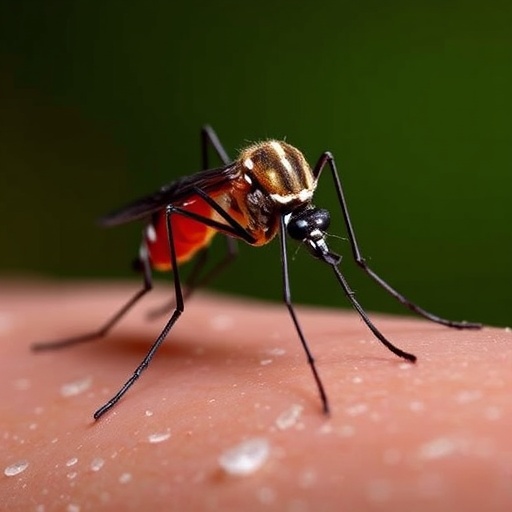
In what could be a pivotal turning point in our understanding of insect repellents, scientists have uncovered evidence that mosquitoes, particularly the yellow fever mosquito Aedes aegypti, can learn to associate the smell of DEET—the world’s most widely used insect repellent—with a rewarding food source. This finding poses intriguing questions about the limitations of DEET and the adaptive intelligence of mosquitoes, potentially altering how we approach protecting ourselves from biting pests that spread dangerous diseases.
DEET has long been celebrated as the gold standard in insect repellency, a defense that wards off ticks, flies, and mosquitoes alike. Its efficacy has been attributed to its powerful ability to disrupt insect olfactory receptors, making humans effectively “invisible” or unattractive targets to these vectors. Yet, emerging data indicates that repeated exposure to DEET might erode its repellent properties. Claudio Lazzari and his colleagues at the University of Tours in France have demonstrated that under specific conditioning circumstances, mosquitoes may not only become less repelled but may actually be attracted by the scent of DEET, perceiving it as a signal associated with food.
The researchers ingeniously adapted the principles of Pavlovian conditioning to explore this behavior. Pavlov’s classic experiments showed that dogs could be conditioned to associate a neutral stimulus (a bell) with food, eventually responding to the stimulus itself with salivation. Similarly, the team designed an innovative setup in which mosquitoes were exposed to blood as a food source while concurrently being exposed to the scent of DEET, enabling the insects to learn the association between the repellent’s odor and a rewarding meal.
To quantify mosquito behavior, the researchers used a fabric mesh barrier separating insects from a warm bag of blood, which simulated a natural feeding source. Prior to conditioning, when DEET vapor was present, the insects avoided approaching the blood, confirming DEET’s repellent effect. However, after a series of four conditioning trials—each consisting of 20 seconds of blood access with the final 10 seconds coinciding with DEET exposure—the mosquitoes’ reactions shifted dramatically. When presented solely with DEET vapor, more than 60% of the conditioned mosquitoes eagerly attempted to feed, indicating the acquisition of a learned appetitive response to a stimulus previously known to repel them.
The study also involved a behavioral test using an innovative two-choice assay involving human hosts. One human hand was smeared with DEET, while the other remained untreated. Conditioned mosquitoes displayed a preference for biting the hand treated with DEET, further reinforcing the idea that olfactory learning alters innate repellent responses, rendering the chemical an inadvertent lure under certain circumstances.
Further experimentation extended to training mosquitoes to associate the DEET scent with a sugary reward, an alternative to the blood meal. The insects quickly learned to link the repellent’s odor with the anticipated treat, biting enthusiastically upon detecting DEET. This discovery broadens the implications of associative learning beyond blood-feeding, suggesting a more generalizable capacity for sensory adaptation in these vectors.
This ability of mosquitoes to alter their behavioral response to DEET has significant public health ramifications. The finding implies that, under conditions where DEET residual concentrations on skin diminish to sub-repellent yet detectable levels, mosquitoes might become more prone to bite individuals who have applied DEET hours earlier. This nuanced vulnerability could challenge DEET’s traditionally unassailable reputation, prompting a reexamination of application guidelines to maintain effective deterrence.
Beyond immediate public health relevance, these findings provide vital insight into the mode of action of DEET itself. Claudio Lazzari suggests that the repellent’s effects are closely tied to the information DEET conveys to mosquito sensory receptors, which is likely an evolutionary exploitation of natural plant defense chemicals. These plant-derived analogues naturally repel herbivorous insects, and DEET’s similarity to such compounds renders it a potent deterrent. However, the mosquitoes’ capacity to reassign the valence of DEET odor from aversive to appetitive represents a remarkable example of behavioral plasticity, reflecting ecological pressures that demand continual adaptation.
Despite these concerns, the researchers emphasize that DEET remains the most efficacious insect repellent available today. The compound’s ability to reduce human exposure to mosquito-borne pathogens such as dengue, Zika, and yellow fever is unparalleled, and consequently, it remains indispensable in both endemic and global contexts. The breakthrough lies in understanding the boundaries of its effectiveness, equipping us to refine public health strategies and perhaps innovate novel repellents less susceptible to associative learning.
This study also underscores a growing appreciation for the sophisticated sensory and cognitive capabilities of mosquitoes, once thought to be simple reflexive organisms. The ability to integrate olfactory cues and past experiences to modify behavior represents a compelling dimension to their biology, potentially influencing feeding patterns, host preference, and vectorial capacity.
In light of these revelations, future research avenues will likely explore avenues to counteract or circumvent mosquito associative learning mechanisms. Approaches could include alternating repellent compounds, development of multi-modal deterrents, or disrupting learned associations through targeted interventions. Additionally, understanding how environmental variables and mosquito species diversity influence learning outcomes will be fundamental to tailoring effective repellency across various ecological landscapes.
Perhaps most significantly, this research serves as a cautionary tale about overreliance on chemical repellents without considering the evolutionary adaptability of target organisms. It prompts a paradigm shift towards sustainable vector control strategies encompassing integrated pest management and continuous innovation, harnessing entomological insight to stay ahead of rapidly evolving mosquito populations.
In summary, the groundbreaking research from Lazzari and collaborators brings to light the remarkable adaptability of Aedes aegypti mosquitoes in overcoming the aversive properties of the insect repellent DEET through associative learning. This phenomenon introduces a complex layer of behavioral plasticity affecting repellent performance and mosquito-host interactions. While DEET’s lifesaving utility remains intact, these findings urge vigilance and innovation in our ongoing battle against mosquito-borne diseases.
News Publication Date: 28-May-2026
References:
Lazzari, C. R., De Luca, D., Nally, A., Dufour, C. and Vinauger, C. (2026). Associative learning switches DEET valence from aversive to appetitive in Aedes aegypti. J. Exp. Biol. 229, jeb251935. doi:10.1242/jeb.251935
Cite Scienmag News
Gavin Prescott. (May 28, 2026). Mosquitoes Can Learn to Associate DEET Repellent with a Meal, Threatening Its Effectiveness. Scienmag. https://scienmag.com/mosquitoes-can-learn-to-associate-deet-repellent-with-a-meal-threatening-its-effectiveness/
Gavin Prescott. "Mosquitoes Can Learn to Associate DEET Repellent with a Meal, Threatening Its Effectiveness." Scienmag, 28 May 2026, https://scienmag.com/mosquitoes-can-learn-to-associate-deet-repellent-with-a-meal-threatening-its-effectiveness/. Accessed 4 September 2026.
Gavin Prescott. "Mosquitoes Can Learn to Associate DEET Repellent with a Meal, Threatening Its Effectiveness." Scienmag. May 28, 2026. https://scienmag.com/mosquitoes-can-learn-to-associate-deet-repellent-with-a-meal-threatening-its-effectiveness/


