


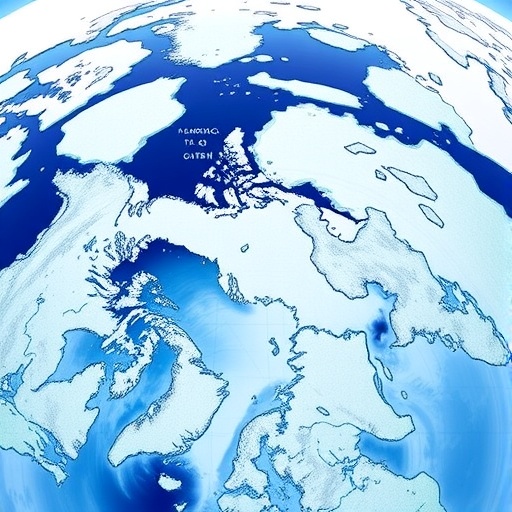
The Arctic Ocean, a critical component of Earth’s climate system, is undergoing rapid transformations fueled by drastic sea ice loss. Recent research published in Communications Earth & Environment by Santos-García and colleagues unveils a profound regime shift in the nitrogen biogeochemistry of the Arctic Ocean, driven fundamentally by the retreat and disappearance of its perennial sea ice cover. This breakthrough study expands our understanding of how the diminishing ice cover is not just a symptom of climate change but a driver reshaping marine nutrient cycles in unprecedented ways.
Nitrogen is a foundational element for life, often playing a limiting role in the productivity of marine ecosystems. The Arctic Ocean’s nitrogen dynamics have historically been influenced by a delicate balance between biological processes, ice-associated microbial communities, and physical oceanographic conditions. The acceleration of sea ice loss disrupts this balance, triggering shifts in nitrogen transformation pathways that have caused the biogeochemical regime to evolve into a state fundamentally distinct from the one observed even a few decades ago.
The study employed a comprehensive approach integrating in situ observations, biogeochemical modeling, and isotope tracing techniques to unravel the complex nitrogen pathways operating under varying sea ice conditions. The direct consequence of reduced ice cover is increased light penetration and altered water column stratification, both of which modulate the activity of nitrogen-fixing microbes and nitrifying communities. The authors document a notable suppression of nitrification rates combined with an unexpected spike in nitrogen fixation in regions previously considered nitrogen-limited and biogeochemically stable.
One of the most striking revelations is that previously ice-entrenched microbial communities, responsible for key nitrogen processes, are being replaced or functionally altered as open water conditions prevail. These microbial shifts lead to changes in the balance of nitrate, ammonium, and dissolved organic nitrogen forms, affecting the overall nutrient availability for primary producers. Consequently, the Arctic Ocean’s food web base is being remodeled, with potential ripple effects on higher trophic levels including commercially important fish species.
The research emphasizes that the observed regime shift transcends seasonal or interannual variability. Instead, it represents a long-lasting alteration in nitrogen dynamics linked intrinsically to the physical state changes imposed by climate warming. This points to a new Arctic marine environment where traditional biogeochemical cycles, nutrient budgets, and ecosystem productivity frameworks will no longer apply. The system has transitioned to a novel state with uncertain ecological and climatic feedbacks.
Furthermore, the study highlights critical feedback mechanisms by which nitrogen biogeochemistry can influence Arctic carbon cycling. Enhanced nitrogen fixation can fuel primary productivity, promoting potential carbon sequestration. However, altered nitrogen cycling might also accelerate remineralization rates and greenhouse gas releases, complicating predictions of the Arctic’s role in global climate regulation. This duality underscores the complexity of the Arctic marine system’s response to ice retreat.
Santos-García et al. also project that as sea ice continues to wane, regions once isolated beneath multi-year ice will experience intensified nitrogen recycling in open water, coupled with greater exchange between ocean and atmosphere. These changes enhance the vulnerability of the Arctic Ocean to external nutrient inputs and contaminant transport pathways, further transforming its biogeochemical landscape. The implications for ecosystem resilience and biodiversity conservation are profound.
From a methodological standpoint, the integration of isotope-enabled biogeochemical models with robust empirical datasets marks a significant advance in Arctic science. This approach allowed the authors to quantify the rates of nitrogen transformation processes with unprecedented precision under dynamic ice conditions. Their results challenge existing paradigms and provide a valuable framework for future studies investigating climate-driven shifts in polar nutrient cycles.
Notably, the regime shift documented by this study aligns temporally with marked changes in Arctic physical parameters such as declining ice thickness, altered circulation patterns, and warming trends. This temporal coherence reinforces the causative link between sea ice loss and modified nitrogen cycling. Understanding this link is vital for developing predictive models that accurately capture the Arctic’s evolving marine biogeochemistry under continued climatic stress.
The findings raise urgent questions about the fate of nitrogen-dependent ecosystems and their capacity to adapt to rapid environmental changes. Changes in nitrogen availability may favor opportunistic species or cause trophic mismatches, destabilizing intricate food web relationships. This could have socioeconomic impacts for indigenous populations and industries reliant on Arctic marine resources, underscoring the intersection of biogeochemical research and human well-being.
In sum, the work of Santos-García and colleagues represents a seminal contribution that reshapes our view of Arctic Ocean nutrient dynamics in the Anthropocene. It frames sea ice loss not merely as a physical phenomenon but as a critical driver of marine chemical transformations with far-reaching ecological consequences. This paradigm shift compels the scientific community to re-evaluate how we monitor, model, and manage polar marine ecosystems in a rapidly changing world.
Ultimately, these insights help pave the way toward integrated environmental stewardship strategies that embrace the complexity of biogeochemical feedbacks in the Arctic. They highlight the imperative for sustained multidisciplinary research to unravel the cascading effects of cryosphere changes on ocean chemistry, biology, and climate. Through such endeavors, we can better anticipate and mitigate the impacts of global change on this vulnerable and vital region.
As the Arctic continues its transition toward an ice-free future during summer months, its nitrogen biogeochemistry will likely undergo further and potentially more dramatic shifts. The establishment of new nitrogen regimes will redefine ecological baselines, influencing productivity, carbon cycling, and habitat suitability. This study provides a crucial foundation for tracking these transformations and developing adaptive management frameworks responsive to ongoing polar environmental change.
The emerging narrative of the Arctic Ocean reveals a complex interplay between physical environmental drivers and biogeochemical cycles. Sea ice loss triggers shifts far beyond melting ice extent; it catalyzes systemic changes that ripple throughout marine ecosystems, carbon fluxes, and atmospheric interactions. By revealing the mechanisms through which nitrogen dynamics are altered, this research sheds light on broader Arctic system vulnerabilities and resilience pathways.
In closing, the study conducted by Santos-García et al. serves as a clarion call for heightened scientific and policy attention to the Arctic’s nitrogen cycle transformations. As Arctic sea ice continues its retreat, the Arctic Ocean stands on the brink of a new ecological epoch, characterized by altered nutrient fluxes, trophic structures, and climate feedbacks. This evolving paradigm demands immediate and sustained focus to safeguard the future of the Arctic environment and its global influence.
Cite Scienmag News
Violet Maxwell. (May 28, 2026). Sea Ice Loss Alters Arctic Ocean Nitrogen Cycle. Scienmag. https://scienmag.com/sea-ice-loss-alters-arctic-ocean-nitrogen-cycle/
Violet Maxwell. "Sea Ice Loss Alters Arctic Ocean Nitrogen Cycle." Scienmag, 28 May 2026, https://scienmag.com/sea-ice-loss-alters-arctic-ocean-nitrogen-cycle/. Accessed 4 September 2026.
Violet Maxwell. "Sea Ice Loss Alters Arctic Ocean Nitrogen Cycle." Scienmag. May 28, 2026. https://scienmag.com/sea-ice-loss-alters-arctic-ocean-nitrogen-cycle/


