


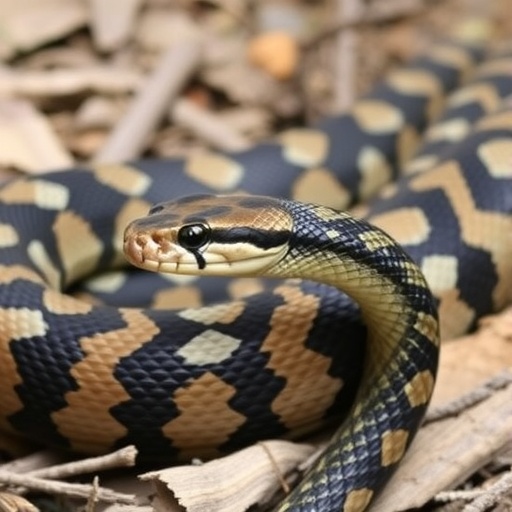
A groundbreaking initiative has launched an innovative way to observe timber rattlesnakes in their natural habitat remotely, enhancing both public engagement and scientific inquiry. Leveraging a cutting-edge live-streaming platform, Project RattleCam, a collaborative effort between California Polytechnic State University (Cal Poly) and Dickinson College in Pennsylvania, allows viewers worldwide to witness the secretive lives of timber rattlesnakes from the comfort of their own homes. This latest livestream installation, unveiled on May 18, 2024, is positioned at a confidential location in Pennsylvania, offering continuous, 24-hour footage that extends into the early fall.
What sets this livestream apart are the technologically advanced night-vision cameras that capture nocturnal activities of snakes and cohabiting wildlife such as rodents and weasels. This high-resolution, infrared imaging provides unparalleled insights into behavioral ecology, revealing rhythms and interactions invisible during daylight. The deployment in Pennsylvania is the project’s third, complementing previous streams in Colorado and California, which have each grown a dedicated following and contributed to an expanding repository of ecological data.
The timber rattlesnake (Crotalus horridus) is a species of significant biological interest due to its extensive geographic range, from the dense forests of the Eastern United States to northern latitudes where few rattlesnake species survive. Regarded as one of the largest rattlesnakes globally, its enigmatic behaviors continue to captivate herpetologists and naturalists alike. The species’ conservation status is precarious; it is federally listed as threatened or endangered in numerous states and is regionally extinct in Maine, Delaware, and Rhode Island. Understanding its ecology in varying habitats is crucial for informed conservation strategies.
Experts emphasize that timber rattlesnakes, though venomous, exhibit pronounced docility and primarily use their venom defensively. Their reticent nature and tendency to avoid humans challenge prevailing stereotypes about serpents. This species was historically the first venomous snake European settlers encountered upon arriving in America, embedding it deeply in both ecological and cultural narratives. Project RattleCam’s live observations demystify their natural conduct, revealing a species more complex and nuanced than popular myth suggests.
One of the most fascinating recent scientific revelations about timber rattlesnakes comes from ongoing community science facilitated by the project. Researchers recently described a hitherto undocumented form of intraspecific communication involving rapid, tactile head vibrations. This behavior potentially represents a novel signaling mode, enhancing understanding of social interactions within this secretive pit viper species, and emphasizing the importance of continuous observation in natural settings.
Project RattleCam has cultivated a vibrant community of over 24,000 subscribers and amassed more than five million views, reflecting widespread fascination with live wildlife observation. The project’s interactive live chats, moderated by professional scientists and volunteer community members, foster a participatory research environment. Viewers assist in identifying individual snakes, track behavioral patterns, and even assign nicknames to frequently observed subjects, such as “Scar,” notable as the first named rattlesnake from the Pennsylvania installation.
The value of this community science approach extends beyond education and engagement. Analyses generated with public participation have led to peer-reviewed scientific publications co-authored by citizen scientists, demonstrating the efficacy of crowdsourced data in advancing herpetological knowledge. This democratization of research empowers individuals worldwide to contribute to cutting-edge science, bridging the gap between academia and public interest.
An integral component of Project RattleCam’s mission is conservation education. The project’s RattlEd program delivers curriculum-based materials for elementary school teachers, integrating live footage into lesson plans aligned with Next Generation Science Standards. These resources cultivate early scientific literacy, emphasize critical thinking, and connect students with real-world ecosystem concepts, thereby fostering a new generation of informed conservation advocates.
Addressing social misconceptions and unwarranted fear surrounding rattlesnakes remains a persistent challenge researchers confront. Misguided attempts to harm or kill snakes pose risks both to humans and snake populations. Project scientists encourage safe coexistence by promoting awareness of snake relocation experts and resources such as FreeSnakeRelocation.com. Observing the animals in their natural environment through live streams has proven effective in reducing public apprehension, highlighting the project’s role in enhancing human-wildlife coexistence.
From a biomechanical perspective, the timber rattlesnake’s venom comprises a complex mixture of peptides and enzymes with significant medical importance, having inspired the development of anticoagulant drugs that mitigate heart attack risk. Such pharmacological derivatives underscore the multifaceted value of venomous reptiles beyond ecological balance, spotlighting their contribution to biomedical research.
Ultimately, Project RattleCam embodies an intersection of technological innovation, ecological research, and public engagement. By enabling round-the-clock observation of these elusive snakes, the project provides unprecedented scientific insights while fostering an informed and empathetic public outlook towards venomous species. The seamless integration of community involvement, education, and research marks a paradigm shift in wildlife science, setting a precedent for future ecological monitoring initiatives.
To explore this captivating window into the timber rattlesnake’s world and engage with ongoing research, viewers can access the free livestream channel on YouTube or visit the official website at rattlecam.org. This initiative not only strengthens conservation efforts but also inspires a deeper understanding of and respect for the intricate lives of one of North America’s most iconic serpents.
News Publication Date: June 2024
Web References:
- Project RattleCam official website: https://rattlecam.org
- Free Snake Relocation: https://www.freesnakerelocation.com/
Cite Scienmag News
Margaret Porter. (May 27, 2026). Live Rattlesnake Cam in Pennsylvania Offers 24/7 Access to Timber Rattlesnake Observation—Third Installment Now Streaming. Scienmag. https://scienmag.com/live-rattlesnake-cam-in-pennsylvania-offers-24-7-access-to-timber-rattlesnake-observation-third-installment-now-streaming/
Margaret Porter. "Live Rattlesnake Cam in Pennsylvania Offers 24/7 Access to Timber Rattlesnake Observation—Third Installment Now Streaming." Scienmag, 27 May 2026, https://scienmag.com/live-rattlesnake-cam-in-pennsylvania-offers-24-7-access-to-timber-rattlesnake-observation-third-installment-now-streaming/. Accessed 4 September 2026.
Margaret Porter. "Live Rattlesnake Cam in Pennsylvania Offers 24/7 Access to Timber Rattlesnake Observation—Third Installment Now Streaming." Scienmag. May 27, 2026. https://scienmag.com/live-rattlesnake-cam-in-pennsylvania-offers-24-7-access-to-timber-rattlesnake-observation-third-installment-now-streaming/


