


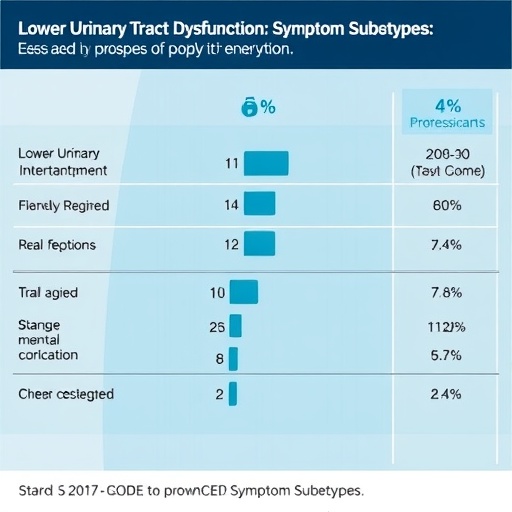
Lower urinary tract dysfunction (LUTD) is a pervasive condition that manifests through a constellation of distressing urinary symptoms affecting millions worldwide. Despite its widespread prevalence, especially among aging populations, the intricacies of LUTD’s symptomatology have long eluded comprehensive understanding. A recent series of investigative efforts undertaken by the Symptoms of Lower Urinary Tract Dysfunction Research Network (LURN) offers groundbreaking insights into the complexities of this condition, promising to reshape diagnostic paradigms and therapeutic strategies.
LUTD symptoms encompass a broad spectrum, including urinary frequency, urgency, incontinence, nocturia, and weak urinary stream, among others. These symptoms profoundly impair patients’ quality of life, often leading to social withdrawal, psychological distress, and significant physical discomfort. Notably, the progression and persistence of these symptoms impose a chronic burden, frequently accompanied by comorbid medical conditions that compound patient morbidity. Until recently, the clinical community lacked refined tools to accurately capture the heterogeneity of LUTD manifestations, which hampered efforts to delineate effective, personalized treatment approaches.
Formed in 2012, the LURN initiative embarked on a comprehensive mission to revolutionize the assessment and classification of lower urinary tract symptoms (LUTS). Recognizing the limitations of traditional diagnostic categories such as overactive bladder and benign prostatic hyperplasia (BPH), LURN sought to develop novel self-report instruments designed to capture patient experiences with heightened precision. These instruments aimed to elucidate the nuanced symptom profiles across diverse patient populations, enabling clinicians and researchers to identify distinct phenotypic subgroups within the broader LUTD spectrum.
LURN’s research cohort included over 1,000 men and women actively seeking treatment for LUTS, enrolled in a rigorous 12-month observational study. Participants completed baseline and subsequent interval assessments utilizing the new standardized assessment tools. This longitudinal approach allowed the research team to track symptom evolution, correlations with clinical variables, and patient-reported outcomes over time. The volume and quality of data collected provided an unprecedented depth of insight into the natural history and interindividual variability of LUTD symptoms.
One of LURN’s pivotal discoveries highlights the multifactorial etiology underpinning LUTS. Beyond urological abnormalities, a complex interplay of biological, psychosocial, behavioral, and systemic factors contribute to symptom onset and persistence. For example, inflammatory processes, neurological dysfunction, and hormonal influences intersect with psychological stressors and lifestyle behaviors, collectively shaping the clinical presentation of LUTD. This multidimensional understanding challenges reductionist approaches and calls for integrated diagnostic frameworks that accommodate the full spectrum of contributing elements.
Moreover, LURN data revealed that patients commonly present with a far wider array of urinary symptoms than acknowledged in traditional clinical taxonomy. The findings emphasize that rigid diagnostic boundaries fail to encapsulate the clinical reality, where symptom overlap and variability are the rule rather than the exception. These insights underscore the necessity to refine existing classification systems and emphasize patient-centered phenotyping to guide tailored management strategies.
The technological advancements pioneered by LURN include the creation of three self-report instruments meticulously validated to measure LUTS with high sensitivity and specificity. These tools, available for clinical and research use, enable standardized symptom quantification and facilitate comparisons across studies and populations. Their deployment in the longitudinal cohort allowed for critical evaluation of symptom trajectories and response to treatments, laying the groundwork for predictive modeling and precision medicine in LUTD.
In addition to patient-reported outcomes, LURN’s research infrastructure encompassed the systematic collection of biological specimens, including urine and blood samples. This biorepository supports future translational research aimed at identifying molecular and genetic biomarkers associated with LUTS subtypes. The integration of biomarker data with clinical phenotyping holds promise for unveiling pathophysiological mechanisms and identifying novel therapeutic targets.
The implications of LURN’s findings resonate deeply within the urological community. By highlighting the inadequacy of conventional diagnostic categories, LURN advocates for a paradigm shift toward subtype-driven management. This approach fosters the development of individualized treatment regimens based on precise symptomatology and underlying pathophysiology, thereby improving patient outcomes and reducing unnecessary interventions.
Furthermore, the psychosocial dimension elucidated by LURN’s studies advocates for a multidisciplinary approach to LUTD management. Incorporating psychological assessment and behavioral interventions alongside medical therapies acknowledges the comprehensive impact of LUTS on patients’ lives and addresses contributory non-urological factors, thereby enhancing holistic care delivery.
LURN’s ongoing work continues to refine symptom-based subtypes, integrating emerging data and expanding cohort diversity to ensure broad applicability. The network’s commitment to open-access research tools and data-sharing facilitates collaborative efforts worldwide, accelerating our collective understanding of LUTD. Such collaborative momentum is vital to addressing the unmet clinical needs posed by this complex condition.
The significance of LURN’s contribution extends beyond urology, providing a model for symptom-driven research in chronic conditions characterized by heterogeneous patient experiences. By prioritizing patient-reported outcomes and leveraging multi-domain data integration, LURN exemplifies a patient-centered research paradigm that can be adapted across medical disciplines.
For patients and clinicians alike, LURN’s advances herald a new era of clarity and hope in the management of lower urinary tract dysfunction. Equipped with refined diagnostic tools and an expanded conceptual framework, the medical community is better positioned to deliver targeted, effective therapies addressing the full scope of LUTS. This evolution underscores the value of rigorous, collaborative research networks in transforming clinical care.
As LUTD incidence continues to rise with global aging, the imperative for precise and effective treatment grows ever stronger. LURN’s pioneering work lays a robust foundation for the next generation of clinical trials, biomarker discovery, and personalized medicine initiatives aimed at alleviating the burden of lower urinary tract symptoms worldwide. The future of LUTD care is moving decisively toward nuanced understanding, individualized interventions, and improved quality of life for affected individuals.
In summary, the Symptoms of Lower Urinary Tract Dysfunction Research Network has fundamentally reshaped our understanding of LUTS. By crafting sophisticated assessment instruments, delineating complex symptom interrelationships, and fostering comprehensive data collection, LURN has addressed critical gaps hampering progress in this field. Its findings advocate for redefined patient subtypes and integrated management strategies, marking a crucial step forward in the ongoing endeavor to alleviate the profound impact of lower urinary tract dysfunction.
Cite Scienmag News
Ophelia Keating. (May 27, 2026). Lower Urinary Tract Dysfunction: Symptom Subtypes Revealed. Scienmag. https://scienmag.com/lower-urinary-tract-dysfunction-symptom-subtypes-revealed/
Ophelia Keating. "Lower Urinary Tract Dysfunction: Symptom Subtypes Revealed." Scienmag, 27 May 2026, https://scienmag.com/lower-urinary-tract-dysfunction-symptom-subtypes-revealed/. Accessed 5 September 2026.
Ophelia Keating. "Lower Urinary Tract Dysfunction: Symptom Subtypes Revealed." Scienmag. May 27, 2026. https://scienmag.com/lower-urinary-tract-dysfunction-symptom-subtypes-revealed/


