


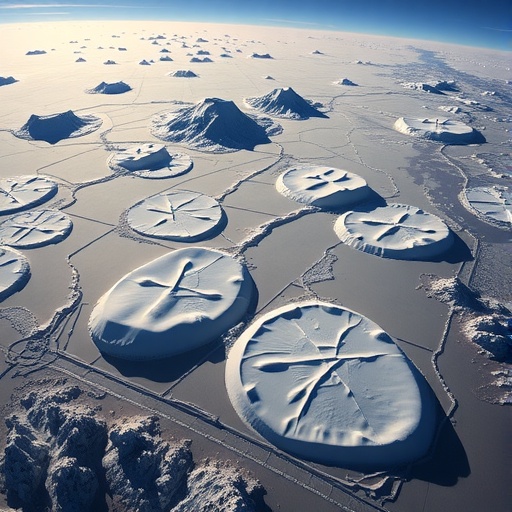
Antarctica’s mighty Ross Ice Shelf and the sprawling West Antarctic Ice Sheet, pillars of polar stability and major contributors to global sea-level regulation, may have undergone substantial reduction during one of Earth’s most recent warm intervals. A groundbreaking study published in Nature Geoscience has unveiled evidence suggesting that these colossal ice masses were markedly smaller during the Last Interglacial period, approximately 129,000 to 116,000 years ago. Using an innovative approach that scrutinizes the chemical fingerprints of ancient dust trapped in Antarctic ice cores, the research sheds new light on the dynamic responses of Antarctic ice to moderate warming events—a scenario alarmingly relevant for our current climate trajectory.
The primary method involved analyzing mineral dust particles embedded in ice cores extracted from East Antarctica’s Allan Hills Blue Ice Area, a geopolitically and climatically pivotal location situated near the Ross Sea margin. This unique site reveals ancient ice near the surface, thanks to natural processes that expose older strata through ice flow and surface ablation. The dust, carrying geochemical signatures, enabled scientists to trace provenance by identifying the distinctive compositions unique to various source regions. Intriguingly, the study identified a pronounced shift in dust origin corresponding with the transition from glacial to interglacial phases: Whereas colder epochs showed dust predominantly originating from southern South America, warmer periods revealed a striking volcanic signature derived from exposed regions proximal to McMurdo Sound in the West Antarctic Rift System.
This volcanic dust signature is an exceptional discovery because Antarctic ice cores typically harbor scant volcanic materials during warm periods due to reduced dust flux, which correlates with diminished ice cover and altered atmospheric dynamics. The lack of discrete volcanic ash layers in the cores indicates that the volcanic particles did not result from individual eruptions. Rather, they were most likely sourced from exposed volcanic terrains—previously hidden beneath the ice—that became accessible as the West Antarctic Ice Sheet retreated. Further supporting this interpretation, the mineral dust from warmer intervals featured notably coarser and more angular particles, suggestive of nearby origins since larger particles are more challenging for winds to transport over long distances.
To unravel the mechanisms behind this environmental transformation, the researchers integrated ice core data with advanced climate and ice sheet modeling. Their simulations tested scenarios ranging from a stable preindustrial Ross Sea ice shelf to partial and full collapse states. These models vividly demonstrated that the disintegration of the Ross Ice Shelf would have led to amplified dust input, increased snowfall, and elevated wind speeds along the Ross Sea coastal margins, all converging toward the Allan Hills ice core site. This convergence of observational and modeling evidence points to a dramatically different Ross Sea environment during the Last Interglacial, characterized by an open ocean facilitated by the loss of ice shelf cover and a significantly diminished West Antarctic Ice Sheet.
Understanding this past ice sheet retreat is crucial because the Ross Ice Shelf functions as a vital buttress restraining the flow of land-based ice into the Southern Ocean. Much of the West Antarctic Ice Sheet resides on bedrock below sea level, rendering it particularly susceptible to destabilization through marine ice sheet collapse processes. If the Ross Ice Shelf weakens or disintegrates, its capability to slow ice discharge diminishes, accelerating ice loss and contributing to global sea-level rise. The study affirms that even modest temperature rises—mere fractions above preindustrial levels—can trigger such profound changes in ice sheet dynamics.
The Last Interglacial period serves as a natural laboratory for scientists, presenting one of the clearest historical parallels to today’s warming world. Temperature estimates indicate that during this epoch, global mean temperatures ranged between 0.5 to 1.5 degrees Celsius above preindustrial levels, yet sea levels were considerably higher, by several meters. This discrepancy underscores the sensitivity of polar ice sheets to seemingly minor climatic shifts and highlights the non-linear nature of ice sheet retreat. Geological and geochemical records from this timeframe enable a more nuanced understanding of how ice volume and extent might respond under current and projected warming conditions.
Moreover, this research affords an unprecedented window into the feedback mechanisms between ice sheet collapse, atmospheric circulation, and sediment transport in polar regions. The marked shift in dust provenance reflects altered wind patterns precipitated by ice shelf retreat, which in turn affects local climate, precipitation, and even global ocean circulation patterns. Such interlinked processes emphasize the complexity of Earth’s cryosphere-climate system and the importance of high-resolution paleoclimate reconstructions in predicting future changes.
The detection of volcanic dust as a new marker for past Antarctic ice sheet behavior introduces a powerful proxy that can be employed in other polar research endeavors. By refining geochemical fingerprinting techniques and expanding ice core datasets, scientists can map ice sheet fluctuations with greater spatial and temporal accuracy. This methodological advance stands to revolutionize paleoclimate studies by providing clearer insights into past ice sheet instability episodes, potentially enabling earlier detection of ongoing or impending retreat.
Lead researchers underscore the dire implications of these findings for future West Antarctic Ice Sheet stability. The geological record suggests that the ice shelf and ice sheet responded dramatically to temperature increases comparable to those anticipated over the next century. Therefore, ongoing warming trends could precipitate a similarly rapid and possibly irreversible retreat, with significant contributions to global sea-level rise. Such outcomes would disproportionately impact coastal communities worldwide through increased flooding, ecosystem disruption, and socioeconomic strain.
This study also highlights the vital role of international, interdisciplinary collaboration in unraveling Antarctica’s climatic past. Combining geochemical expertise, ice core analysis, climate modeling, and fieldwork in remote and challenging environments yields comprehensive insights into the cryosphere’s evolution. These integrative approaches are essential for crafting robust climate predictions and informing policy decisions aimed at mitigating the most catastrophic impacts of climate change.
In summary, the revelation of a diminished Ross Ice Shelf and West Antarctic Ice Sheet during the Last Interglacial warm period, unveiled through meticulous geochemical dust provenance analysis and climate modeling, reframes our understanding of polar vulnerability to global warming. It paints a sobering picture wherein modest increases in temperature can instigate significant ice sheet retreat, with far-reaching consequences for sea-level rise and global climate systems. As Earth navigates an era of unprecedented anthropogenic warming, deciphering past ice sheet dynamics stands as a critical quest to anticipate and mitigate future environmental upheavals.
News Publication Date: 25-May-2026
Web References: https://www.nature.com/articles/s41561-026-01988-1
References: DOI: 10.1038/s41561-026-01988-1
Cite Scienmag News
Violet Maxwell. (May 26, 2026). Ancient Dust Reveals West Antarctic Ice Sheet Retreat During Last Warm Period. Scienmag. https://scienmag.com/ancient-dust-reveals-west-antarctic-ice-sheet-retreat-during-last-warm-period/
Violet Maxwell. "Ancient Dust Reveals West Antarctic Ice Sheet Retreat During Last Warm Period." Scienmag, 26 May 2026, https://scienmag.com/ancient-dust-reveals-west-antarctic-ice-sheet-retreat-during-last-warm-period/. Accessed 3 September 2026.
Violet Maxwell. "Ancient Dust Reveals West Antarctic Ice Sheet Retreat During Last Warm Period." Scienmag. May 26, 2026. https://scienmag.com/ancient-dust-reveals-west-antarctic-ice-sheet-retreat-during-last-warm-period/


