


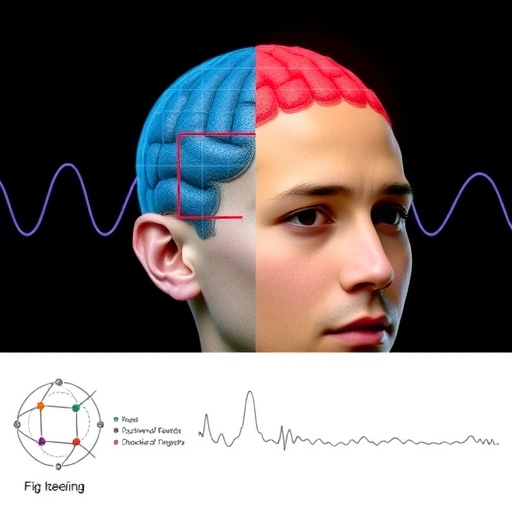
A groundbreaking advancement in the field of affective neuroscience and brain-computer interface technology has emerged from the research labs of the University of Science and Technology of China. Addressing a long-standing challenge in electroencephalogram (EEG)-based emotion recognition, the team led by Mengtong Duan introduces the Domain-Guided Mixture of Experts (DGMoE) framework—an innovative approach poised to revolutionize the way we decode emotional states from brain signals across different individuals.
Emotion recognition is integral to various applications spanning mental health monitoring, adaptive educational systems, and human-machine interaction. Traditionally, such recognition has relied heavily on behavioral cues like facial expressions and vocal tones. However, EEG, which records electrical activity of the brain, offers a more direct window into the neural mechanisms underlying emotions. Despite its promise, EEG-based emotion recognition systems have been hindered by the significant variability in brain activity across different subjects, which has impeded the development of models capable of generalizing well to new individuals.
The DGMoE framework tackles this fundamental issue by leveraging a mixture-of-experts design enhanced with domain guidance rooted in individual brain dynamics. At its core, the method utilizes multiple graph convolutional neural networks (GCNs) as expert modules, each specializing in different EEG channel combinations. This architecture allows the model to capture the intricate spatial distribution and connectivity patterns of brain regions, which are crucial for accurate emotion inference.
Crucially, the system incorporates a sophisticated two-stage expert selection mechanism. In the first stage, the framework dynamically assigns experts at the EEG channel level based on the input’s subject sensitivity profile. This adaptivity means that the model pays closer attention to the most informative brain regions tailored to each individual. In the second stage, at the brain-region level, the framework selects the most stable expert outputs, enhancing robustness across diverse subjects and mitigating noise or idiosyncratic neural patterns.
The method’s efficacy was rigorously validated on multiple public EEG emotion datasets including SEED, SEED-IV, and THU-EP. Remarkably, the DGMoE approach achieved accuracy improvements that consistently outperformed existing state-of-the-art techniques, recording 79.5%, 59.1%, and 57.9% accuracy, respectively. These results underscore the model’s impressive capacity to generalize across subject populations without extensive retraining or manual calibration.
One of the most compelling aspects of DGMoE is its ability to harmonize individualized sensitivity with stable brain patterns, offering a balanced perspective that accommodates both the diversity and commonality present in human neural responses. This bodes well for deploying EEG-based emotion recognition systems in real-world settings where users cannot be pre-profiled or extensively trained on specific models.
The development of DGMoE marks a paradigm shift in computational neuroscience, particularly for affective brain-computer interfaces. By systematically addressing the variability barrier, this framework opens new avenues for precise, adaptive, and personalized recognition of emotions using neural signals. Such advancements could enable next-generation wearable EEG devices and intelligent systems that dynamically respond to users’ affective states in emotionally nuanced ways.
Mengtong Duan highlights the practical implications of this work, emphasizing that overcoming individual differences has remained a critical obstacle to widespread application of EEG emotion recognition. The DGMoE framework not only pushes the envelope on predictive accuracy but also lays theoretical foundations for future models to integrate domain knowledge with expert architectures, enabling more interpretable and versatile solutions.
Looking ahead, the research team envisions extending this approach towards more comprehensive brain decoding tasks, spanning cognitive states, stress detection, and neurological disorder monitoring. The modular and scalable design of DGMoE is well-suited for integration with multimodal data and real-time applications, promising to transform emotional intelligence in technology interfaces.
Moreover, this breakthrough holds significant implications for mental health diagnostics where subtle emotional cues extracted from neural activity can provide early detection and continuous monitoring of psychological well-being. Adaptive learning environments empowered by DGMoE can tailor educational content based on emotional engagement and cognitive load, revolutionizing personalized learning.
The DGMoE framework also exemplifies the growing trend of combining advanced graph neural networks with domain knowledge to tackle complex bio-signal analysis. Such interdisciplinary approaches leverage computational power and neuroscientific insights to distill meaningful patterns from inherently noisy and variable brain data, pushing the boundaries of what is achievable in brain-machine collaboration.
In sum, the DGMoE mixture-of-experts framework represents a visionary step forward, melding cutting-edge AI methodology with neuroscientific rigor, promising to accelerate the maturity of EEG-based emotion recognition. This work not only elevates the scientific understanding of emotion-related brain activity but also charts a promising path towards emotionally aware technologies that can deeply resonate with human experience.
Cite Scienmag News
Cassandra Pierce. (May 26, 2026). Mixture-of-Experts Framework Enhances Cross-Subject EEG Emotion Recognition. Scienmag. https://scienmag.com/mixture-of-experts-framework-enhances-cross-subject-eeg-emotion-recognition/
Cassandra Pierce. "Mixture-of-Experts Framework Enhances Cross-Subject EEG Emotion Recognition." Scienmag, 26 May 2026, https://scienmag.com/mixture-of-experts-framework-enhances-cross-subject-eeg-emotion-recognition/. Accessed 3 September 2026.
Cassandra Pierce. "Mixture-of-Experts Framework Enhances Cross-Subject EEG Emotion Recognition." Scienmag. May 26, 2026. https://scienmag.com/mixture-of-experts-framework-enhances-cross-subject-eeg-emotion-recognition/


