

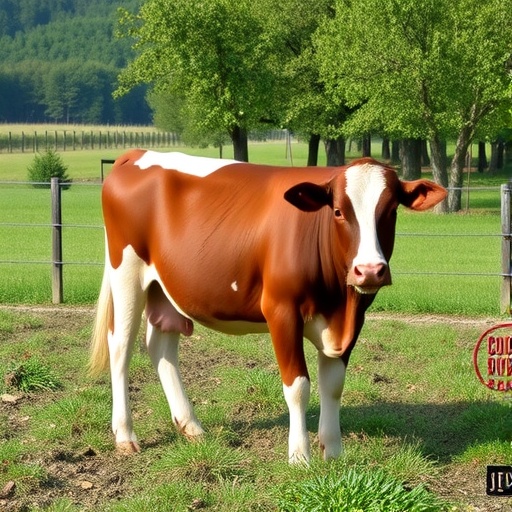
In the heart of Italy’s picturesque Veneto region, a groundbreaking study has emerged that challenges conventional agricultural practices and urges a reevaluation of intensive beef fattening. This highly detailed investigation, recently subjected to an author correction to refine its accuracy, presents a comprehensive environmental analysis that could redefine sustainability paradigms within the livestock industry. By meticulously quantifying the ecological footprint of beef production under intensive farming conditions, the research invites a critical conversation on balancing agricultural productivity and environmental stewardship.
The study’s focal point lies in evaluating the environmental repercussions of intensive beef fattening, a practice widely adopted to meet soaring global demands for red meat. Veneto, known for its vibrant dairy and beef industries, serves as an ideal case study due to its varied farming systems and economic reliance on animal agriculture. Through extensive data collection, the team led by Martinić, Magrin, and Poore applies rigorous life cycle assessment (LCA) methodologies to isolate and measure key impact categories such as greenhouse gas emissions, water usage, land degradation, and nutrient pollution.
One of the study’s pivotal revelations concerns the disproportionate contribution of methane emissions stemming from enteric fermentation within cattle. Methane, a potent greenhouse gas with a global warming potential significantly higher than carbon dioxide over a 20-year horizon, presents a formidable challenge in the quest to decarbonize agriculture. The researchers document how intensive fattening practices, which amplify feed efficiency and growth rates, paradoxically can either mitigate or exacerbate methane emissions depending on feed composition and management techniques.
Water resource use paints an equally alarming portrait. Intensive beef fattening not only demands vast quantities of water for animal consumption and feed crop irrigation but also impacts water quality through runoff enriched with nitrogen and phosphorus. The study elucidates how nutrient leaching leads to eutrophication in downstream aquatic ecosystems, triggering harmful algal blooms and destabilizing freshwater biodiversity. These findings are particularly critical for environmentally sensitive zones like Veneto, where water scarcity and pollution are growing concerns.
Land use dynamics further complicate the sustainability matrix. Land clearance for growing feed crops such as maize and soybeans intensifies soil erosion, compaction, and organic matter depletion. The investigative team highlights how soil carbon loss exacerbates atmospheric CO2 accumulation, creating a feedback loop that undermines carbon sequestration potential. Moreover, monoculture feed production contributes to biodiversity loss, adversely affecting pollinators and soil microbial communities essential for resilient agricultural landscapes.
The methodology underpinning this research is noteworthy for its integration of remote sensing data, on-farm surveys, and detailed input-output analyses. By triangulating evidence across scales—from microbial soil processes to regional carbon budgets—the research ensures a holistic and nuanced understanding of environmental impacts. This robust approach addresses previous gaps in accounting for indirect emissions and land use changes often overlooked in standard LCAs.
Intriguingly, the study dissects the comparative merits of different intensive farming strategies, ranging from confined feedlots to semi-intensive pasture-based systems. It reveals that incorporating agroecological principles such as rotational grazing, diversified crop rotations, and precision feeding technology can dramatically curb resource inputs and emissions without compromising livestock productivity. These insights pave the way for actionable mitigation pathways that reconcile economic viability with ecological responsibility.
An essential technical contribution of the study lies in its recalibration of emission factors specific to the Veneto context. Recognizing local climatic conditions, feed types, and animal breeds, the authors refine the global emission inventories to provide regionally tailored metrics. This specificity enhances the relevance of policy interventions and enables stakeholders to benchmark progress accurately.
The corrected data also emphasize the importance of manure management in environmental outcomes. Proper handling, storage, and utilization of manure as a fertilizer resource can reduce methane and nitrous oxide emissions, mitigate nutrient runoff, and improve soil health. The researchers advocate for integrated nutrient management frameworks that optimize manure recycling and minimize environmental leakage.
Importantly, the study situates its findings within the broader tapestry of global beef production trends and food security challenges. While acknowledging the rising protein demands driven by population growth and dietary shifts, it cautions against unchecked intensification that externalizes ecological costs. The authors argue for systemic transformations encompassing consumer behavior, supply chain transparency, and technological innovation to foster resilient food systems.
The interdisciplinary nature of this research embodies a confluence of agronomy, environmental science, and economics. By engaging local farmers, policymakers, and scientific experts, the team fosters co-creation of knowledge and pragmatic solutions. This participatory approach is crucial for ensuring adoption of sustainable practices at scale and aligning incentives across diverse stakeholders.
With the increasing frequency of climate-related disruptions, this research assumes added urgency. The Veneto case study illustrates how localized interventions in agricultural systems can cumulatively contribute to global climate mitigation efforts. The study underlines the necessity of integrating agricultural policy with climate action frameworks, emphasizing adaptive management and continuous monitoring.
The author correction appended to the original publication reflects the research team’s commitment to scientific rigor and transparency. By refining data and clarifying methodological nuances, the correction strengthens the credibility and applicability of the findings. Such diligence is essential to inform evidence-based policymaking and public discourse around sustainable agriculture.
This investigation ultimately challenges the prevailing notion that intensification is an unequivocal pathway to sustainability. Rather, it portrays a complex landscape where technological advancements must be judiciously combined with ecological considerations and socio-economic factors. The nuanced perspective offered by the study serves as a valuable guide for translating sustainability goals into tangible agricultural practices.
As this research reverberates through the scientific and agricultural communities, it has the potential to catalyze innovation and inspire widespread adoption of best practices. The Veneto experience stands as a testament to the power of integrated environmental assessments to transform normative paradigms and galvanize action toward a more sustainable and equitable food future.
The profound implications of this study extend beyond the borders of Italy, resonating with global efforts to achieve the Sustainable Development Goals, particularly those related to climate action, responsible consumption, and life on land. Its nuanced insights will inform both local contexts and international dialogue on sustainable beef production, contributing to a more informed and sustainable trajectory for livestock agriculture worldwide.
Subject of Research:
Environmental impacts of intensive beef fattening practices in the Veneto region, Italy
Article Title:
Author Correction: Environmental impacts of intensive beef fattening: a case study in the Veneto region, Italy
Article References:
Martinić, O., Magrin, L., Poore, J. et al. Author Correction: Environmental impacts of intensive beef fattening: a case study in the Veneto region, Italy. npj Sustain. Agric. 4, 41 (2026). https://doi.org/10.1038/s44264-026-00157-6
Image Credits: AI Generated


