


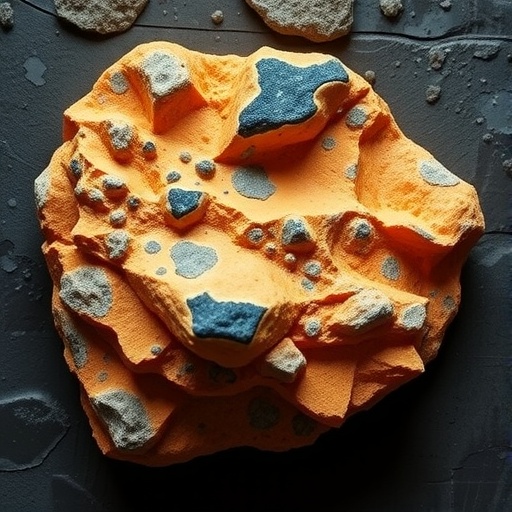
A revolutionary new study reveals unprecedented insights into the environmental conditions of the early Cambrian period, focusing on the Yangtze Block region. In what promises to significantly deepen our understanding of Earth’s ancient ocean chemistry and biogeochemical cycles, the research uncovers a strong correlation between widespread euxinic conditions and the extraordinary sedimentary deposition of barite and witherite. These findings not only illuminate key processes in early Cambrian marine settings but also offer a window into the complex interaction between ocean chemistry and metal precipitation during a pivotal era in Earth’s history.
The early Cambrian period, approximately 541 to 509 million years ago, is renowned for profound biological diversification, including the Cambrian explosion. Researchers have long sought to unravel the environmental parameters that shaped this pivotal transition. The new investigation leverages geochemical proxies and sedimentological analysis to establish that large swaths of the Yangtze Block experienced euxinia — that is, anoxic conditions characterized by high levels of hydrogen sulfide in the water column. This euxinia, coupled with significant barite (barium sulfate) and witherite (barium carbonate) mineral deposition, reveals a dynamic link between microbial activity, ocean chemistry, and mineral formation in the early Cambrian.
Euxinia, typically associated with stagnant marine environments, is a redox state in which oxygen is depleted and hydrogen sulfide accumulates, often as a result of microbial sulfate reduction. Prior to this research, the temporal and spatial extent of euxinia during the early Cambrian was poorly constrained, especially in the Yangtze Block, which is a key geological terrane in South China. The study uses an integrated approach involving isotopic signatures, element concentration profiles, and mineralogical identification to document the scale and intensity of euxinic conditions that prevailed regionally.
Intriguingly, the discovery of massive barite deposits coeval with euxinic waters challenges the conventional notion that sulfate minerals require oxygenated conditions for formation. Instead, the study posits a nuanced model where sulfate is sourced from both seawater and microbial recycling under euxinic conditions. This suggests that microbial sulfate reduction was not only active but prolific enough to drive the precipitation of large barite deposits, serving as a sensitive environmental proxy for ancient ocean chemistry and diagenetic processes.
The presence of witherite, a barium carbonate mineral that is relatively rare in sedimentary environments, provides additional clues about the paleoenvironmental chemistry. Witherite’s co-deposition alongside barite signals shifts in carbonate chemistry and barium cycling that may have been influenced by fluctuations in pH, alkalinity, and organic carbon remineralization. It reflects a complex interplay where barite precipitation could be coupled with carbonate saturation states, influenced by microbial metabolism and the euxinic setting.
These geochemical conditions would have significant implications for the bioavailability of essential trace metals and nutrients, which in turn could have affected early metazoan evolution during the Cambrian explosion. Euxinia is known to impose both selective pressures and habitat constraints on marine organisms, potentially driving adaptations to low-oxygen environments as well as influencing evolutionary trajectories. The study hints at the possibility that such biogeochemical feedbacks were more pervasive and regionally extensive on the Yangtze Block than previously acknowledged.
The research team applied cutting-edge techniques, including sulfur isotope analysis to differentiate between various sulfate reduction pathways and barite formation mechanisms. By analyzing isotopic fractionation patterns, they could infer the dominant microbial processes at work and reconstruct the redox landscape with unprecedented resolution. Furthermore, sediment core sampling combined with scanning electron microscopy helped map the textural relationships between barite, witherite, and organic-rich shales, reinforcing the connection between euxinia and mineral precipitation.
Remarkably, the onset of these euxinic conditions aligns temporally with known global carbon isotope excursions and sea-level fluctuations documented in the early Cambrian stratigraphy. This synchrony suggests that broader climatic and oceanographic drivers influenced regional water column chemistry on the Yangtze Block, potentially linked to enhanced nutrient loading, restricted basin circulation, or tectonic events. Such large-scale environmental perturbations may have catalyzed the unique geochemical scenario observed.
The study’s findings challenge prior assumptions that extensive euxinia and massive sulfate mineral deposits are mutually exclusive or temporally decoupled. Instead, the data support a more complex environmental mosaic where euxinic conditions and massive barite and witherite deposition were intimately coupled. This raises exciting new questions about the controls on mineral precipitation under low-oxygen conditions, and about how ancient marine ecosystems negotiated these chemically extreme environments.
Moreover, these revelations carry implications beyond paleogeochemistry, extending into economic geology. Barite deposits are significant for industrial use, including drilling mud additives and pigment production, and understanding their formation mechanisms can aid in exploration strategies. The link between euxinia and barite mineralization could thus guide the search for similar deposits in other ancient sedimentary basins, potentially tapping into previously overlooked resources.
Equally important, the findings enrich our broader narrative of Earth’s oxygenation history. The early Cambrian was a time when oxygen levels in the oceans and atmosphere were fluctuating, influencing ecosystem development and elemental cycles. Documenting extensive euxinia challenges simple oxidation models and underscores the heterogeneity of ancient redox landscapes. This can refine models of ocean-atmosphere interactions, biogeochemical feedback loops, and the environmental constraints on early life evolution.
The Yangtze Block, as a geological region, emerges from this study as a critical archive of early Cambrian environmental change. The robust dataset assembled allows for detailed paleoenvironmental reconstructions and sets a benchmark for comparative studies elsewhere. It also highlights the importance of integrated geochemical and sedimentological research in decoding Earth’s ancient past, particularly during times of major biological and climatic transition.
In summary, the newly published research elucidates a tightly linked scenario where regional euxinic conditions co-occurred with massive deposits of barite and witherite in the early Cambrian Yangtze Block. This coupling not only informs paleoceanographic and biogeochemical dynamics but also provides fresh clues on the environmental context surrounding the emergence of complex life. By bridging the gap between sedimentary mineralogy and redox processes, this work paves the way for future investigations into the drivers and consequences of ocean chemistry variations during critical intervals of Earth’s history.
The implications for both fundamental Earth science and applied resource exploration make this a landmark study. Its innovative use of isotope geochemistry and mineralogical evidence sets a new standard for unraveling complex ancient environments. As research continues, the findings from the Yangtze Block could serve as a template for understanding euxinia-related processes and mineralization in other early Cambrian successions worldwide, helping decode the intimate connections between life, chemistry, and the planet’s evolving surface conditions.
Cite Scienmag News
Violet Maxwell. (May 26, 2026). Early Cambrian Euxinia Sparks Massive Barite, Witherite Deposits. Scienmag. https://scienmag.com/early-cambrian-euxinia-sparks-massive-barite-witherite-deposits/
Violet Maxwell. "Early Cambrian Euxinia Sparks Massive Barite, Witherite Deposits." Scienmag, 26 May 2026, https://scienmag.com/early-cambrian-euxinia-sparks-massive-barite-witherite-deposits/. Accessed 3 September 2026.
Violet Maxwell. "Early Cambrian Euxinia Sparks Massive Barite, Witherite Deposits." Scienmag. May 26, 2026. https://scienmag.com/early-cambrian-euxinia-sparks-massive-barite-witherite-deposits/


