


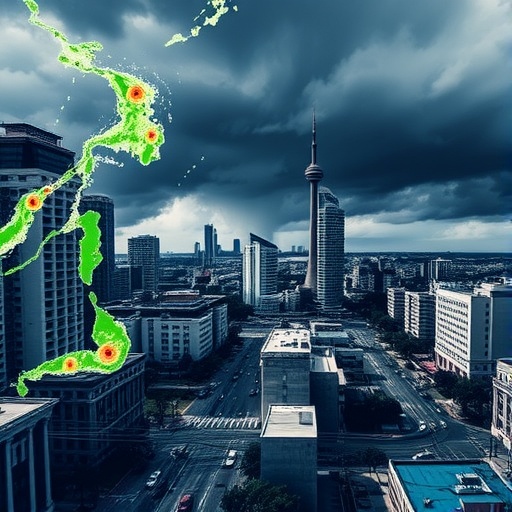
Weather radar is revolutionizing our understanding of storms, allowing scientists to investigate not only the horizontal footprint of precipitation but also its intricate vertical structure. Unlike traditional rain gauges or satellite imagery, radar captures reflectivity data that inform about the size and concentration of raindrops in the atmosphere. Measured in decibels of reflectivity (dBZ), these data offer a detailed three-dimensional view of storms, providing a window into evolving storm dynamics and intensity.
Researchers have leveraged the power of GridRad, a specialized dataset that synthesizes radar reflectivity observations from over a hundred radars across the contiguous United States. Spanning more than two decades of data with remarkable spatial and temporal resolution, GridRad enables the detailed study of convective storms—those intense, vertically developed systems often responsible for severe weather. Importantly, analyzing reflectivity directly rather than converting it to rain rate circumvents uncertainties inherent in the traditional reflectivity-to-precipitation relationships, sharpening the fidelity of storm characterization.
Focusing on four urban hubs in Texas—Dallas–Fort Worth, Austin, San Antonio, and Houston—researchers established careful domains encompassing both urban cores and adjacent rural areas to tease apart the influences of urbanization on storms. These rural zones were positioned based on urban diameters to provide regionally appropriate and unbiased comparison points. The strategy considered potential interference from other urban centers and geographical constraints like coastlines, ensuring that the analyses would accurately detect urban signatures in storm behaviors.
Storm identification relied on a two-threshold system applied to the three-dimensional radar reflectivity volumes. High-reflectivity grid cells exceeding 40 dBZ marked potential storm cores, which were then expanded to neighboring cells above 20 dBZ, capturing the full extent of precipitation. A key innovation was tracking these storm volumes through consecutive hourly radar snapshots, stitching together their evolution over time to distinguish individual storm events. This temporal linkage avoided conflating separate convective cells into a single event and maintained the integrity of storm lifecycle analysis.
The study faced challenges recognizing and correcting for artefacts in radar data. Isolated reflectivity spikes and marginal domain intersections could erroneously inflate storm counts or obscure urban influences. To mitigate this, storms smaller than 100 square kilometers were excluded, and storm centroid tracking—weighted by reflectivity intensity—helped filter out events largely outside the designated research areas. Additionally, splitting prolonged storm time series where reflectivity dipped between peaks prevented merging unrelated episodes such as successive frontal passages into a single event. These meticulous refinements enhanced the reliability of the final dataset comprising thousands of storm events per domain.
Classifying the diverse storm types characteristic of Texas during the warm seasons demanded a blend of subjective expertise and objective algorithm development. Visual inspection of radar animations guided the initial categorization into five types: single-cell storms, isolated storms, tropical systems, and warm- and cold-frontal storms, each with unique spatial, temporal, and dynamic signatures. Objective metrics quantifying storm area, heavy rainfall footprint, movement speed, and direction were distilled from the radar data to create a classification scheme calibrated against synoptic weather charts and local meteorological observations.
Importantly, the classification emphasized storm dynamics—such as duration and centroid velocity—over rigid predefined meteorological categories. For example, tropical systems exhibited slow-moving, extensive storm areas with long durations, whereas single-cell and isolated storms were localized and transient. Frontal storms displayed characteristic directional motions tied to large-scale weather patterns. The calibrated algorithm, validated against hundreds of labeled storms, allowed scalable classification across the extensive 23-year dataset, enabling robust urban–rural comparative analyses.
Given the inherent uncertainties in radar-based storm detection and classification, sensitivity analyses were critical. Researchers tested how varying reflectivity thresholds affected storm counts and urban–rural contrasts. The findings indicated that while local-scale storms like single-cell and isolated types showed sensitivity and a moderate reduction in counts with higher thresholds, larger-scale frontal and tropical systems remained consistent. Crucially, significant urban effects persisted across threshold variations, underscoring the robustness of the urban signal embedded in storm characteristics.
A special attention was paid to storms influenced by tropical systems in Houston, cross-validating identified events with official hurricane and tropical cyclone reports. The identification of tropical-influenced storms aligned well with recognized hurricane seasons, tropical waves, and convective episodes modulated by tropical moisture, testifying to the efficacy of the classification method in capturing these complex phenomena. This underscores potential for applying such radar-based analytic frameworks to other coastal metropolitan areas vulnerable to tropical weather.
Nevertheless, the authors caution that the classification algorithm is context-specific, calibrated on storm properties prevalent in Texas. Adapting the approach to other climatic regions will require recalibration to local storm trajectories, scales, and synoptic conditions. This flexibility ensures that the methodology can be globally extended to enhance understanding of urban storm interactions in diverse meteorological settings, a critical need as urbanization and climate change reshape precipitation patterns worldwide.
The multidisciplinary fusion of high-resolution radar data, robust algorithmic processing, and synoptic meteorology in this work opens new frontiers in resolving how urban landscapes influence storms of different typologies. By embracing the complexity of storm behaviors and their distinct signatures, the research moves beyond simplistic models to reveal nuanced urban effects that vary across convective, frontal, and tropical systems. This knowledge is pivotal for urban planning, water resource management, and weather prediction in the face of intensifying urbanization.
Altogether, this study presents a comprehensive framework for storm characterization integrating multi-dimensional radar reflectivity, storm tracking, and classification within an urban–rural contrast paradigm. Such detailed understanding of storm morphology, dynamics, and classification fosters improved risk assessments and climate resilience strategies tailored to specific urban environments. As cities worldwide face escalating flood risks and weather extremes, these scientific advancements will be instrumental in crafting adaptive and informed responses.
The research also highlights the promise of GridRad and similar radar synthesis datasets as invaluable tools for atmospheric science, bridging observational gaps across scales and regions. The algorithms developed here provide a template for meticulous data curation and analysis, balancing computational feasibility with precision, thereby setting a new standard for large-scale storm characterization studies. By elucidating the complex interplay between urban areas and varied storm systems, the work propels us closer to unraveling the climatological consequences of urban sprawl.
Finally, ongoing efforts to refine classification methods and validate them with independent data sources, such as National Oceanic and Atmospheric Administration archives and tropical cyclone reports, illustrate the importance of integrative meteorological research. The open availability of radar animations and classification data encourages transparency, reproducibility, and collaborative advancement in the field. Such initiatives will undoubtedly stimulate further discoveries about urban influences on storms, ultimately contributing to safer, smarter, and more resilient urban communities worldwide.
Cite Scienmag News
Denise Maddox. (May 20, 2026). Divergent Urban Storm Responses: Convective, Frontal, Tropical. Scienmag. https://scienmag.com/divergent-urban-storm-responses-convective-frontal-tropical/
Denise Maddox. "Divergent Urban Storm Responses: Convective, Frontal, Tropical." Scienmag, 20 May 2026, https://scienmag.com/divergent-urban-storm-responses-convective-frontal-tropical/. Accessed 4 September 2026.
Denise Maddox. "Divergent Urban Storm Responses: Convective, Frontal, Tropical." Scienmag. May 20, 2026. https://scienmag.com/divergent-urban-storm-responses-convective-frontal-tropical/


