


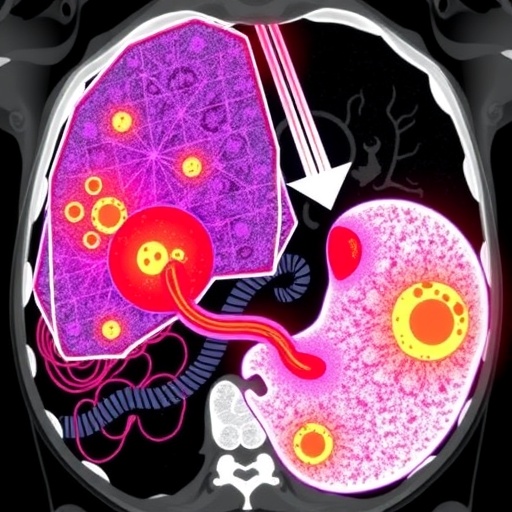
In a groundbreaking advancement poised to revolutionize cancer diagnostics, researchers have unveiled a sophisticated deep learning model designed to predict lymph node metastasis (LNM) in primary gastric cancer from routine histopathological images. This novel approach addresses a critical challenge in oncology: the frequent underdiagnosis of lymph node metastasis, an essential prognostic factor that guides treatment selection and patient management. The innovative study, recently published in the British Journal of Cancer, marks a major leap forward in harnessing artificial intelligence to extract intricate pathological insights that often elude human observers.
Gastric cancer remains one of the leading causes of cancer mortality worldwide, largely due to its tendency to metastasize to regional lymph nodes, a process associated with poorer survival outcomes. Traditional assessment of lymph node involvement typically relies on manual microscopic examination and sentinel lymph node biopsy, methods hindered by their limited sensitivity and the substantial time, expertise, and resources required. As a result, many cases of occult metastasis remain undetected during initial evaluation, depriving clinicians of crucial information needed to optimize therapeutic strategies. This limitation has spurred researchers to explore computational tools capable of providing objective and scalable microscopic evaluation.
The team behind the study developed a deep learning-based model trained on whole-slide images (WSIs) of primary gastric tumors, a form of digital pathology that captures vast amounts of histological detail at ultra-high resolution. The model leverages convolutional neural networks (CNNs), architectures well-suited for image analysis, to automatically identify subtle morphologic patterns associated with metastatic spread to lymph nodes. Unlike prior attempts that mainly focused on tumor tissue typing or grading, this AI-driven technique directly predicts LNM status—offering a predictive precision that promises early intervention and improved patient prognostication.
A key innovation presented by the researchers is the model’s ability to detect occult tumor cells—microscopic metastatic deposits that evade conventional histopathological detection. By training the neural network on an extensive retrospective dataset of gastric cancer cases with known lymph node status, the model learned to associate minute, often cryptic, histological features within the primary tumor microenvironment with distant metastatic behavior. This predictive capability could transform pathological workflows by prioritizing cases for more intensive scrutiny or adjunct molecular testing.
Technically, the model processes gigapixel-scale WSIs by partitioning them into smaller image tiles, each analyzed for regional characteristics before synthesizing a slide-level prediction. This hierarchical approach enables the system to handle the formidable computational complexity inherent in digital pathology. The integration of attention mechanisms within the network architecture allows the algorithm to focus selectively on diagnostically relevant image regions, mimicking expert pathologists’ visual reasoning while maintaining high throughput. Moreover, the model’s training involved robust data augmentation and regularization strategies to enhance generalizability across diverse tissue sections and staining variations.
Validation results showcased remarkable accuracy, sensitivity, and specificity, outperforming conventional assessment methods and rivaling expert pathologic review in predicting lymph node involvement. The authors report that this AI model could act as an indispensable adjunct in clinical settings, especially where access to specialized pathology services is limited. Furthermore, its prognostic information could support personalized treatment planning, potentially sparing patients from overtreatment or under-treatment by refining risk stratification based on precise metastatic status.
While the potential of AI in cancer pathology has been increasingly recognized, this study is one of the first to target the prediction of metastatic spread directly from primary tumor histology, emphasizing the prognostic significance of the primary microenvironmental clues often disregarded during routine diagnostics. This advance epitomizes a shift toward integrative diagnostic paradigms, where computational imaging biomarkers complement pathological evaluation, enabling earlier and more accurate detection of metastasis.
Importantly, this research underscores the critical role of interdisciplinary collaboration, combining expertise in oncology, pathology, computer science, and data analytics to integrate complex biological insights with cutting-edge AI methodologies. By bridging these fields, the study exemplifies how machine learning can unlock latent diagnostic information encoded within readily available clinical data, thereby enhancing clinical decision-making without necessitating additional invasive procedures.
Looking ahead, the researchers envision deploying this deep learning framework as a scalable tool embedded into pathology laboratory workflows worldwide, augmenting human expertise and facilitating standardized reporting. Such deployment could accelerate diagnostic turnaround, reduce inter-observer variability, and ultimately improve outcomes for gastric cancer patients. The model’s modular design further allows adaptation to other cancer types where lymph node metastasis critically influences prognosis.
Despite these promising findings, the authors acknowledge current limitations, including the need for prospective clinical trials to validate real-world impact and integration with other diagnostic modalities such as radiology and molecular profiling. Moreover, ensuring the interpretability and transparency of AI-powered predictions remains paramount to fostering clinician trust and regulatory approval. Ongoing efforts to refine model explainability and harmonize data standards will be vital to translating these advances from bench to bedside.
As digital pathology continues its rapid evolution, this deep learning-based prediction strategy represents a paradigm shift in oncologic diagnostics—where artificial intelligence synergizes with traditional histology to illuminate the hidden metastatic potential of tumors. By converting routine histopathological images into powerful prognostic tools, the study brings us closer to precision oncology’s elusive goal: delivering truly personalized cancer care informed by data-driven insights.
The fusion of machine intelligence and pathological expertise not only enhances diagnostic accuracy but also offers hope for earlier intervention strategies that could improve survival rates for gastric cancer patients globally. As awareness of AI’s transformative potential spreads, such research invigorates the ongoing quest to harness technology in conquering one of medicine’s most formidable adversaries. The integration of deep learning into routine clinical workflows heralds a new era in cancer diagnostics—one where every pixel of tissue image tells a story critical to saving lives.
In summary, this pioneering study vividly demonstrates how deep learning models trained on primary tumor histology can accurately predict lymph node metastasis and detect occult tumor cells in gastric cancer. The technique offers an unprecedented window into metastatic spread, surpassing existing diagnostic boundaries and propelling the future of pathology toward digital, data-enabled precision medicine. With further validation and refinement, AI-driven metastasis prediction promises to become a crucial pillar of integrated oncological care, guiding therapy and improving prognostication for millions of patients worldwide.
As the world eagerly watches this integration of artificial intelligence with cancer pathology, researchers and clinicians alike recognize that the future of cancer diagnosis lies not only in advanced molecular techniques but also in harnessing the prodigious power of computational imaging analysis. By unlocking subtle histopathological cues invisible to the human eye, this deep learning breakthrough charts a bright course toward more accurate, efficient, and personalized cancer care.
Cite Scienmag News
Nathaniel Bowman. (May 19, 2026). AI Predicts Gastric Cancer Spread from Tissue Images. Scienmag. https://scienmag.com/ai-predicts-gastric-cancer-spread-from-tissue-images/
Nathaniel Bowman. "AI Predicts Gastric Cancer Spread from Tissue Images." Scienmag, 19 May 2026, https://scienmag.com/ai-predicts-gastric-cancer-spread-from-tissue-images/. Accessed 3 September 2026.
Nathaniel Bowman. "AI Predicts Gastric Cancer Spread from Tissue Images." Scienmag. May 19, 2026. https://scienmag.com/ai-predicts-gastric-cancer-spread-from-tissue-images/


