


In the quest to address rising global energy demands, especially in urban environments facing soaring cooling costs, passive daytime radiative cooling has emerged as a groundbreaking pathway to reduce energy consumption efficiently. This innovative approach harnesses the natural physics of thermal radiation, enabling surfaces to cool themselves beneath the ambient temperature without any external power input. The principle revolves around reflecting incoming solar radiation while simultaneously emitting heat as infrared radiation through the Earth’s atmospheric window into cold outer space. This dual capability effectively lowers surface temperatures even when under direct sunlight. Yet, engineering a material that achieves both exceptionally high solar reflectance and near-unity infrared emissivity, in a scalable and environmentally benign manner, remains a formidable scientific challenge.
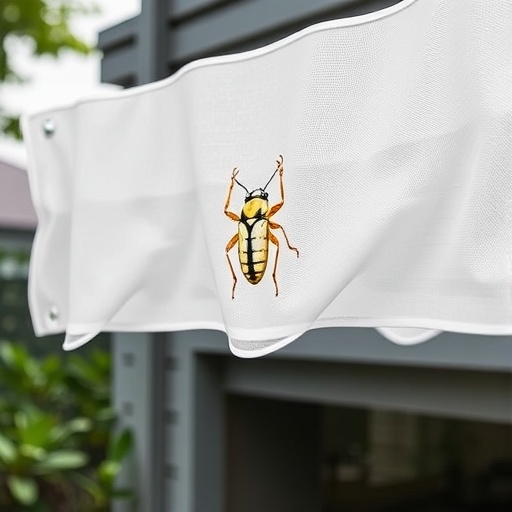
A recent breakthrough was realized by an interdisciplinary research team who turned to nature’s own designs for inspiration, particularly the white beetle. Renowned for its ability to maintain a surprisingly cool body temperature under intense solar exposure, the white beetle owes this adaptation to its intricate, multi-scale micro- and nanostructures that manipulate light scattering efficiently. Rather than replicating the beetle’s appearance in a superficial sense, the researchers decoded the underlying hierarchical architecture responsible for its optical properties, endeavoring to emulate this mechanism in a synthetic material optimized for daytime passive cooling.
Central to their design is a cellulose-based aerogel integrated with metal-organic frameworks (MOFs), specifically MOF-801, a hygroscopic compound famed for regulating moisture during phase transitions. The material combines nanofibrillated cellulose and cellulose nanocrystals, forming a porous network with structural complexity across nanoscale and microscale dimensions. Employing a technique called directional freeze-casting, water molecules interact with MOF-801 particles, which modulate ice nucleation dynamics. This controlled freezing process orchestrates the self-assembly of cellulose fibers and nanoparticles into a hierarchical scaffold composed of interconnected macropores, facilitating hetero-photonic scattering of sunlight.
Detailed optical characterization revealed that the aerogel achieves a remarkable solar reflectance of 95.8%, effectively bouncing back nearly all incident sunlight across the spectral range. Simultaneously, it exhibits an infrared emissivity of 95%, allowing efficient thermal radiation to escape through atmospheric windows. Such synergistic optical performance is a significant advance, made possible by the carefully engineered hetero-photonic scattering network within the aerogel’s porous architecture. Computational simulations based on finite-difference time-domain (FDTD) methods corroborate these experimental findings, elucidating how the hierarchical structure amplifies scattering intensity far beyond conventional porous materials.
Field testing under real outdoor sunlight conditions demonstrated that this aerogel can induce subambient cooling effects reaching up to 7.1 °C below the surrounding temperature during the daytime. Infrared thermography showed that surfaces coated with this cellulose-MOF aerogel maintained considerably lower temperatures than those covered with standard nanocellulose aerogels. This performance underscores the potential of bioinspired structural design for passive cooling applications, harnessing nature’s evolutionary strategies in next-generation materials science.
Beyond performance, the sustainability credentials of the cellulose aerogel are striking. Owing to its renewable biomass origin, the aerogel demonstrates excellent biodegradability, breaking down in soil within 21 days, and significantly reducing lifecycle environmental impacts compared to petrochemical-based foam insulators. Additionally, prolonged ultraviolet exposure studies confirm the material’s durability, indicating robust outdoor stability and longevity—key attributes for building-integrated applications that demand long-term reliability.
To translate laboratory success into real-world benefits, the researchers performed extensive building energy simulations using EnergyPlus software. The results indicated that applying the cellulose cooling aerogel as a façade coating in typical Chinese cities could slash annual cooling energy demand by approximately 43.5%. The greatest savings were found in densely populated southern regions marked by intense heat and solar radiation, where conventional cooling costs are prohibitively high. These findings highlight not only the aerogel’s technical merit but also its practicality as an energy-saving, carbon-reducing intervention in urban infrastructure.
This study marks a vital intersection of biomimicry, material science, and sustainability, opening exciting avenues for passive thermal management technologies. By decoding the photonic scattering tactics of white beetles and merging them with the advanced chemistry of MOFs and renewable cellulose, the research team has realized a scalable approach for fabricating lightweight, efficient cooling materials. This work sets a new benchmark for combining optical engineering with environmental stewardship—an imperative in designing the smart cities of tomorrow.
The implications extend beyond buildings, suggesting potential applications in vehicle cooling, outdoor equipment, and wearable technologies where thermal regulation is crucial. Moreover, the fabrication processes described are compatible with large-scale and low-cost manufacturing, addressing a perennial barrier that has hindered the commercialization of radiative cooling materials. Future research can expand upon this platform by integrating multifunctionality, such as humidity control or self-cleaning surfaces, further enhancing adaptability and impact.
In essence, this study exemplifies how deep insights into natural photonic structures, paired with cutting-edge materials chemistry and engineering, can yield transformative solutions to global challenges. As climate change intensifies, passive daytime radiative cooling technologies like this cellulose-based aerogel stand out as a beacon of hope—offering a sustainable, energy-free pathway to mitigate urban heat and reduce carbon footprints worldwide.
News Publication Date: 13-May-2026
Web References:
Journal of Bioresources and Bioproducts
DOI Link
Keywords
Aerogel, Low-density materials, Photonic scattering, Passive radiative cooling, Cellulose nanomaterials, Metal-organic frameworks, Hierarchical porous structure, Sustainable building materials, Energy efficiency, Biomimetic design, Thermal emissivity, Solar reflectance
Cite Scienmag News
Bethany Barker. (May 18, 2026). Cellulose Aerogel Inspired by White Beetles Enables Passive Daytime Cooling. Scienmag. https://scienmag.com/cellulose-aerogel-inspired-by-white-beetles-enables-passive-daytime-cooling/
Bethany Barker. "Cellulose Aerogel Inspired by White Beetles Enables Passive Daytime Cooling." Scienmag, 18 May 2026, https://scienmag.com/cellulose-aerogel-inspired-by-white-beetles-enables-passive-daytime-cooling/. Accessed 4 September 2026.
Bethany Barker. "Cellulose Aerogel Inspired by White Beetles Enables Passive Daytime Cooling." Scienmag. May 18, 2026. https://scienmag.com/cellulose-aerogel-inspired-by-white-beetles-enables-passive-daytime-cooling/


