


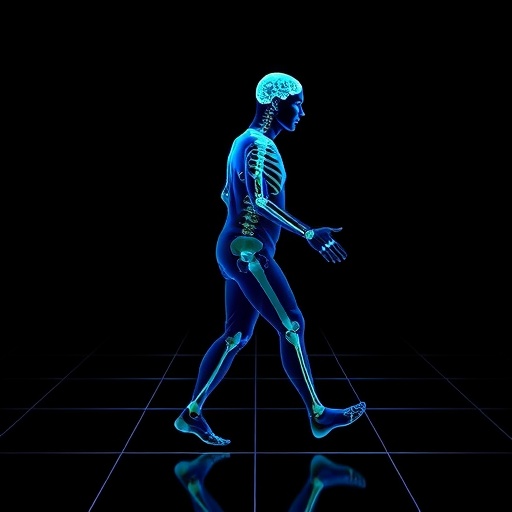
In a groundbreaking advancement at the intersection of neuroscience, artificial intelligence, and movement disorder therapy, researchers have unveiled a novel approach to tracking gait in individuals with Parkinson’s disease through a sophisticated cross-subject adversarial learning framework. This innovative methodology, pioneered by Choi and Bronte-Stewart and detailed in their forthcoming 2026 publication in Communications Engineering, promises to revolutionize how clinicians monitor and potentially predict motor symptoms in this debilitating neurodegenerative condition.
Parkinson’s disease is characterized by progressive motor dysfunction, including tremors, rigidity, and notably, gait disturbances that severely impact patients’ quality of life. Traditional gait tracking methods rely heavily on wearable sensors or observational assessments, which often suffer from inconsistencies and require extensive calibration for each patient. This new technology — termed the N2G calibrator — leverages neural signals directly from the brain to create an adaptive and universal gait tracking system, capable of functioning across different patients without individualized retraining.
At the core of the N2G calibrator lies an adversarial learning framework, a subset of machine learning wherein two neural networks engage in a ‘game’ to improve the accuracy and robustness of data interpretation. One network, the generator, attempts to predict gait-related motor outputs from neural data, while the other, the discriminator, evaluates these predictions against true motor parameters, pushing the system to refine its outputs continually. This interplay enables the model to extract generalized features from diverse neural patterns, transcending individual variations that have traditionally hampered cross-subject applicability.
The technical sophistication of this approach stems from its capacity to handle high-dimensional, noisy neural data recorded during patients’ movement. Neural signals, especially from deep brain structures affected in Parkinson’s disease, are notoriously complex and individualized. The N2G calibrator integrates techniques such as domain adaptation and feature alignment within its adversarial network, ensuring that the learned representations of neural signals correspond accurately to gait parameters irrespective of the source patient. This eliminates the need for retraining the model with new data from each individual, a significant leap towards clinical scalability.
Moreover, the neural signal inputs are acquired through non-invasive or minimally invasive neurophysiological recording methods, enhancing the feasibility of deployment in routine clinical environments or even home monitoring. By integrating electromyography, electroencephalography, or local field potentials from implanted devices, the system robustly correlates brain activity with motor actions in real-time. This real-time capability opens avenues not only for passive monitoring but also proactive intervention, potentially informing neurostimulation therapies tailored to immediate gait disruptions.
In validation studies, the N2G calibrator demonstrated impressive accuracy, predicting gait speed, stride length, and variability with remarkable precision across a variety of Parkinson’s subjects. What sets this work apart is the system’s adaptability: it maintains its predictive performance when confronted with new patients whose neural signatures differ markedly from those in the training cohort. This cross-subject generalization addresses a chronic bottleneck in AI applications for neurological disorders, where data heterogeneity impedes broad utility.
The implications of such technology ripple far beyond gait tracking. The adversarial learning framework could be adapted to other neurodegenerative disorders characterized by abnormal motor dynamics, such as Huntington’s disease or multiple sclerosis. Furthermore, this approach may empower closed-loop neuroprosthetic devices that respond dynamically to the brain’s signaling patterns, restoring increasingly naturalistic movement control.
From a clinical management perspective, the N2G calibrator could usher in an era of precision medicine for Parkinson’s disease. By continuously and quantitatively monitoring gait parameters derived from direct brain activity, clinicians could tailor medication timing, dosage, or deep brain stimulation protocols with unprecedented granularity. In doing so, they might not only mitigate symptoms more effectively but also slow progression by targeting early motor irregularities detected through the system.
The engineering challenges surmounted in developing the N2G calibrator also reflect broader trends in artificial intelligence for healthcare. Integrating machine learning algorithms with neurobiological data demands multi-disciplinary expertise, bridging computational science, biomedical engineering, and clinical neurology. The researchers’ success illustrates the power of such collaborative efforts, signaling a future where adaptive AI tools become integral to neurological diagnostics and therapy personalization.
Despite its promise, the technology does raise important considerations for data privacy, device security, and patient consent, especially due to the sensitivity of neural data involved. Ensuring that the system operates within ethical frameworks and robust cybersecurity measures will be critical as it transitions from bench to bedside. Moreover, long-term studies will be essential to establish the durability of the model’s predictive performance and its impact on patient outcomes over extended periods.
Looking ahead, further enhancements might include integrating multimodal data streams such as kinematics from motion capture systems or environmental sensors to augment neural decoding accuracy. Coupling the N2G calibrator with wearable technology could facilitate seamless, continuous monitoring outside clinical settings, providing rich longitudinal datasets to inform both individualized care and broader epidemiological insights into Parkinson’s gait dynamics.
In effect, the N2G calibrator represents a paradigm shift — moving from reactive symptom management towards predictive, brain-driven gait monitoring. It embodies the convergence of cutting-edge AI methodologies and deep neurophysiological understanding, heralding a new frontier in movement disorder diagnostics. This development not only amplifies the potential for improving the lives of millions affected by Parkinson’s disease but also exemplifies how intelligent systems can decode the intricate language of the brain, transforming raw neural signals into actionable clinical intelligence.
The work of Choi and Bronte-Stewart thus stands as a beacon for future endeavors in neuroscientific AI applications, charting a path where disease monitoring becomes not merely about observing decline, but about enabling proactive, personalized intervention grounded in the brain’s own activity patterns. As this technology matures and gains wider implementation, it could redefine standards of care and offer hope for more effective management of Parkinson’s disease worldwide.
In conclusion, the N2G calibrator’s cross-subject adversarial learning framework marks a significant milestone in neural signal-driven gait tracking. Its ability to seamlessly adapt across patients, harnessing the power of adversarial networks to overcome inter-subject variability, sets a new benchmark for AI applications in neurology. By translating complex brain signals into precise motor predictions, this system equips clinicians with a potent tool to monitor, understand, and ultimately influence Parkinson’s disease progression in ways previously unattainable.
Cite Scienmag News
Cassandra Pierce. (May 18, 2026). N2G: AI Enhances Gait Tracking in Parkinson’s. Scienmag. https://scienmag.com/n2g-ai-enhances-gait-tracking-in-parkinsons/
Cassandra Pierce. "N2G: AI Enhances Gait Tracking in Parkinson’s." Scienmag, 18 May 2026, https://scienmag.com/n2g-ai-enhances-gait-tracking-in-parkinsons/. Accessed 3 September 2026.
Cassandra Pierce. "N2G: AI Enhances Gait Tracking in Parkinson’s." Scienmag. May 18, 2026. https://scienmag.com/n2g-ai-enhances-gait-tracking-in-parkinsons/


