


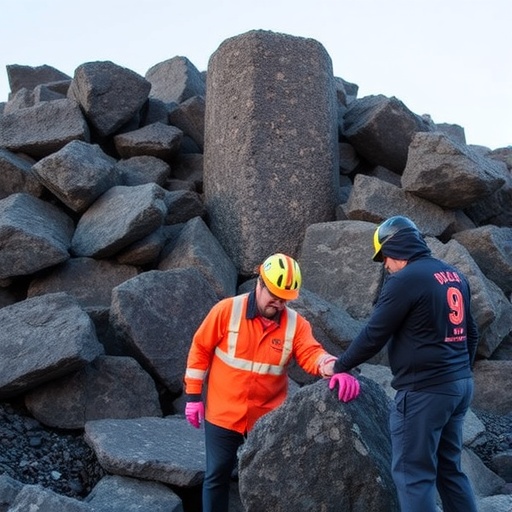
In the complex field of underground mining, particularly in closely spaced coal seams, the stability of surrounding rock structures presents a formidable challenge for engineers and geologists alike. A recent groundbreaking study by Wang, Zhao, Liu, and colleagues has illuminated critical failure mechanisms impacting the surrounding rock of retreat roadways beneath remnant coal pillars, providing an advanced understanding that could revolutionize mine safety protocols globally. Published in Scientific Reports in 2026, this research offers not only a comprehensive analysis of destabilization phenomena but also introduces innovative control technologies designed to mitigate associated risks.
Retreat roadways in underground coal mines are vital pathways for operational access and ventilation. These roadways are often situated beneath remnant coal pillars—sections of coal intentionally left in place to support the overburden during extraction processes in nearby seams. However, these pillars, especially when adjacent to closely spaced coal seams, can impose complex stress distributions on the surrounding rock mass, leading to gradual or sudden failure events. The intricate interplay of stress, rock properties, and mining geometry demands detailed examination to prevent catastrophic collapses and ensure worker safety.
The team’s investigation begins by characterizing the geological and structural features of the rock surrounding the retreat roadways. These features significantly influence the rock’s mechanical behavior under the mining-induced stress regime. Using an array of geotechnical techniques, including in-situ stress measurements and laboratory rock mechanics testing, the researchers identified pronounced anisotropy and heterogeneity in rock strength around the remnant pillars. Such variability exacerbates stress concentration effects, thereby weakening the support system beneath the retreat roadways.
In analyzing the failure mechanisms, the study highlights a combination of tensile fracturing and shear sliding as primary disruptors of rock integrity. Tensile cracks often initiate perpendicular to the maximum principal stress and propagate through pre-existing fissures, which are prevalent due to the geological history of coal seam deposition. Shear failure, driven by increasing differential stress, results in slip planes that undermine the cohesion of the rock mass, culminating in roof falls or rib spalling within the mining roadways.
Temperature and moisture variations were found to further complicate the mechanical stability of the surrounding rock. Mining activities can alter the microclimate of underground spaces, facilitating chemical weathering processes and moisture ingress. These environmental factors degrade rock strength over time, challenging the reliability of conventional support systems and demanding more adaptive control strategies.
Innovatively, the research introduces a novel control technology dubbed “Adaptive Rock Reinforcement System” (ARRS). This system integrates real-time monitoring of rock deformation with automated reinforcement deployment. Utilizing embedded sensors and smart materials, ARRS can detect early signs of failure and react dynamically by adjusting support density and location. This marks a significant leap forward from traditional static support methods, offering a proactive approach to underground rock stability management.
Numerical modeling played a crucial role in elucidating failure patterns and testing the efficacy of the control technology. Finite element and discrete element models simulated the stress evolution and fracture propagation under various mining conditions. These simulations convinced the authors that preemptive reinforcement, tailored to site-specific stress patterns, drastically decreases the probability of catastrophic failure events.
The industrial implications of these findings extend beyond the studied mine site. Many coal-producing regions worldwide operate with similar geological constraints and mining methods. The adoption of ARRS, combined with the mechanistic insights into rock failure, promises to enhance operational safety, reduce downtime caused by structural failures, and potentially lower costs related to post-failure repairs and accident liabilities.
Moreover, this research underscores the necessity of interdisciplinary collaboration. Successful implementation of control technologies requires integration not just of geological and engineering expertise but also of cutting-edge sensor technology, data analytics, and automation systems. The study advocates for more investment into such multidisciplinary approaches to meet the increasing challenges faced by the mining industry as resource extraction moves into more geologically complex and deeper environments.
The comprehensive dataset collected by Wang and colleagues provides a valuable resource for future research. Their open sharing of geotechnical, mechanical, and environmental data offers other researchers a foundation to further refine predictive models and develop complementary mitigation techniques. This commitment to transparency and scientific cooperation reinforces the study’s long-term potential impact.
The ethical dimensions of mining safety are also brought to the forefront in this work. By demonstrating effective methods to manage rock failure risks, the study contributes to protecting miners’ lives and promoting responsible resource extraction practices. It aligns with global movements aimed at improving occupational health standards and minimizing environmental footprints in extractive industries.
This study not only advances scientific knowledge but also holds promise for directing policy formulations. Regulatory bodies could incorporate these enhanced understanding and technologies into mining codes, fostering safer mining operations across different jurisdictions. The proactive adaptation of mine design, informed by such research, could set new benchmarks in mining engineering.
Future research directions inspired by this work include exploring the scalability of ARRS to other geological contexts and mining techniques. For example, coal seams with different mineralogical compositions or structural conditions may require calibrated adaptations of the technology. Furthermore, long-term monitoring studies could validate the system’s durability and economic viability over extended mining cycles.
In conclusion, the pioneering work conducted by Wang, Zhao, Liu, and their team represents a seminal contribution to underground coal mining engineering. Their dual approach dissecting failure mechanisms and devising adaptive control technologies offers a roadmap for safer and more efficient mining practices. As the demand for coal and other minerals persists globally, advancing the stability and safety of mining infrastructures is imperative, and this study equips the industry with indispensable tools and knowledge to meet that challenge.
Wang, Y., Zhao, Z., Liu, H. et al. Failure mechanism and control technology for the surrounding rock of retreat roadways beneath remnant coal pillars in close-distance coal seams.
Sci Rep (2026). https://doi.org/10.1038/s41598-026-53086-2
Cite Scienmag News
Denise Maddox. (May 18, 2026). Controlling Surrounding Rock Failure in Coal Pillar Retreats. Scienmag. https://scienmag.com/controlling-surrounding-rock-failure-in-coal-pillar-retreats/
Denise Maddox. "Controlling Surrounding Rock Failure in Coal Pillar Retreats." Scienmag, 18 May 2026, https://scienmag.com/controlling-surrounding-rock-failure-in-coal-pillar-retreats/. Accessed 4 September 2026.
Denise Maddox. "Controlling Surrounding Rock Failure in Coal Pillar Retreats." Scienmag. May 18, 2026. https://scienmag.com/controlling-surrounding-rock-failure-in-coal-pillar-retreats/


