


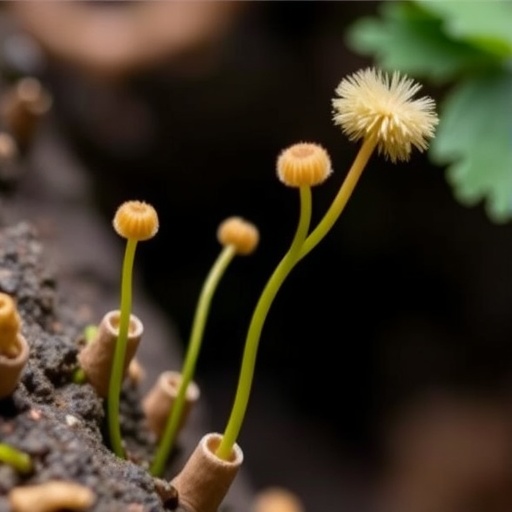
In a remarkable advancement in microbial taxonomy, researchers have identified a novel species within the genus Kitasatospora, isolated from the rhizosphere soils of the fern Dryopteris championii. This discovery not only broadens the current understanding of actinobacterial diversity but also challenges existing taxonomic classifications within the genus. The strain, designated KL5^T, represents a novel species provisionally named Kitasatospora dryopteridis sp. nov., marking a significant milestone in microbial systematics with implications for soil microbial ecology and bioprospecting.
The isolation of strain KL5^T from the rhizosphere—a dynamic microenvironment rich in plant-microbe interactions—highlights the ecological specificity of this actinobacterium. The rhizosphere of Dryopteris championii offers a unique niche where microbial communities can evolve distinct traits under selective pressures imposed by plant root exudates and soil chemistry. Recognizing such specificity is indispensable to unraveling plant-associated microbial diversity and potential functional roles these microbes might play in plant health and nutrient cycling.
The taxonomic characterization of KL5^T relied on a comprehensive polyphasic approach integrating phenotypic, chemotaxonomic, and genomic analyses. Notably, cell-wall peptidoglycan analyses revealed an abundance of meso and LL-diaminopimelic acids, a chemical signature characteristic of actinobacteria but nuanced in various genera. This distinctive compositional pattern provides an important chemotaxonomic marker affirming the classification of the strain within Kitasatospora, although its precise differentiation from related species required deeper molecular interrogation.
Further chemotaxonomic profiling unraveled that KL5^T’s whole-cell hydrolysates contained galactose and ribose, sugars whose presence can aid in delineating subtle taxonomic distinctions among actinomycetes. The membrane lipid constitution, consisting predominantly of diphosphatidylglycerol, phosphatidylglycerol, phosphatidylethanolamine, phosphatidylinositol, and phosphatidylinositol mannosides, echoes typical features observed in related taxa but with potential variations indicative of species-level differentiation. Additionally, fatty acid analysis demonstrated a predominance of iso-C_15:0, anteiso-C_15:0, iso-C_16:0, C_16:0, and anteiso-C_17:0—fatty acids often implicated in microbial membrane fluidity and environmental adaptability.
Central to the elucidation of strain KL5^T’s taxonomic identity was the 16S rRNA gene sequence analysis, a gold standard in bacterial systematics. The sequence exhibited a close affinity to Kitasatospora arboriphila HKI 0189^T with 99.29% similarity, suggesting a near phylogenetic relationship. However, such high similarity in 16S rRNA genes frequently masks underlying genomic divergence; hence, additional genomic tools were employed to resolve the taxonomic status conclusively.
Phylogenomic analyses corroborated the intimate relationship between strain KL5^T and K. arboriphila, but the revelation came from the average nucleotide identity (ANI) and digital DNA–DNA hybridization (dDDH) metrics. ANI values below 95%, specifically at 90.40%, accompanied by a dDDH value of 37.2%, pointed convincingly toward a novel species designation rather than conspecificity. These genomic thresholds are widely accepted within microbiology for demarcating species boundaries, thus validating that KL5^T merits recognition as a distinct taxon.
The meticulous phenotypic assessments complemented genomic findings, with observed physiological and morphological traits further differentiating KL5^T from closely related Kitasatospora species. Collectively, these integrated datasets form a robust framework substantiating the proposal of Kitasatospora dryopteridis as a new species. The isolation and typification of this organism expand the taxonomic richness of Kitasatospora, a genus known for its ecological ubiquity and biotechnological potential.
Moreover, the study presented a thought-provoking re-evaluation of two previously characterized species within the genus: Kitasatospora cinereorecta and Kitasatospora paracochleata. Through comparative genomic analyses, these taxa were inferred to represent a single species, necessitating taxonomic revision. Upholding the principle of priority in nomenclature, the proposal designates K. paracochleata as a later heterotypic synonym of K. cinereorecta, promoting taxonomic clarity and consistency across microbial classification systems.
This taxonomic refinement is consequential beyond academic name changes. The genus Kitasatospora is a prolific source of secondary metabolites, including antibiotics and bioactive compounds. Accurate species delineation underpins effective screening protocols for novel natural products and guides ecological studies assessing functional roles within soil ecosystems. Consequently, identifying Kitasatospora dryopteridis opens new avenues for exploring untapped metabolic capabilities harbored within soil actinobacteria.
The significance of isolating Kitasatospora dryopteridis from the rhizosphere of Dryopteris championii also resonates with the broader quest to understand plant-microbe symbioses. Fern-associated microbiota remain understudied compared to those of flowering plants, and discoveries such as KL5^T underscore the hidden microbial diversity that can influence plant health and adaptation. Future research may unravel how K. dryopteridis interacts with its host plant, potentially contributing to nutrient acquisition, stress resilience, or pathogen suppression.
Integrating cutting-edge phylogenomic technologies in this study showcases the transformative power of genomics in resolving complex taxonomic questions. Where classical methods faced limitations due to phenotypic plasticity and genetic conservation, high-resolution genome metrics deliver definitive evidence to demarcate species boundaries. This evolution in methodology promises to accelerate discoveries of microbial diversity while refining our understanding of evolutionary trajectories.
The comprehensive study lays a foundation not merely for taxonomy but also for functional microbiology and evolutionary biology. It establishes a concrete example of how novel bacterial species can be discovered and correctly positioned within existing taxonomic frameworks through multidisciplinary approaches. The work sets a benchmark for future studies aiming to uncover microbial life from diverse environmental matrices and optimize classification protocols.
In the context of antibiotic discovery, Kitasatospora species have historically been pivotal due to their biosynthetic diversity. The identification of K. dryopteridis suggests potential for novel bioactive compound biosynthesis that could be harnessed to combat antibiotic resistance—a rising global health threat. Subsequent investigations may focus on genome mining and metabolomics to unlock the biosynthetic pathways encoded within the newly discovered bacterium.
This study epitomizes the synergy between environmental microbiology and genomics, pushing the frontiers of microbial taxonomy and ecology. It reminds the scientific community that even well-studied environments like soil harbor uncultured and uncharacterized microbial taxa with significant ecological and biomedical relevance. Encouraging interdisciplinary collaborations will be key in accelerating such discoveries and translating findings into practical applications.
To summarize, the characterization and designation of Kitasatospora dryopteridis sp. nov. represent a landmark in actinobacterial taxonomy, integrating phenotypic, chemotaxonomic, and genomic insights. The concurrent proposal consolidating two previously separate species underscores the importance of genomic data in resolving taxonomic ambiguities. This work not only enriches the genus Kitasatospora but also heralds new research opportunities in microbial ecology and biotechnology, reaffirming the intricate connections between microbial diversity and ecosystem functionality.
Cite Scienmag News
Morgan Morrow. (May 16, 2026). New Kitasatospora Species and Synonym Proposed. Scienmag. https://scienmag.com/new-kitasatospora-species-and-synonym-proposed/
Morgan Morrow. "New Kitasatospora Species and Synonym Proposed." Scienmag, 16 May 2026, https://scienmag.com/new-kitasatospora-species-and-synonym-proposed/. Accessed 5 September 2026.
Morgan Morrow. "New Kitasatospora Species and Synonym Proposed." Scienmag. May 16, 2026. https://scienmag.com/new-kitasatospora-species-and-synonym-proposed/


