


As humanity sets its sights on longer and more ambitious space voyages following the milestone success of Artemis II, the challenges of maintaining astronaut health over extended periods beyond Earth’s atmosphere have come sharply into focus. Among these, nutritional adequacy and variety stand out as critical issues. Traditional space rations, primarily composed of dried and shelf-stable foods, provide necessary calories and nutrients but lack diversity and certain essential compounds, notably omega-3 fatty acids. A newly published study in ACS Food Science & Technology introduces an innovative approach that could revolutionize astronaut nutrition: customizable, fortified beverage emulsions designed to deliver vital nutrients in a stable, palatable format suitable for space conditions.
Extended microgravity exposure presents a suite of physiological challenges for astronauts, most notably the degradation of bone density and muscle mass. These issues arise chiefly due to the absence of adequate gravitational loading, which ordinarily stimulates osteogenesis and muscle maintenance on Earth. While resistive exercise regimens serve as a cornerstone countermeasure, nutritional strategy is an equally pivotal, complementary avenue. Fortifying space diets with nutrient-enriched food items provides an additional layer of defense against musculoskeletal decline. The research team, spearheaded by lead author Svenja Schmidt along with collaborators Volker Hessel and Ian Fisk, focused on creating emulsion-based drinks rich in omega-3 fatty acids—a class of lipids with well-documented roles in anti-inflammatory processes, bone metabolism, and protection against radiation-induced cellular damage, all of which are pertinent to astronaut health.
The technical challenge tackled by the researchers hinges on formulating beverage emulsions that maintain physicochemical stability in both Earth’s gravity and the microgravity environment experienced onboard spacecraft or the International Space Station (ISS). Emulsions are mixtures of immiscible liquids—commonly water and oil—dispersed finely to create a stable heterogeneous solution. Typically, emulsions such as those found in commercial sodas or flavored beverages rely on continuous agitation and emulsifiers to maintain homogeneity. However, the absence of gravity-driven forces such as sedimentation and creaming in microgravity necessitates specialized design strategies.
The breakthrough reported involves a microfluidic emulsion generation system capable of spontaneously producing highly dispersed and stable emulsions by exploiting capillary forces. The system introduces controlled quantities of oil and water in a steady flow, ensuring intimate mixing at a microscopic scale without relying on gravitational stratification. This allows the creation of water-based emulsions incorporating oil-soluble compounds such as omega-3 rich fish oil and essential oil flavorings in a way that mimics familiar beverage textures and appearances. The stability of these emulsions under microgravity conditions effectively counteracts the potential for phase separation or degradation during extended space missions.
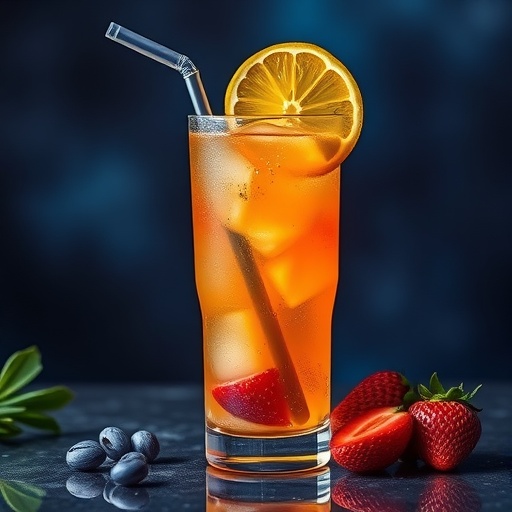
Through an extensive screening of formulation parameters—including variations in coconut oil-derived fats, different emulsifiers, organic fruit acids, sugar concentrations, and flavor additives—the researchers optimized a suite of six drink formulations that allow personalization in flavor profiles and sweetness intensity. The flavors developed include floral and citrus notes, and the sweetness levels can be adjusted to enhance palatability. Each standardized serving, roughly 330 milliliters or 11 fluid ounces, delivers approximately one-third of an astronaut’s daily recommended intake of omega-3 fatty acids, providing a substantial nutritional boost in an appealing liquid form.
The emulsions’ rheological properties resemble those of a flat soda—lightly viscous but smooth—providing a familiar mouthfeel conducive to consumption in space environments where sensory perception can be altered. The study outlines that these beverages maintain their consistency and homogeneity without requiring carbonation, an advantage given the complexities and safety issues linked with pressurized carbonated drinks in enclosed spacecraft.
Next steps for the research involve comprehensive sensory testing to evaluate acceptability, taste consistency, and preference both on Earth and under microgravity conditions, alongside rigorous shelf-life assessments correlated to the unique storage and environmental stresses encountered during spaceflight. Understanding how the formulation withstands radiation exposure, temperature fluctuations, and prolonged storage is paramount to ensuring the operational viability of these beverages in mission architectures extending months or years.
This innovative fusion of food science and aerospace nutrition embodies multidisciplinary synergy, blending expertise in emulsion technology, microfluidics, and biochemistry to address a pressing human spaceflight challenge. More broadly, the research sets a benchmark for future investigations into modular and customizable nutrition solutions that can adapt to variable space mission scenarios and individual astronaut needs. The project is a testament to the foresight of integrating functional foods into astronaut diets to safeguard physical health, provide psychological comfort through palatable nutritional variety, and ultimately support mission success.
Financial support for the study was provided by the Ph.D. Program of the Nottingham-Adelaide Alliance, the Australian Research Council Centre of Excellence “Plants for Space,” and the Biotechnology and Biological Sciences Research Council. This funding underscores an increasing strategic commitment to advancing biotechnological and food science solutions to support long-duration human space exploration.
As Volker Hessel aptly notes, contributing to this niche yet vital aspect of spaceflight nutrition is “one small piece in the big puzzle of human space exploration,” spotlighting the visionary nature of the work to help astronauts maintain optimal health and performance while confronting the rigors of journeying beyond our planet.
The American Chemical Society (ACS), publisher of ACS Food Science & Technology, continues to play an instrumental role in disseminating groundbreaking scientific research addressing global challenges, including space nutrition science. While ACS itself does not conduct primary research, its platform facilitates global collaboration and innovation dissemination, accelerating technological advances such as those detailed in this study.
For researchers and stakeholders invested in the future of space nutrition, this study marks a critical milestone towards achieving biologically optimized nourishment, promoting resilience in microgravity, and enhancing the overall quality of life for astronauts on missions that will push human boundaries further into the cosmos.
News Publication Date: 8-Apr-2026
Web References:
- https://doi.org/10.1021/acsfoodscitech.5c01291
- https://www.acs.org/pressroom/newsreleases/2022/march/space-grown-lettuce-could-help-astronauts-avoid-bone-loss.html
References:
Volker Hessel, Svenja Schmidt, Ian Fisk et al., “Customizable Drinks with Stable Emulsions Delivering Omega-3 Fatty Acids Suitable for Microgravity,” ACS Food Science & Technology, 2026. DOI: 10.1021/acsfoodscitech.5c01291
Keywords
Space Nutrition, Omega-3 Fatty Acids, Microgravity, Emulsions, Space Exploration, Astronaut Health, Beverage Technology, Microfluidics, Bone Health, Functional Foods, Space Food Innovation, Nutritional Physiology
Cite Scienmag News
Daisy Hatcher. (May 15, 2026). Personalized beverages offer vital nutrients for space missions, new study reveals. Scienmag. https://scienmag.com/personalized-beverages-offer-vital-nutrients-for-space-missions-new-study-reveals/
Daisy Hatcher. "Personalized beverages offer vital nutrients for space missions, new study reveals." Scienmag, 15 May 2026, https://scienmag.com/personalized-beverages-offer-vital-nutrients-for-space-missions-new-study-reveals/. Accessed 4 September 2026.
Daisy Hatcher. "Personalized beverages offer vital nutrients for space missions, new study reveals." Scienmag. May 15, 2026. https://scienmag.com/personalized-beverages-offer-vital-nutrients-for-space-missions-new-study-reveals/


