


In the global race to decarbonize energy systems and mitigate climate change, public support for energy policies is a linchpin that can determine the trajectory of national and international efforts. Despite widespread acknowledgment of the necessity to shift towards cleaner energy sources, mobilizing sustained, informed public backing has proven challenging. Previous research has highlighted a mosaic of variables thought to influence citizens’ willingness to endorse climate mitigation measures. However, these studies often lacked a comprehensive approach to evaluate and rank these predictors based on their true influence, especially within the nuanced contexts of specific energy policy domains.
A groundbreaking study published recently in Nature Energy leverages cutting-edge machine-learning techniques to uncover the most potent predictors of public support for energy and climate mitigation policies among informed citizens across Europe. This research not only rigorously assesses a vast array of potential variables but validates its insights by accurately forecasting the outcome of a real-world referendum in Switzerland focused on renewable energy. Importantly, the study extends its scope to verify the generalizability of its findings across six European countries, scrutinizing public support for an array of climate mitigation strategies.
The urgency of decarbonizing the energy sector cannot be overstated. Transitioning from fossil-fuel dependence to renewable energy sources is central to meeting international climate goals, reducing greenhouse gas emissions, and combating global warming’s escalating impacts. Yet, while technology and economics often dominate the conversation, the role of informed public opinion is just as critical. Policymakers require reliable insights into the psychosocial and perceptual factors that shape support or opposition to complex policy instruments. This study bridges that knowledge gap through an innovative analytical framework.
Employing sophisticated machine-learning models, the research team sifted through extensive survey data collected from informed citizen cohorts, parsing out the most meaningful predictors of policy endorsement. These algorithms, designed to handle complex, multidimensional datasets, excelled at identifying patterns and ranking variables by their predictive power, surpassing traditional statistical methods in both accuracy and granularity. This methodological advance enabled the researchers to ascertain the relative weight of variables across diverse energy policy contexts.
One of the pivotal findings was the outsized influence of affective responses—emotional reactions underpinning individual attitudes towards energy policies. Unlike purely cognitive or rational evaluations of policy merit, affective responses tap into deeper feelings such as hope, fear, and moral conviction. These emotional dimensions were found to directly impact support levels, highlighting the importance of addressing public sentiment alongside factual information in policy communication strategies.
In addition to emotions, the study identified societal and environmental policy-impact beliefs as strong predictors. These beliefs reflect how citizens perceive potential benefits and trade-offs of mitigation measures not only for the environment — such as pollution reduction or biodiversity protection — but also for society at large, including economic opportunities and health improvements. Notably, support increased when policies were seen to generate equitable societal benefits, underscoring the role of fairness perceptions in shaping energy policy preferences.
Fairness perceptions emerged as a critical dimension, reinforcing the idea that public endorsement hinges on trust that policies distribute benefits and burdens justly. Equity concerns span socioeconomic factors, geographic considerations, and intergenerational justice, and this study shows that perceived discrepancies can dampen support. Hence, transparent communication about policy impacts and inclusive policymaking that addresses fairness directly will be vital to sustaining support.
The innovative aspect of this research lies not only in identifying individual predictors but also in integrating perceived trends in collective public support over time. The sense that a policy is gaining momentum, winning broader acceptance, or becoming a social norm was shown to significantly boost individual endorsement. This social dynamic provides policymakers with a psychological lever: framing mitigation efforts as part of an irreversible, widely embraced movement could mobilize fence-sitters and hesitant constituents.
Validity and real-world applicability of the machine-learning model were demonstrated through its deployment to forecast the outcome of a landmark renewable energy referendum in Switzerland. The model achieved remarkable accuracy, confirming that the key predictors identified do not just exist theoretically but have practical explanatory and predictive power. This case study underscores the potential to anticipate societal responses to policy proposals before implementation, enabling proactive strategy adjustments.
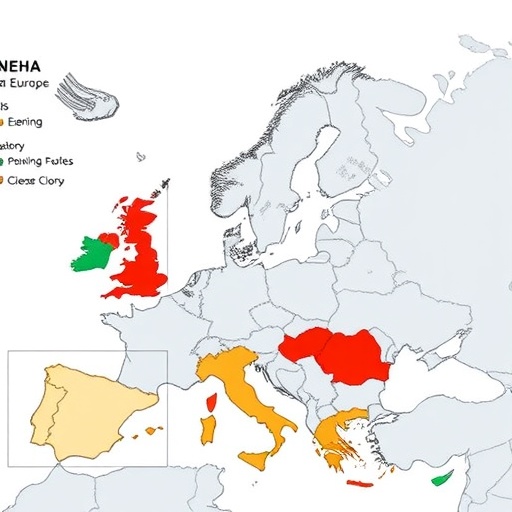
Extending beyond Switzerland, the team tested the robustness of their model across a broader European context, incorporating data on public support for various mitigation policies in six countries. The model successfully generalized, confirming the universality of the core predictors—affective responses, fairness perceptions, impact beliefs, and social trend awareness—as foundational elements driving energy policy support across diverse national landscapes. This European-wide validation signals that despite cultural and political differences, the psychological mechanics of policy endorsement show consistent patterns.
By illuminating these intricately intertwined predictors, this research injects fresh rigor into the design and implementation of energy policies. It stresses the necessity for policymakers to craft narratives and strategies that resonate emotionally while demonstrating tangible benefits and fairness. Moreover, the study advocates for continuous public engagement that nurtures perception of positive social dynamics to amplify collective buy-in. These insights could guide communication campaigns, stakeholder dialogues, and legislative frameworks to better align with public values.
From the scientific perspective, the application of machine learning in social science research represents a paradigm shift. It allows handling extensive, multi-faceted datasets with enhanced objectivity and predictive accuracy. This study exemplifies how advanced computational methods can unpack complex human attitudes toward climate action, breaking free from reductive approaches. Such integrative exploration of psychological, social, and environmental dimensions provides a richer, more actionable understanding, vital in the multidimensional challenge of climate policy.
This research also brings to light important considerations regarding public knowledge and information. The focus on informed citizens emphasizes that depth of understanding enhances the discernment of policy impacts and the reliability of expressed preferences. Consequently, education, transparent information provision, and combating misinformation remain indispensable priorities to foster an informed electorate capable of making decisions aligned with long-term sustainability.
Looking forward, the implications of this study are profound. Governments aiming to implement ambitious climate policies can leverage these predictive insights to tailor strategies that maximize public acceptance. This could reduce political resistance, accelerate policy deployment, and ultimately hasten the transition towards a low-carbon future. The approach also signals potential for adaptive policymaking informed by real-time sentiment tracking assisted by machine-learning analytics.
However, challenges remain. Emotions and fairness are subjective and may evolve rapidly in response to external events, media framing, or political rhetoric. Maintaining continuous engagement and updating models to reflect shifting public moods will be essential to preserve predictive relevance. Additionally, the interplay between local contexts and broader societal trends requires nuanced understanding to avoid one-size-fits-all policy messaging.
In conclusion, this pioneering research delineates a pathway for harmonizing science, policy, and society in the quest to combat climate change. Through harnessing advanced analytical tools and centering psychological and social predictors, it lays the groundwork for more effective, citizen-aligned energy policies. The promise of accelerating Europe’s—and potentially the world’s—energy transition hinges not only on technology and economics but fundamentally on decoding and integrating the human factors that shape democratic support for transformative change.
Krainz, M., Sorgato, V., Vallaeys Mora, I. et al. Predictors of informed energy policy support across Europe.
Nat Energy (2026). https://doi.org/10.1038/s41560-026-02050-5
Cite Scienmag News
Sloane Callahan. (May 15, 2026). Key Drivers of Energy Policy Support in Europe. Scienmag. https://scienmag.com/key-drivers-of-energy-policy-support-in-europe/
Sloane Callahan. "Key Drivers of Energy Policy Support in Europe." Scienmag, 15 May 2026, https://scienmag.com/key-drivers-of-energy-policy-support-in-europe/. Accessed 6 September 2026.
Sloane Callahan. "Key Drivers of Energy Policy Support in Europe." Scienmag. May 15, 2026. https://scienmag.com/key-drivers-of-energy-policy-support-in-europe/


