


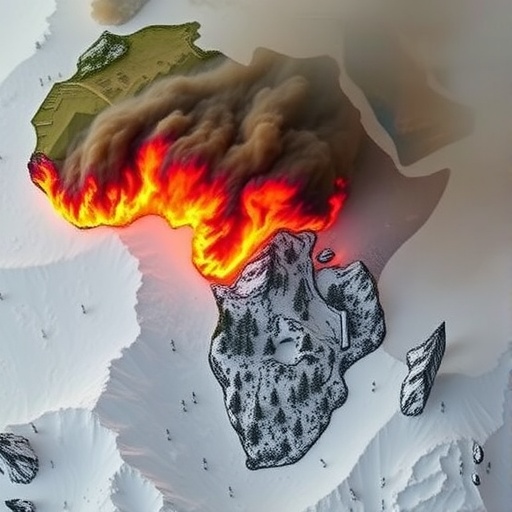
In a groundbreaking new study published in Nature, scientists have uncovered the emergence of wildfires in the alpine zones of Central Africa’s highest mountains—an ecological phenomenon never before documented in the region’s recorded history. This discovery challenges long-standing assumptions that the cool, moist conditions of tall tropical mountains preclude fire activity. Researchers reveal that a wildfire recorded in the 21st century marks the first incidence of fire above 3,800 meters in the Rwenzori Mountains within the last 12,000 years. These findings have profound implications for understanding how climate change and human activity might be transforming fragile alpine ecosystems.
Wildfires have traditionally been associated with lower-elevation landscapes, especially in temperate and dry tropical regions. These fires pose serious risks to ecosystems, air quality, and human societies. However, dense moisture regimes and cooler temperatures at high altitudes have typically shielded alpine and Afroalpine zones from such disturbances. The Rwenzori Mountains—sometimes called the “Mountains of the Moon”—stand as a towering natural fortress, housing unique biodiversity adapted to stable, cold environments. The recent emergence of fire at these elevations signals a dramatic shift in ecosystem dynamics, prompting urgent questions about future environmental stability.
The absence of historical fire records at these high elevations has left scientists largely in the dark about past fire regimes in Afromontane ecosystems. Traditional climate proxies and paleoecological data emphasize the rarity of natural fires at such heights, reinforcing the view that they are impervious to fire disturbances. This newly analyzed sediment core data from the Rwenzori reveals an abrupt onset of fire activity in the 21st century at alpine sites, contrasting sharply with the longstanding fire-free history. This paradigm shift underscores the need to reassess how mountain ecosystems might react under ongoing global change pressures.
Analysis of charcoal particles embedded in lake sediments across an elevational gradient tells a complex story of historical fire activity. At mid-elevations near 2,990 meters, the researchers detected a marked increase in fire occurrence approximately two thousand years ago. This temporal spike in burning coincides with archaeological and paleoenvironmental evidence suggesting increased human presence and land use changes in the region. It appears that anthropogenic influence played a significant role in shaping fire regimes at mid-mountain levels, catalyzing shifts in vegetation structure and composition, particularly the expansion of bamboo-dominated zones.
The ecological responses to fire at different elevations highlight the delicate balance between climate, vegetation, and human impacts. At mid-elevations, the rise in bamboo ecosystems following increased fire incidence points to fire as a dynamic agent driving vegetation succession. However, at higher altitudes above 3,800 meters, the prior absence of fire has meant that the native Afroalpine flora remain vulnerable to rapid change. The recent wildfire represents a novel disturbance in this ecosystem, potentially altering species composition, soil processes, and carbon cycling in ways not witnessed for millennia.
Climate change is widely implicated in transforming mountainous habitats worldwide, with warming temperatures and altered precipitation patterns facilitating conditions conducive to fire ignition at higher elevations. The intensification of droughts and lengthening of dry seasons in tropical Africa increase vulnerability to surface fires, even in previously fire-resistant zones. When combined with growing human pressures—such as agricultural encroachment, resource extraction, and land management practices—the risk of wildfire in alpine landscapes escalates substantially. This convergence of factors underscores the complexity of modern fire ecology in tropical mountain systems.
Understanding the drivers behind this newly observed alpine fire regime requires integrating paleoecological records with contemporary environmental monitoring and climate modelling. The study’s detailed sediment core analyses provide a window into past fire histories extending up to 12,000 years, revealing long intervals without alpine burning. These records affirm that the recent fires are anomalous and likely linked to unprecedented anthropogenic influence and climate trajectories. Such insights are crucial for formulating strategies to mitigate fire risk and preserve fragile alpine ecosystems.
The findings also raise profound questions about the resilience and adaptation potential of Afroalpine species to disturbance. Many plant species inhabiting these elevations evolved in historically fire-free environments, which may lack traits for rapid recovery or fire tolerance. As fire intrudes into these habitats, the ecological consequences could include reduced biodiversity, altered nutrient cycling, and shifts in ecosystem services critical to local communities. Assessing the vulnerability of endemic flora and fauna to fire disturbances is an urgent priority for conservation biologists.
The study calls for enhanced fire monitoring and management frameworks tailored to high-altitude tropical mountain areas, where fire regimes may rapidly evolve under shifting environmental conditions. Conventional fire prevention policies may not account for the novel risks posed by alpine fires, necessitating adaptive approaches that consider the unique ecological and social contexts of these regions. Engaging local populations who have historically influenced mid-elevation fire patterns will be essential to developing effective fire stewardship that protects both ecosystems and livelihoods.
Moreover, the work highlights the broader implications for global mountain systems facing similar emerging fire threats. As climate warming progresses, fire incidence is increasing in many mountain ranges worldwide, from the Andes to the Himalayas, often breaking historical ecological thresholds. The African alpine fire discovery joins a growing body of evidence demonstrating that no mountain environment is immune to the rapid environmental transformation wrought by interconnected human and climatic forces.
This pioneering investigation into the twenty-first century emergence of alpine fire represents a vital contribution to understanding how mountain ecosystems respond to global change. The Rwenzori Mountains serve as a natural laboratory revealing that human footprint and climate stress collectively drive novel disturbance regimes, reshaping ecosystems that for millennia appeared fireproof. Addressing these challenges demands coordinated research, conservation, and policy efforts to safeguard high-altitude biodiversity and the critical ecosystem functions these landscapes provide.
While the future trajectory of fire in Afroalpine ecosystems remains uncertain, recognizing the recent shift in fire dynamics is the first step towards building resilient mountain systems. Continued interdisciplinary research integrating climate science, ecology, paleohistory, and human dimensions will be critical to navigating the rapid environmental transformations unfolding in these iconic landscapes. The Rwenzori study reminds the global community that the age-old assumptions about fire’s constraints are no longer valid in a rapidly changing world, signaling a new chapter in mountain ecology.
In summary, this discovery challenges existing paradigms by documenting wildfire at unprecedented alpine elevations in Central Africa during the 21st century. It reveals intricate links between human activity, climate change, and fire regimes across elevational gradients. These insights emphasize the urgency of rethinking ecological resilience and fire management for tropical mountain ecosystems—or risk profound and irreversible transformations. The Rwenzori Mountains stand as both a warning and an opportunity to better understand and protect vulnerable alpine environments amid escalating global environmental change.
Cite Scienmag News
Gavin Prescott. (May 14, 2026). Alpine Fires Surge in Central Africa Mountains. Scienmag. https://scienmag.com/alpine-fires-surge-in-central-africa-mountains/
Gavin Prescott. "Alpine Fires Surge in Central Africa Mountains." Scienmag, 14 May 2026, https://scienmag.com/alpine-fires-surge-in-central-africa-mountains/. Accessed 3 September 2026.
Gavin Prescott. "Alpine Fires Surge in Central Africa Mountains." Scienmag. May 14, 2026. https://scienmag.com/alpine-fires-surge-in-central-africa-mountains/


