


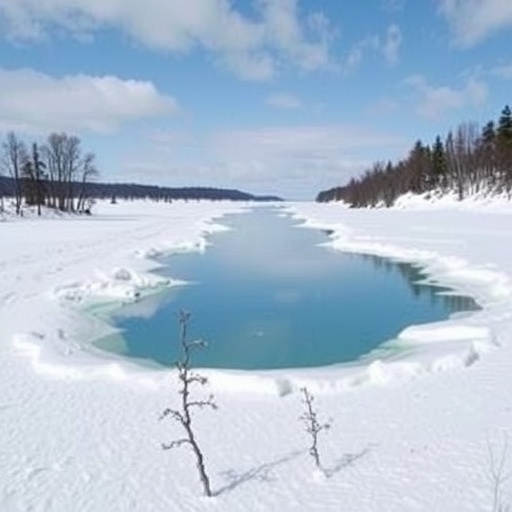
In a groundbreaking advance that could fundamentally alter our understanding of the chemical processes occurring in icy environments, researchers have uncovered a striking duality in the fate of dissolved organic carbon (DOC) within ice. This phenomenon hinges on the intricate interplay between nitrate ions and carbon-nitrogen coupling reactions, revealing that DOC can either be broken down into simpler molecules or polymerized into more complex substances depending on nitrate availability. The findings, published in Communications Earth & Environment, provide compelling evidence for a nitrate-mediated mechanism that governs whether organic carbon undergoes decomposition or synthesis in frozen matrices, an insight with profound implications for biogeochemical cycles and climate science.
Organic carbon compounds dissolved in aqueous environments are essential players in terrestrial and aquatic ecosystems, closely linked to global carbon cycles and the regulation of greenhouse gases. In ice-rich settings, such as polar ice caps, glaciers, and permafrost, the fate of this carbon has long been enigmatic. Traditionally viewed as inert or merely preserved, new evidence now demonstrates that ice is an active chemical reactor. The latest research elucidates how DOC does not remain static but participates in dynamic chemical transformations mediated by the presence of nitrate ions and carbon-nitrogen coupling pathways.
At the core of the investigation lies the balance between two opposing pathways: decomposition of DOC into small molecular entities and polymerization into larger, potentially refractory compounds. Nitrate, a nitrogen-containing anion commonly found in polar ice, serves as a crucial mediator. Through a series of sophisticated laboratory experiments simulating ice conditions, the researchers revealed that when nitrate concentrations exceed a critical threshold, the carbon compounds undergo polymerization, suggesting a formation of higher molecular weight organic matter. In contrast, in nitrate-poor or nitrate-depleted ice, DOC primarily decomposes, generating smaller carbon fragments with different environmental behaviors.
Delving into the mechanistic details, the study highlights the nitrate-mediated carbon-nitrogen coupling as the driver behind these divergent pathways. This coupling involves intricate chemical interactions where nitrogen species derived from nitrate actively participate in bonding with carbon atoms, facilitating either the breaking or forming of chemical bonds in organic compounds. The research team employed advanced spectroscopic methods, including nuclear magnetic resonance (NMR) and Fourier-transform infrared spectroscopy (FTIR), combined with isotopic labeling techniques, to unravel these coupling reactions at a molecular level, confirming the presence of nitrogen-carbon crosslinks in polymerized products.
This revelation carries significant implications for the cycling of carbon and nitrogen in cold environments. Traditionally, the decomposition of DOC in ice, especially under cold, low-energy conditions, was thought to be limited, resulting in the accumulation of organic materials that could be released upon thawing. However, the demonstrated capacity of nitrate to induce polymerization suggests the formation of new, more resilient organic matter within ice, which may alter the timing and quality of organic carbon exported during melting seasons, potentially affecting downstream ecosystems and global carbon budgets.
Furthermore, understanding whether DOC is decomposed or polymerized in ice can shed light on the sources and sinks of greenhouse gases, including carbon dioxide and methane. Decomposition pathways typically produce these gases as byproducts, contributing to atmospheric concentrations upon ice melt. In contrast, polymerized carbon may remain trapped longer, potentially delaying or mitigating immediate greenhouse gas emissions. This nuanced carbon fate in frozen matrices adds complexity to climate models that must now incorporate nitrate dynamics as a pivotal factor influencing carbon turnover in cryospheric regions.
The experimental framework of this study was robust, replicating natural ice conditions under controlled laboratory environments. By varying nitrate concentrations and measuring resultant DOC transformations, the researchers ensured their conclusions were grounded in realistic scenarios. Additionally, field sampling in polar glaciers and seasonal snowpacks equipped the study with environmental relevance, verifying that the lab-observed mechanisms extrapolate to natural settings where nitrate availability varies seasonally and spatially.
Critically, the roles of microbial communities, often neglected in abiotic ice chemistry, were considered. The data indicated that chemical transformations mediated by nitrate occurred independently of biological activity, underscoring the significance of purely chemical processes in frozen environments. This distinction is vital for accurate predictions, as it challenges assumptions that microbial metabolism is the dominant driver of organic carbon fate in ice.
The environmental ramifications extend beyond polar regions. High mountain glaciers and seasonal snowpacks similarly harbor DOC and nitrate, suggesting that nitrate-mediated carbon-nitrogen coupling is a ubiquitous phenomenon in diverse icy ecosystems. Such ubiquity underscores the need to re-examine regional carbon budgets and predict future changes as global warming accelerates ice melt and alters chemical fluxes.
Interestingly, the polymerization of DOC in nitrate-rich ice might contribute to the formation of complex organic aerosols upon release into the atmosphere. These aerosols, influencing cloud formation and albedo, link snow and ice chemistry with broader atmospheric processes, revealing a web of interactions spanning cryosphere, biosphere, and atmosphere. Thus, nitrate’s role in modulating organic carbon transformations gains an interdisciplinary dimension, touching on atmospheric chemistry and climate feedback mechanisms.
The discovery also opens up new questions regarding the origins of nitrate in ice and its variability. Sources range from atmospheric deposition, including anthropogenic pollution and natural processes like lightning and biological fixation, which may differentially impact the carbon transformations observed. Seasonal and geographic variations in nitrate input could lead to spatial heterogeneity in DOC fate, influencing local ecosystems and biogeochemical cycling patterns.
In the broader scope of global change biology and environmental chemistry, this study epitomizes the importance of interdisciplinary approaches combining geochemistry, molecular spectroscopy, and environmental science. By unveiling the nitrate-dependence of DOC chemical pathways in ice, the research not only challenges existing paradigms but provides a basis for future investigations into chemical and ecological dynamics in cryospheric environments under changing climates.
The findings invite scientists to rethink carbon storage potentials in frozen regions and emphasize the necessity of monitoring nitrate levels as a predictor for the fate of organic carbon. This insight is particularly consequential in the context of increasing human impacts on atmospheric nitrogen cycles, which could indirectly influence ice chemistry and global carbon feedbacks.
As warming trends continue, the balance between DOC decomposition and polymerization in ice may shift, potentially accelerating the release of greenhouse gases or altering the nature of organic carbon exported to terrestrial and aquatic systems. This knowledge equips researchers, policymakers, and climate modelers with a refined lens to assess risks and design mitigation strategies that factor in the nuanced chemistry of ice-bound organic matter.
Ultimately, the study offers a compelling narrative: ice is not merely a passive reservoir of organic carbon but an active chemical realm where nitrate concentrations dramatically determine whether dissolved organic matter breaks apart or coalesces. This realization not only expands our scientific horizons but underscores the intricate mysteries still embedded in Earth’s frozen frontiers, beckoning further exploration to unravel their roles in the planet’s future.
Cite Scienmag News
Violet Maxwell. (May 11, 2026). Nitrate Drives Organic Carbon Fate in Ice. Scienmag. https://scienmag.com/nitrate-drives-organic-carbon-fate-in-ice/
Violet Maxwell. "Nitrate Drives Organic Carbon Fate in Ice." Scienmag, 11 May 2026, https://scienmag.com/nitrate-drives-organic-carbon-fate-in-ice/. Accessed 5 September 2026.
Violet Maxwell. "Nitrate Drives Organic Carbon Fate in Ice." Scienmag. May 11, 2026. https://scienmag.com/nitrate-drives-organic-carbon-fate-in-ice/


