

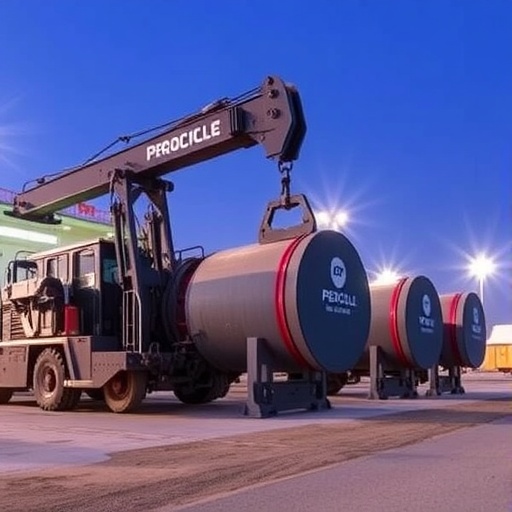
PeroCycle, an innovative force in closed-loop carbon recycling, has recently achieved a significant milestone by securing a comprehensive feasibility assessment contract with Jindal Steel (Oman). This collaboration sets the stage for a transformational approach to steel manufacturing, particularly within Jindal’s operations at the strategic Port of Duqm. At its core, the assessment will explore the potential integration of PeroCycle’s patented carbon recycling technology into the steelmaking process, aiming to transform industrial off-gases—byproducts traditionally viewed as waste—into vital operational resources. This partnership not only signifies a leap forward for sustainable steel production in the Middle East but could also establish a new global standard in low-carbon industrial manufacturing.
The essence of PeroCycle’s technology lies in its capability to capture and recycle carbon-containing off-gases emitted during steel production and reintroduce them as feedstock within the manufacturing cycle. Originating from pioneering research developed at the University of Birmingham, this patented process directly addresses the pressing challenge of decarbonizing heavy industries. Steel, cement, and chemical manufacturing contribute a substantial share of global carbon emissions, and innovative solutions like PeroCycle’s are crucial to meeting climate targets. By recycling these gases, the technology dramatically reduces reliance on fossil fuel-based reducing agents such as natural gas, coal, and coke—commonly used in traditional blast furnace and direct reduction processes.
What makes PeroCycle’s approach particularly compelling is its versatility; the technology is designed for seamless integration into both newly constructed plants and existing facilities. This retrofit capability is critical from an economic standpoint, as it prevents the obsolescence of capital-intensive steelmaking infrastructure. Companies can thus avoid the substantial financial burdens and operational disruptions associated with building entirely greenfield plants. Instead, steel producers can pursue decarbonization pathways that align with their existing capital structures, allowing a pragmatic and scalable transition toward sustainable industrial practices.
The ongoing feasibility study represents a multi-dimensional engineering and economic assessment intended to craft a detailed roadmap toward full-scale implementation. It prioritizes the evaluation of the technical integration of PeroCycle’s system with proven gas separation technologies such as Vacuum Pressure Swing Adsorption (VPSA) and Pressure Swing Adsorption (PSA). These widely adopted gas purification methods concentrate high-purity gases from off-gas streams, enabling more efficient recycling and reuse. Verifying the synergy between these processes is essential for optimizing the overall system’s performance, energy efficiency, and carbon reduction potential.
From an engineering design perspective, the study will generate in-depth Process Flow Diagrams (PFDs), crucial for visualizing the sequence and interrelation of all unit operations involved in the off-gas recycling process. These PFDs serve as the backbone for subsequent system design and integration efforts. Additionally, comprehensive mass and energy balance calculations will provide insights into the material flows and thermodynamic efficiencies, key parameters that underpin the technology’s scalability and commercial viability. This level of detail ensures that every component of the process is optimized for maximum environmental benefits without compromising operational reliability.
Site-specific evaluations will determine the real-world economic impact and environmental benefits of deploying PeroCycle’s technology at the Port of Duqm facility. These assessments will appraise not only onsite reductions in direct CO2 emissions (Scope 1) but also the potential to lower indirect emissions (Scope 2) associated with purchased utilities such as electricity and steam. By quantifying these savings, the feasibility study will offer Jindal Steel a comprehensive, data-driven strategy to align their production practices with international climate commitments, all while maintaining robust competitiveness in the global steel market.
PeroCycle’s CEO, Grant Budge, highlighted the transformative potential of this collaboration, emphasizing the fusion of advanced recycling technology with Jindal Steel’s operational expertise. Budge noted that the project transcends the typical scope of feasibility studies, proposing instead a blueprint that could revolutionize industrial decarbonization. This vision accentuates the dual objectives of enabling industrial growth while meeting environmental imperatives, particularly in industries historically resistant to rapid decarbonization due to process complexity and capital intensity.
Jindal Steel’s CEO in Oman, Harssha Shetty, affirmed sustainability as a cornerstone of the company’s long-term strategy. By proactively investigating emerging technologies like that of PeroCycle, Jindal Steel demonstrates leadership in adopting pathways that reduce carbon intensity without sacrificing economic resilience. The company’s engagement in this pioneering feasibility study reflects a broader trend among industrial heavyweights striving to future-proof their operations amid escalating regulatory and market pressures favoring sustainable production.
Beyond immediate operational benefits, this strategic engagement offers PeroCycle a valuable platform to validate its technology readiness in a highly complex and large-scale industrial context. The Middle East is rapidly establishing itself as a global hotspot for industrial decarbonization efforts, driven by both economic diversification ambitions and climate action commitments. Successfully demonstrating the scalability and integration capability of PeroCycle’s solutions in this region will enhance the company’s credibility and facilitate subsequent engineering, production, and construction phases for demonstrator-scale installations.
Moreover, this partnership anticipates cascading impacts across multiple industrial sectors reliant on fossil carbon inputs. If PeroCycle’s technology can reduce carbon emissions by up to 90% in steelmaking, as projected, the ripple effect could accelerate the transformation of related foundation industries including cement and chemicals. This aligns with broader international decarbonization goals, underscoring the essential role of innovative carbon recycling technologies in meeting net-zero emissions targets.
The engineering challenge central to this study revolves around retrofitting gas capture and conversion technologies into an existing steelmaking ecosystem without impairing operational throughput. Ensuring synchronous integration with production cycles requires meticulous planning of construction phasing and deployment strategies, all while maintaining adherence to safety, quality, and efficiency standards. Successful navigation of these complexities will not only prove the feasibility of such ambitious retrofits but also provide empirical data critical for commercial-scale rollouts.
In summary, the PeroCycle-Jindal Steel partnership marks a pivotal chapter in the story of industrial decarbonization. It epitomizes how cutting-edge research, grounded in university innovation, can catalyze pragmatic solutions with the potential for real-world impact on one of the planet’s most challenging carbon emission sources. The upcoming feasibility study promises to shed light on the technical, economic, and environmental viability of closed-loop carbon recycling in steelmaking, potentially charting a course for the industry’s future and inspiring similar transformative initiatives worldwide.
Subject of Research: Integration of closed-loop carbon recycling technology for decarbonization in steel manufacturing.
Article Title: Pioneering Carbon Recycling: PeroCycle and Jindal Steel Partner to Revolutionize Sustainable Steelmaking
News Publication Date: Not specified
Web References:
Keywords
Steelmaking, Carbon Recycling, Industrial Decarbonization, Sustainability, Foundation Industries, Off-Gas Recovery, VPSA, PSA, Closed-Loop Technology, Retrofit Integration, Process Flow Diagrams, Carbon Emissions Reduction


