


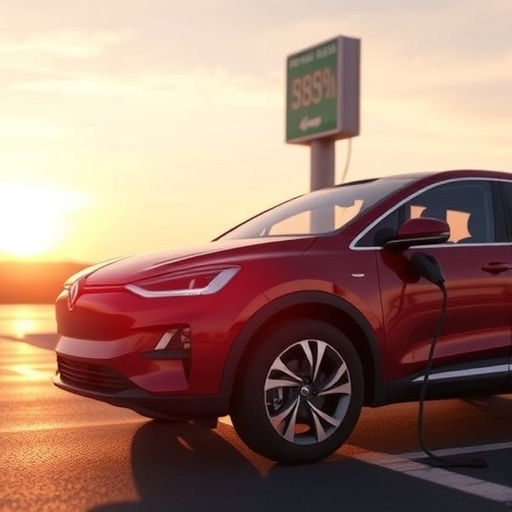
As global fuel prices continue to fluctuate and rise, the automotive industry is witnessing a significant transformation in how hybrid vehicles are utilized by drivers. A recent comprehensive study published in the Journal of the Association of Environmental and Resource Economists sheds light on the nuanced relationship between gasoline costs and the operational patterns of plug-in hybrid electric vehicles (PHEVs). This research delves into the behavioral economics behind hybrid vehicle use, revealing that as gasoline prices ascend, drivers increasingly shift towards electric modes of travel, thereby augmenting the environmental efficacy of these vehicles.
The proliferation of plug-in hybrid vehicles reflects a broader effort by societies worldwide to curb carbon emissions and confront climate change impacts. Governments have played a pivotal role by promoting sales of hybrid models through purchase subsidies and tax incentives, which have successfully accelerated adoption rates. Yet, the actual environmental benefit of these vehicles is contingent not merely on their acquisition but critically on how they are driven. Contrary to earlier assumptions that hybrids inherently minimize emissions, the study reveals that the extent to which drivers engage electric propulsion versus internal combustion engines significantly influences overall emissions performance.
Focusing on microlevel data sourced from the German Spritmonitor app, the research team — Laura Grigolon, Eunseong Park, and Kevin Remmy — analyzed real-world driving patterns. Despite electricity often being cheaper than gasoline, the data indicates that only about 32% of hybrid vehicle mileage is traveled using their electric powertrains. This phenomenon is partly attributed to what the authors describe as a “hassle cost” associated with electric charging, encompassing both perceived and actual inconveniences such as locating charging stations, charging duration, and planning trips around charging availability.
The interplay between fuel costs and driver behavior forms a core pillar of this research. By examining periods of volatility in fuel prices, the authors identified a direct proportional response in electric usage. Specifically, a 10% increase in gasoline prices corresponds with roughly a 1.5 percentage point rise in electric driving share within the hybrid mix. While this increment might appear marginal, it translates into a substantial aggregate effect on emissions when scaled across large hybrid vehicle populations. This elasticity underlines the economic mechanisms influencing not only the purchase but also the everyday operational decisions of hybrid car owners.
Hybrid vehicles are often marketed as the bridge technology leading to a full electric vehicle future, promising immediate reductions in fossil fuel dependency. However, this study argues that the intrinsic environmental advantages of plug-in hybrids are frequently overstated if drivers remain reliant on gasoline engines during routine travel. Such reliance can diminish the anticipated decline in greenhouse gas emissions, impeding efforts toward national and international climate targets. Therefore, policymakers and environmental strategists are urged to consider behavior-driven interventions alongside technological advancements.
An intriguing insight from the research is the role of consumer psychology and convenience in energy choices. While the cost differential between electricity and gasoline is a significant motivator, the behavioral “friction” created by charging logistics cannot be overlooked. This friction may involve time costs, accessibility concerns, or even awareness gaps regarding electric mode benefits. These findings suggest that infrastructure development — such as increasing the density of fast-charging stations — coupled with user education, could amplify the emission reduction potential of hybrid vehicles.
Furthermore, the research places hybrid vehicle usage within a dynamic economic context, reflecting real-world decision-making processes under fluctuating market conditions. By utilizing high-resolution app data, the study captures the granular details of individual driving behavior, which traditional aggregated transportation studies might miss. This approach enables a more precise quantification of how external economic variables like fuel price shocks influence eco-friendly driving practices.
The implications of these findings extend beyond individual consumer behavior, informing environmental policy design and climate change mitigation strategies. Subsidies aimed solely at boosting hybrid vehicle purchases may fall short if not coupled with incentives or support measures that promote frequent electric charging. This might include monetary rewards for electric mode mileage or reduced electricity tariffs for hybrid owners. Addressing the charging hassle could also involve integrating vehicle-to-grid technologies and enhancing smart charging solutions.
Moreover, the study charts a path forward in evaluating the environmental performance of plug-in hybrids, advocating for metrics that consider both ownership and use phases. Traditional lifecycle assessments might overestimate the environmental gains by assuming idealized electric use ratios. Recalibrating these models to reflect actual driver behavior yields more accurate forecasts of emission trajectories and better guides investment decisions in sustainable transportation technologies.
This research also opens avenues for further inquiry into regional differences in hybrid use behaviors, influenced by factors such as electricity grid carbon intensity, urban design, and cultural attitudes toward technology adoption. Since the data is derived primarily from the German market, subsequent studies could explore how these dynamics vary globally and what lessons can be drawn for scalable policy frameworks.
Ultimately, the study by Grigolon, Park, and Remmy underscores the complex interdependence between economic conditions and environmental outcomes in the transition toward electrified transportation. It highlights the necessity for holistic approaches integrating consumer behavior, technological feasibility, infrastructure readiness, and policy environments to realize the full potential of hybrid vehicle technologies in combating climate change.
The rising trajectory of gasoline prices not only incentivizes increased electric mode usage but also enhances public awareness of sustainable mobility options. As hybrid drivers respond adaptively to economic signals, the automotive ecosystem evolves, favoring cleaner consumption patterns. Such adaptive behaviors represent critical leverage points for shaping a future where electrification contributes meaningfully to reducing the carbon footprint of personal transportation worldwide.
This study marks a significant advancement in environmental economics by providing empirical evidence on how fuel price fluctuations tangibly affect hybrid car usage patterns. The insights gained reinforce the importance of fostering supportive systems that diminish user inconvenience and amplify financial incentives, thereby driving widespread behavioral shifts toward electrified driving.
Cite Scienmag News
Sloane Callahan. (May 7, 2026). Rising Gas Prices Drive Surge in Electric Vehicle Adoption. Scienmag. https://scienmag.com/rising-gas-prices-drive-surge-in-electric-vehicle-adoption/
Sloane Callahan. "Rising Gas Prices Drive Surge in Electric Vehicle Adoption." Scienmag, 7 May 2026, https://scienmag.com/rising-gas-prices-drive-surge-in-electric-vehicle-adoption/. Accessed 4 September 2026.
Sloane Callahan. "Rising Gas Prices Drive Surge in Electric Vehicle Adoption." Scienmag. May 7, 2026. https://scienmag.com/rising-gas-prices-drive-surge-in-electric-vehicle-adoption/


