


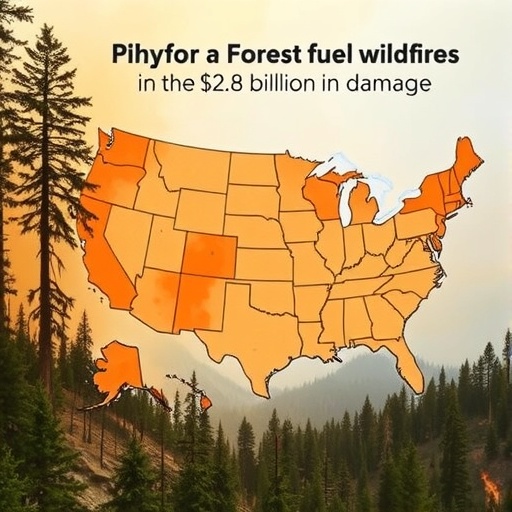
In an era marked by escalating wildfire incidents and intensities, a groundbreaking study led by researchers at the University of California, Davis, provides compelling evidence on the economic and environmental efficacy of forest fuel treatments. Detailed analysis covering nearly 300 wildfires across the western United States between 2017 and 2023 reveals that every dollar invested in treatments such as forest thinning and prescribed burns yields approximately $3.75 in wildfire damage mitigation. This unprecedented large-scale evaluation, published in the esteemed journal Science, underscores the critical role of proactive forest management in mitigating wildfire impacts in an increasingly fire-prone landscape.
Forest fuel treatments are designed to reduce the amount of combustible material—namely, deadwood, dense underbrush, and overgrown tree canopies—that fuel wildfire spread and severity. The UC Davis-led research team employed a novel methodology by analyzing actual wildfire behaviors when intersecting areas with fuel reduction measures, rather than relying solely on simulation models. This approach enabled accurate quantification of benefits that include reduction of tree canopy mortality, limiting wildfire propagation, and lowering the intensity of burned areas. Their findings offer a transformative perspective on wildfire management policies that have traditionally emphasized suppression over prevention.
The economic valuation of the forest treatments considered several critical wildfire-related damage categories. The team meticulously quantified the avoided structural losses, reduced carbon dioxide emissions, and lessened health impacts from wildfire-induced air pollution, particularly fine particulate matter exposure. According to their estimates, wildfires in the western United States generate annual damages that could range from $185 billion to $540 billion, a staggeringly high societal cost exacerbated by climate change and increased wildfire frequencies. The evidence that fuel treatments can prevent a significant portion of these losses suggests a cost-effective strategy that policymakers urgently need to prioritize.
A pivotal aspect of the study’s methodology involved dissecting wildfire spread patterns relative to treated versus untreated forest areas. By controlling for variables such as weather conditions and firefighting efforts and integrating fire simulation models, researchers established that wildfires entering treatment zones were over 13 percentage points less likely to continue spreading. This containment effect is especially notable in high-severity fire events, which result in the destruction of more than three-quarters of tree canopy cover. The reduction in burned areas within treated landscapes was substantial, with decreases ranging between 20% to 35%, pointing directly to the critical protective function these treatments serve.
Among the different treatment methods evaluated, prescribed burns emerged as significantly more effective than mechanical thinning alone. Prescribed burning reduces fuel loads in a controlled manner, effectively removing accumulated undergrowth and facilitating healthier forest regeneration. This finding signals a strategic pivot for forest management practices, highlighting the necessity to incorporate more prescribed fire regimes to bolster wildfire resilience. Additionally, the spatial scale of treatments proves decisive; only landscape-level interventions exceeding 2,400 acres delivered the most robust reductions in wildfire spread and severity, suggesting that piecemeal treatment efforts may be insufficient.
The aggregated benefits of the fuel treatments across the studied wildfires paint a compelling picture of prevention outweighing suppression. The research quantifies a 36% reduction in total burned area, equivalent to roughly 152,000 acres. More importantly, the treatments avoided the destruction of over 4,000 buildings, sequestered approximately 2.7 million tons of carbon dioxide that otherwise would have been released, and lowered the emission of fine particulate matter by nearly 26,000 tons. These pollution reductions also translated to tangible health and societal benefits—specifically, an estimated prevention of 59 premature deaths linked to smoke exposure—highlighting the broader public health implications of effective forest management.
Monetizing these diverse benefits, the study estimates that fuel treatments prevented approximately $2.8 billion in wildfire damages. This figure includes nearly $895 million saved from avoided structural losses, $503 million from reduced carbon emissions, and a striking $1.39 billion relating to reduced health costs and productivity losses from smoke pollution. Such a comprehensive valuation underscores the multifaceted nature of wildfire damages and the far-reaching economic ripple effects that investment in preventive treatments can mitigate. This financial rationale provides a compelling argument for increasing allocation of public funds to forest management programs.
Beyond the quantifiable economic and environmental merits, the study speaks volumes about the current underfunding of forest fuel treatments. Lead author Frederik Strabo emphasizes that forest management activities are public goods often overlooked in budgetary priorities. Reduced funding leads to more wildfire damages falling on communities and taxpayers, effectively shifting financial burdens downstream. As climate change intensifies wildfire risks, the study clearly advocates for a fundamental recalibration in wildfire policy—from a reactionary suppression focus to proactive prevention and management.
These findings arrive at a crucial inflection point when the western United States confronts an unprecedented increase in wildfire severity and frequency. As forests endure longer dry seasons, higher temperatures, and altered precipitation patterns, the likelihood of catastrophic wildfire events escalates. Strategic forest fuel treatments not only mitigate immediate wildfire damages but also enhance the resilience of forest ecosystems to future disturbances. The integration of these management approaches into national wildfire policy frameworks could substantially alleviate long-term societal costs and environmental degradation.
The collaborative research effort benefited from support by the Giannini Foundation for Agricultural Economics and the USDA Forest Service and represents a multidisciplinary integration of expertise from agricultural economics to ecological modeling. Other key contributors include Matthew N. Reimer of UC Davis and Calvin Bryan from the Department of Economics at Washington and Lee University. The study’s comprehensive analytical approach, spanning empirical wildfire data, economic impact assessments, and dynamic modeling of firefighting efforts, sets a new benchmark for wildfire research.
In conclusion, this landmark study decisively confirms the tremendous value of forest fuel treatments in wildfire risk reduction, economic savings, and public health protection. It offers policymakers, land managers, and communities a scientifically grounded case for substantial investments in preventive forest management techniques. As wildfire regimes evolve under climate pressures, accelerating implementation of prescribed burns and large-scale landscape thinning will be essential to safeguarding lives, properties, and carbon stocks. This research inaugurates a paradigm shift toward recognizing prevention as the keystone of sustainable wildfire management over the coming decades.
News Publication Date: 7-May-2026
Web References: DOI: 10.1126/science.aea6463
Cite Scienmag News
Courtney Benton. (May 7, 2026). Forest Fuel Treatments Curb Wildfire Spread, Saving $2.8 Billion in Damage. Scienmag. https://scienmag.com/forest-fuel-treatments-curb-wildfire-spread-saving-2-8-billion-in-damage/
Courtney Benton. "Forest Fuel Treatments Curb Wildfire Spread, Saving $2.8 Billion in Damage." Scienmag, 7 May 2026, https://scienmag.com/forest-fuel-treatments-curb-wildfire-spread-saving-2-8-billion-in-damage/. Accessed 4 September 2026.
Courtney Benton. "Forest Fuel Treatments Curb Wildfire Spread, Saving $2.8 Billion in Damage." Scienmag. May 7, 2026. https://scienmag.com/forest-fuel-treatments-curb-wildfire-spread-saving-2-8-billion-in-damage/


