


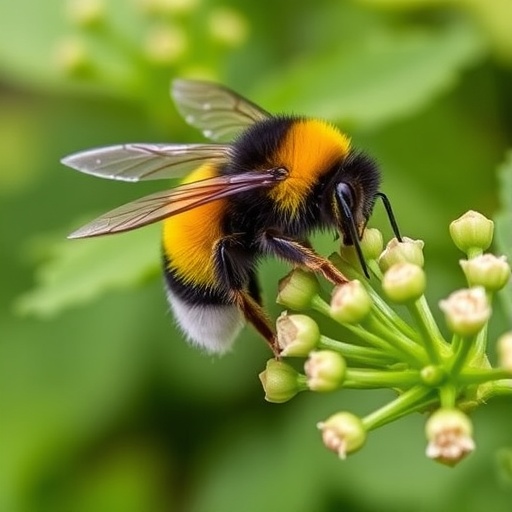
New research is reshaping our understanding of how rising temperatures affect bumble bees, particularly those species that establish subterranean nests. Contrary to popular belief that warming climates uniformly harm pollinators, this study reveals a nuanced interaction between temperature and bumble bee physiology and behavior. The findings suggest that moderate increases in temperature could actually improve colony success for certain bumble bees by reducing the energy expenditure needed for brood incubation, though extreme heat events may pose significant threats that could contribute to population declines in some regions like the southeastern United States.
At the core of this research is the recognition that social insects such as bumble bees operate as integrated colonies rather than isolated individuals. Clint Penick, an assistant professor of insect ecology at Auburn University and the study’s corresponding author, emphasizes the complexity of these systems. He explains that within a single colony, a variety of specialized roles ensure survival, and disruptions in function due to environmental stress have cascading effects. Therefore, evaluating the impact of higher temperatures demands a holistic approach encompassing the entire bee society.
Previous studies have highlighted that individual bumble bees experience significant thermal stress when foraging on hot days, with body temperatures reaching potentially harmful levels. Elsa Youngsteadt, co-author and applied ecology professor at North Carolina State University, underscores the importance of extending focus beyond foragers to the colony’s microenvironment. The nest, particularly the queen’s chamber where new bees develop, plays a pivotal role in colony resilience and is affected differently by temperature changes than solitary bee activity.
Bumble bees have evolved intricate thermoregulatory strategies to maintain nest temperatures within optimal limits for brood development. In warmer conditions, worker bees fan their wings to circulate air and cool the nest interior. Conversely, cooler air prompts them to incubate larvae by vibrating their flight muscles to generate heat. Despite the complexity of these behaviors, continuous monitoring of nest temperature in natural or simulated environments has been lacking, leaving a gap in understanding the full implications of climate warming on bumble bee colonies.
To address this gap, the research team utilized a multifaceted experimental design focusing primarily on Bombus impatiens, the eastern bumble bee species widely used in commercial pollination and known for its subterranean nesting habits in the wild. Simulated underground nests were established to characterize baseline temperature profiles absent of bee activity, alongside aboveground nest boxes commonly used in agricultural settings to observe environmental temperature patterns.
Further experimentation involved laboratory microcolonies that were subjected to controlled temperature variations, enabling precise observation of how nest warming or cooling influenced bee behavior. This controlled manipulation revealed that temperature fluctuations alter the balance between fanning and incubation activities, suggesting a metabolic trade-off that directly impacts foraging potential and brood care. These findings illuminate the dynamic physiological adjustments bees make in response to their thermal environment.
Complementing the lab work, field observations tracked bumble bee visitation rates to cucumber flowers across a latitudinal gradient from Georgia to Michigan, correlating insect activity with local ambient temperatures. The choice of cucumber as a model plant was strategic given its dependence on insect pollination and its widespread cultivation, which allowed for controlled comparisons across diverse climatic zones while minimizing confounding plant variables.
By integrating data from simulated nests, behavioral assays, and field observations, the researchers employed modeling approaches to project potential impacts of ambient temperature increases on bumble bee colony functioning. The models predict that moderate warming could enhance colony performance by saving time otherwise spent incubating brood, allowing worker bees to allocate more effort to foraging and resource collection, thereby potentially increasing colony growth and survival under certain conditions.
However, the study also cautions that this positive outlook is not universal. Aboveground nests, which are more exposed to temperature fluctuations, showed increased fanning behavior to offset heat stress, indicating greater energetic costs. Most critically, there exists an upper thermal threshold beyond which bees cannot cool the nest effectively, leading to dangerous conditions for developing larvae. In warmer climates akin to Georgia, occasional acute heat events far exceed this threshold, raising concerns about larval mortality and colony failure despite generally favorable conditions for the rest of the year.
The researchers emphasize that while the frequency and severity of such damaging heat episodes remain uncertain, these events could have outsized impacts on population dynamics, particularly in the southern range margins where bumble bees are already experiencing declines. Furthermore, warming may affect floral resources by altering nectar and pollen quality, posing additional indirect stressors to bee health that merit further investigation.
Strategies to mitigate the negative effects of increased temperatures, especially for commercial bumble bees housed in aboveground nest boxes, are urgently needed. Penick advocates for development of nest environments that better mimic the thermal stability of subterranean habitats, potentially improving survivability and productivity. Conservation efforts should also prioritize maintaining and restoring shaded and forested habitats, which provide natural cooling and nesting refuges for wild bee populations.
Beyond structural interventions, the study highlights the power of widespread gardening and plantings of native, perennial flowers near human dwellings as an accessible way to support pollinator resilience. By reducing the distance bees must travel for forage, these local floral resources can help buffer colonies against thermal and ecological stresses, contributing to the broader goal of stabilizing bumble bee populations amid climate change.
This comprehensive research contributes crucial insights into the complex relationships between nesting biology, thermal environment, and climate vulnerability among social bees, underscoring the need for multifaceted approaches to pollinator conservation. While rising temperatures pose challenges, evidence that moderate warming may offer some benefits to colony dynamics presents a nuanced perspective often lost in broader climate discourse. Continued research is necessary to untangle these mechanisms and guide interventions supporting both wild and managed bumble bee species.
News Publication Date: 27-Apr-2026
Web References:
https://doi.org/10.1111/1365-2656.70267
References:
Mullan, F., Penick, C. A., Youngsteadt, E., Green, N., McCluney, K. (2026). Nesting biology shapes climate vulnerability of social bees (Bombus spp.). Journal of Animal Ecology. https://doi.org/10.1111/1365-2656.70267
Cite Scienmag News
Gavin Prescott. (May 6, 2026). How Rising Temperatures Can Boost or Harm Bumble Bee Populations. Scienmag. https://scienmag.com/how-rising-temperatures-can-boost-or-harm-bumble-bee-populations/
Gavin Prescott. "How Rising Temperatures Can Boost or Harm Bumble Bee Populations." Scienmag, 6 May 2026, https://scienmag.com/how-rising-temperatures-can-boost-or-harm-bumble-bee-populations/. Accessed 4 September 2026.
Gavin Prescott. "How Rising Temperatures Can Boost or Harm Bumble Bee Populations." Scienmag. May 6, 2026. https://scienmag.com/how-rising-temperatures-can-boost-or-harm-bumble-bee-populations/


