

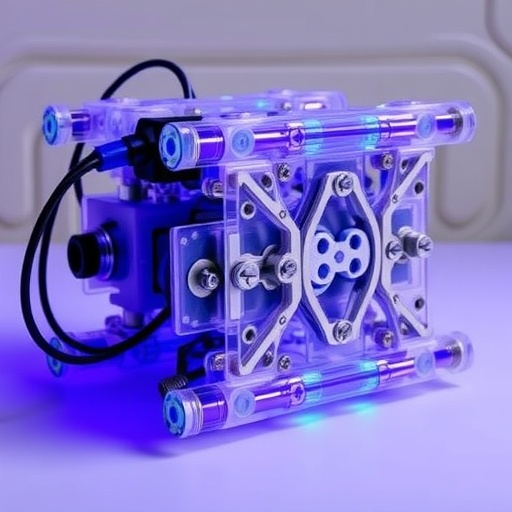
In a groundbreaking advancement that could reshape the future of robotics and pneumatic systems, researchers have unveiled a bio-inspired mechanical central pattern generator (CPG) capable of scalable pneumatic control from a single input to multiple outputs. This innovative technology, detailed by Qi, Zhao, Shao, and their team in the 2026 issue of Communications Engineering, embodies a convergence of biological principles and mechanical engineering, allowing highly customizable and flexible control in pneumatic actuators. The potential applications range from soft robotics to advanced prosthetics, promising unprecedented efficiency and dexterity through a novel one-to-many control architecture.
Central pattern generators are neural circuits found extensively in biological organisms, enabling rhythmic outputs such as walking, breathing, and swimming without requiring constant sensory feedback. Emulating these biological networks mechanically has long been a challenge, especially when aiming for adaptability and scalability. The research team from leading institutions tackled this head-on by designing a mechanical CPG system that mimics the fundamental oscillatory and modulatory functions of its biological counterparts, yet with mechanical components optimized for pneumatic control environments.
At the core of this bio-inspired device lies an intricate arrangement of mechanically coupled oscillators, carefully engineered to produce stable, repeatable rhythmic signals. By leveraging principles observed in central nervous system patterns, these oscillators generate uniform control signals that are seamlessly distributed to multiple pneumatic actuators. The elegance of this design is its ability to handle complex timing and phase relationships across several outputs from a singular customizable source, a feature rarely achieved in conventional pneumatic control systems.
This breakthrough is underpinned by the team’s innovative use of customizable mechanical linkages and valves, incorporating responsive materials and smart design geometry to allow real-time tuning of oscillation frequency, amplitude, and phase delay. Such tunability gives researchers and engineers the ability to adapt the pneumatic outputs to suit a variety of task-specific needs without requiring a complete redesign of the system. The scalability of this approach facilitates one-to-many control schemes, which are especially vital in addressing the challenges posed by increasingly complex robotic systems.
The pneumatic control achieved through this mechanical CPG shows significant advantages over traditional electronic control systems, particularly in contexts where electromagnetic interference or power consumption are critical concerns. Pneumatics inherently offer compliance and safety in human-interactive environments, qualities that are amplified by the mechanical robustness and reliability of the bio-inspired design. As a result, robots and devices employing this new CPG can operate more fluidly, mimicking natural biological motions with enhanced grace and coordination.
The research team conducted extensive experimental validation, describing in meticulous detail the performance metrics of their system under various loading and environmental conditions. Their mechanical CPG demonstrated not only high endurance but also impeccable adaptability when controlling modular pneumatic actuator arrays. The oscillation patterns retained their integrity over prolonged usage, highlighting the potential for real-world applications where reliability is paramount, such as wearable robotics and adaptive assistive devices.
Control precision in multi-actuator systems is notoriously difficult due to the interactions between individual elements, which often cause phase desynchronization and reduced efficiency. However, the mechanical architecture devised by Qi and colleagues naturally enforces stable phase locking across actuators. This biophysical mimicry ensures coordinated contraction and relaxation cycles, essential for sophisticated locomotion or manipulation tasks. The system’s intrinsic mechanical feedback loop provides an elegant solution to the longstanding challenge of synchronizing distributed pneumatic components.
Another standout feature of this mechanical CPG is its modularity. The researchers emphasized that system size and complexity could be expanded or contracted without losing the fidelity or predictability of the oscillatory control signals. This modular adaptability fosters the integration of the device into a wide range of robotic platforms, whether demanding micro-scale applications or large-scale machinery. The one-to-many scalability is not just a technical enhancement but a paradigm shift in how pneumatic robot actuators can be controlled with minimal computational overhead.
The integration of bio-inspiration with customizable mechanical logic also opens new frontiers in soft robotics, an area where traditional rigid control electronics often fall short. The gentle and continuous pressure modulation enabled by this system mimics muscle contractions more closely than conventional binary valve systems, thus enabling smoother and more natural movements. This fundamental advancement increases the potential for bio-mimetic devices that operate harmoniously within human environments, improving both user comfort and machine performance.
From a materials perspective, the team leveraged advanced composites and smart elastomers designed to enhance fatigue resistance and responsiveness. They tailored the mechanical properties of each component to optimize the frequency response and reduce hysteresis, which are critical for sustaining stable oscillations over time. These material innovations complement the system’s architectural ingenuity, ensuring that performance won’t degrade even in demanding operational scenarios.
The scalability of this mechanical central pattern generator extends beyond just increasing actuator count. It facilitates hierarchical layering of control signals, enabling complex gait patterns or multi-limb coordination strategies to be implemented with minimal computational burden. This layered control mimics biological motor control centers, where higher-level commands cascade down to localized CPGs managing specific motions. The researchers’ device brings these biological strategies into viable mechanical implementation, bridging neuroscience and engineering in a novel way.
Beyond the immediate robotics applications, the mechanical CPG could revolutionize pneumatic systems in industrial automation, where controlling multiple air-driven actuators simultaneously is often cost-prohibitive or overly complex. The device’s inherent simplicity combined with its adaptability promises to reduce hardware complexity, lower power consumption, and improve maintenance profiles. Industries facing stringent operational constraints, such as aerospace manufacturing or medical device production, stand to gain substantially from this technology’s deployment.
The global implications of this work are profound. By enabling more biologically faithful control mechanisms with scalable sophistication, this technology accelerates the path towards truly autonomous, intelligent machines capable of complex physical interaction. The potential for robots that think and move more like living organisms opens possibilities not only for industrial efficiency but also for individualized healthcare, rehabilitation, and exploration systems that respond to human needs with unprecedented synergy.
In conclusion, Qi, Zhao, Shao, and their team have delivered a pioneering approach to mechanical control inspired deeply by biological central pattern generators. Their research marks a pivotal step in the quest for scalable, customizable, and efficient pneumatic control systems, blending the elegance of natural rhythmic movement with the practicality of modern engineering. As this technology matures and integrates into next-generation robotic platforms, it is poised to reshape not just how machines move but fundamentally how they interact with the world around them—transforming pneumatic control from a mechanical utility into a bio-inspired art form.
Subject of Research: Bio-inspired mechanical central pattern generators and scalable pneumatic control systems in robotics.
Article Title: A bio-inspired customizable mechanical central pattern generator enables one-to-many scalable pneumatic control.
Article References:
Qi, Y., Zhao, Y., Shao, J. et al. A bio-inspired customizable mechanical central pattern generator enables one-to-many scalable pneumatic control. Commun Eng (2026). https://doi.org/10.1038/s44172-026-00680-x
Image Credits: AI Generated


