


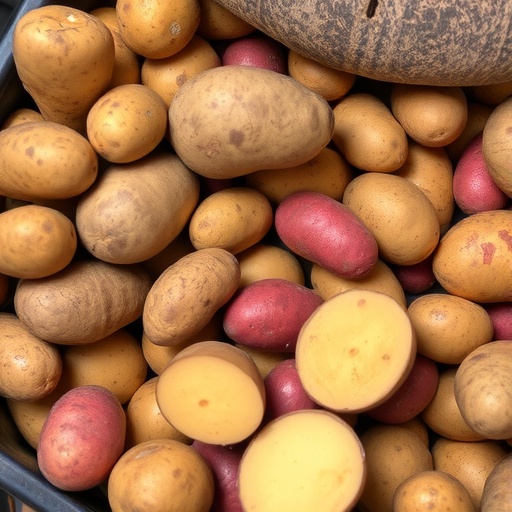
A groundbreaking study emerging from the collaborative efforts of evolutionary scientists at UCLA and the University at Buffalo has illuminated a fascinating chapter in human genomic adaptation, specifically among Indigenous Andean populations. This research, recently published in the prestigious journal Nature Communications, reveals that these high-altitude inhabitants possess an unusually high number of copies of the salivary amylase gene, AMY1, a crucial genetic component facilitating starch digestion. Intriguingly, this genetic trait appears to have been shaped by natural selection in response to profound dietary and environmental shifts occurring between 6,000 and 10,000 years ago, coinciding with the domestication of the potato in the Andean highlands.
The enzyme salivary amylase, encoded by the AMY1 gene, initiates the breakdown of starch into simpler sugars beginning in the oral cavity, an early and efficient step in carbohydrate digestion. The heightened copy number of AMY1 among Andean populations, averaging around 10 copies per genome, far exceeds that observed in most other global populations. This genomic architecture provides these individuals with enhanced starch-processing capabilities, likely conferring a significant survival and reproductive advantage during periods when starch-rich tubers became dietary mainstays under the challenging conditions of high-altitude life.
Evolutionary anthropologist Abigail Bigham, who led the research at UCLA, describes this adaptation as a striking example of the interplay between cultural practices and biological evolution. The domestication of the potato, an integral starch source first cultivated by Indigenous individuals of the Andes, transformed local diets and set the stage for selective pressures that favored those with increased enzymatic capacity for starch metabolism. These pressures, intensified by the physiological demands of hypoxia inherent to high-altitude environments, contributed to the sculpting of the human genome in this unique ecological niche.
The research methodology was rigorous, involving the collection of DNA samples from Quechua-speaking Indigenous Peruvians, whose genomes were analyzed alongside vast datasets encompassing a diverse array of modern human populations. This comparative genomic approach enabled the team to detect statistically robust signals of natural selection acting on the AMY1 gene cluster specifically within Andean groups. The findings highlight an evolutionary mechanism wherein individuals possessing approximately 10 or more copies of AMY1 exhibited a survival or reproductive advantage estimated at around 1.24% per generation, a significant rate given the timescale involved.
Notably, the study adds nuance to our understanding of the temporal context of AMY1 gene copy number variation. While the initial duplication event that gave rise to multiple AMY1 copies predates modern humans by hundreds of thousands of years—occurring at least 800,000 years ago—the selective enrichment of higher copy numbers within Andean populations is a relatively recent phenomenon. This enrichment likely coincided with the Neolithic agricultural revolution in the region, underscoring the profound influence of subsistence strategies on genomic evolution.
Omer Gokcumen, a co-corresponding author from the University at Buffalo, emphasizes the broader implications of this research. It exemplifies a rare and compelling instance where the direct effect of diet-induced natural selection can be measured and quantified at the genetic level, providing a model for understanding how human genomes continue to evolve in response to cultural innovations related to food production and consumption.
Understanding the genetic variation in AMY1 also sheds light on current human metabolic diversity and potential health impacts. Variability in amylase production influences digestive efficiency and may modulate the gut microbiome, affecting metabolic processes and susceptibility to diet-related diseases. This research invites further inquiry into gene-diet interactions and their ramifications for public health, particularly as global diets become increasingly homogenized with the ubiquity of processed, carbohydrate-rich foods such as French fries.
One particularly challenging aspect addressed by the researchers was disentangling the impact of natural selection from demographic effects introduced by European colonization, which dramatically reduced Indigenous population sizes and genetic diversity in the Americas. Employing state-of-the-art ultra-long DNA sequencing technologies and sophisticated statistical models allowed the team to conclusively attribute the heightened AMY1 copy numbers to ancient selection pressures rather than recent population bottlenecks.
The evolutionary narrative uncovered by this study reprises the concept that evolution is not an instantaneous engineer but a sculptor of pre-existing variation, gradually favoring advantageous traits across generations. The higher AMY1 copy number in modern Andean populations is thus the cumulative legacy of selective forces acting over millennia, favoring individuals capable of more efficient starch digestion amid an environment dominated by cold, hypoxia, and limited dietary resources.
Furthermore, the findings challenge simplistic notions within popular dietary discourse, such as the ‘paleo diet,’ which posits that human metabolism is optimized solely for Paleolithic-era foods predating agriculture. Instead, this work compellingly illustrates that human genetic adaptation is ongoing, incorporating evolutionary responses to post-agricultural dietary shifts within the relatively recent 10,000-year frame, thereby broadening our understanding of metabolic flexibility and resilience.
Beyond the scientific novelty, this research invites a re-examination of how cultural heritage and environmental constraints intersect to mold human biology. The Andean example underscores that cultural innovations—like potato cultivation—are not merely anthropological curiosities but active drivers of genetic change, reinforcing the co-evolutionary dance of humans and their ecosystems.
The extensive international collaboration underpinning this study involved experts from institutions spanning the Americas and Eurasia, reflecting the global relevance and interdisciplinary nature of contemporary evolutionary genomics. Supported by prominent funding bodies including the National Science Foundation, the National Institutes of Health, and the Leakey Foundation, this research not only enriches academic knowledge but also holds promise for informing medical and nutritional science in diverse populations.
As we move deeper into the era of precision medicine and personalized nutrition, insights gleaned from such evolutionary studies will be invaluable. Investigating the genetic determinants of dietary adaptation offers pathways to understanding differential health outcomes and tailoring interventions that respect both our genomic diversity and cultural identities. The story of the AMY1 gene in the Andes is a testament to the intricate and dynamic relationship between humans and their sustenance.
News Publication Date: February 13, 2024
Web References:
- https://pubmed.ncbi.nlm.nih.gov/39882941/
- https://www.buffalo.edu/news/releases/2024/10/our-love-of-carbs-predate-agriculture-and-maybe-even-our-split-from-Neanderthals.html
References: Published in Nature Communications
Cite Scienmag News
Juliet Wilcox. (May 5, 2026). Indigenous Andeans’ Digestive Superpower Possibly Connected to Potatoes, Researchers Say. Scienmag. https://scienmag.com/indigenous-andeans-digestive-superpower-possibly-connected-to-potatoes-researchers-say/
Juliet Wilcox. "Indigenous Andeans’ Digestive Superpower Possibly Connected to Potatoes, Researchers Say." Scienmag, 5 May 2026, https://scienmag.com/indigenous-andeans-digestive-superpower-possibly-connected-to-potatoes-researchers-say/. Accessed 3 September 2026.
Juliet Wilcox. "Indigenous Andeans’ Digestive Superpower Possibly Connected to Potatoes, Researchers Say." Scienmag. May 5, 2026. https://scienmag.com/indigenous-andeans-digestive-superpower-possibly-connected-to-potatoes-researchers-say/


