


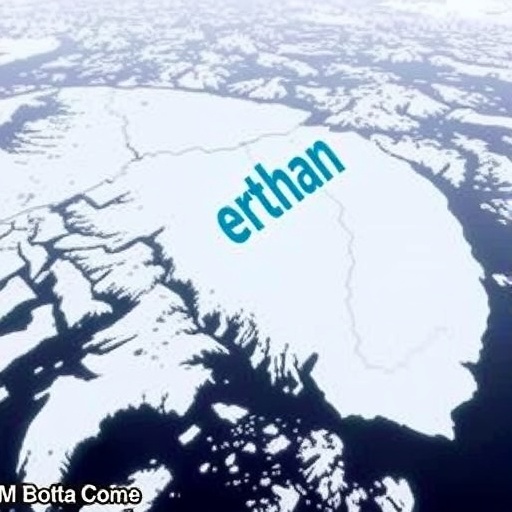
In a groundbreaking study published in Nature Geoscience, researchers have unveiled compelling evidence of methane emissions emanating from beneath the Greenland Ice Sheet, shedding new light on subglacial carbon cycling and its implications for climate change. Methane, a potent greenhouse gas, has been detected at glacier margins worldwide, yet its sources and dynamics beneath glaciers have remained elusive. This research, based on extensive sampling of meltwater streams along the western margin of Greenland’s ice sheet, reveals intricate details about the age, origin, and sustained release of subglacial methane, painting a picture of past ice sheet behavior with profound consequences for future climate models.
The team conducted a comprehensive survey involving 26 meltwater streams fed by subglacial channels beneath the Greenland Ice Sheet. These streams, which carry meltwater saturated with methane, were analyzed using radiocarbon dating techniques to determine the age of the biogenic methane. Intriguingly, the methane was found to be between 1.5 and 4.4 thousand years old, indicating its origin during the mid-Holocene period—a time of significant climatic warmth known as the Holocene Thermal Maximum. This discovery implies that methane emissions captured today originated from organic matter that accumulated in the proglacial environment when the ice sheet was smaller than it is presently.
The evidence paints a dynamic picture of the Greenland Ice Sheet’s past, suggesting that during the Holocene Thermal Maximum, retreating ice exposed land that allowed organic matter to build up. As the climate cooled and glaciers advanced again, this organic matter became buried beneath the ice, setting the stage for microbial processes deep beneath the glacier to produce methane that now escapes laterally through meltwater channels. This biogenic methane is supersaturated in the meltwaters emerging at the glacier margins, implying that subglacial microbial communities remain active and continue to transform ancient carbon stocks into methane.
Methane production beneath glaciers is mediated primarily by microbial communities that thrive in anoxic, water-saturated sediments. These microbes metabolize the buried organic carbon, transforming it into methane in a process potentially sustained over millennia. The Greenland case study demonstrates that the ice sheet can preserve and protect these carbon reservoirs under its vast ice cover, maintaining conditions conducive to methane generation. Moreover, the continuous lateral export of methane in meltwater discharge suggests that these subglacial ecosystems are not static but respond dynamically to ice sheet fluctuations and thermal regimes.
Researchers employed a sophisticated continuum degradation model to estimate the longevity and flux of methane release from western Greenland’s subglacial environment. Their results indicate that organic matter beneath this region can support methane emissions for another 200 years under current conditions. The annual methane flux reaching the atmosphere through these meltwater streams is estimated at approximately 715 tonnes, with a probable range between 481 and 1,020 tonnes. This significant lateral flux underscores the Greenland Ice Sheet’s role as an active source of greenhouse gases, a factor not fully incorporated into prevailing ice sheet and climate models.
The isotopic signatures of the methane played a crucial role in distinguishing the sources and transformation pathways of the gas. The team’s isotopic analyses confirmed the biogenic origin of the methane, contrasting it with thermogenic sources or atmospheric contamination, thereby enhancing the robustness of their conclusions. Isotopic assessments serve as molecular fingerprints revealing the metabolic pathways fueling methane production, which hinge on the availability and decomposition of ancient organic material.
This study reframes the Greenland Ice Sheet not just as a passive reservoir locked in ice, but as an ecosystem with active biogeochemical processes influencing atmospheric greenhouse gas concentrations. As glaciers melt and retreat in response to ongoing climate warming, the exposure and mobilization of subglacial carbon stocks could accelerate. The findings raise questions about feedback mechanisms whereby subglacial methane emissions may amplify warming trends, potentially compounding the challenges posed by ice sheet loss and sea-level rise.
While much attention has been focused on carbon dioxide emissions from thawing permafrost and terrestrial ecosystems, methane release from subglacial environments is an underappreciated component of the Earth’s carbon cycle. This research emphasizes the necessity of integrating these sources into global climate projections. Subglacial methane fluxes, although smaller in magnitude than some terrestrial sources, have distinct temporal dynamics linked to ice sheet history and meltwater pathways, requiring refined representation in models to improve predictive accuracy.
Of particular importance is the recognition that glacial environments worldwide—beyond Greenland—may harbor similar processes and methane reservoirs. This suggests the need for expanded investigations of other ice sheets and glaciers to evaluate their collective impact on methane budgets. The methodology and findings presented here establish a template for future research and monitoring, combining geochemical analysis with hydrological and sedimentological insights.
This work also underscores the profound interconnectedness between climate change, cryospheric dynamics, and microbial ecology. The coupling between ice sheet fluctuations and subglacial microbial metabolism emerges as a pivotal factor in understanding long-term greenhouse gas cycles. As glacier margins shift, new microbial habitats form, altering methane production and release. The study encourages interdisciplinary collaboration between glaciologists, microbiologists, and climate scientists to unravel these complexities.
In conclusion, the study by Hatton and colleagues delivers a transformative perspective on the Greenland Ice Sheet’s role in past and present carbon cycling. The mid-Holocene release of ancient methane preserved beneath the ice provides tangible evidence of ice sheet retreat and organic matter burial during a period of warmer climate. The ongoing methane flux observed today signals the persistence of this legacy and points to emerging challenges in quantifying the cryosphere’s feedback to global warming. This research not only deepens scientific understanding but also calls for urgent attention to the silent but potent influence of subglacial methane emissions in a rapidly warming world.
Cite Scienmag News
Violet Maxwell. (May 5, 2026). Mid-Holocene Greenland Ice Sheet Retreat Revealed by Methane. Scienmag. https://scienmag.com/mid-holocene-greenland-ice-sheet-retreat-revealed-by-methane/
Violet Maxwell. "Mid-Holocene Greenland Ice Sheet Retreat Revealed by Methane." Scienmag, 5 May 2026, https://scienmag.com/mid-holocene-greenland-ice-sheet-retreat-revealed-by-methane/. Accessed 7 September 2026.
Violet Maxwell. "Mid-Holocene Greenland Ice Sheet Retreat Revealed by Methane." Scienmag. May 5, 2026. https://scienmag.com/mid-holocene-greenland-ice-sheet-retreat-revealed-by-methane/


