


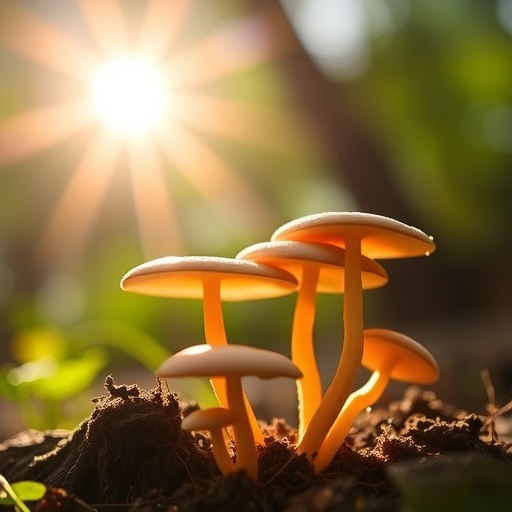
In a significant breakthrough emerging from McGill University, researchers have identified the precise ultraviolet (UV) light exposure parameters that optimize the enhancement of vitamin D₂ in edible mushrooms. This discovery overturns earlier assumptions that longer or more intense UV exposure necessarily yields better nutritional outcomes. Instead, their detailed meta-analysis demonstrates that moderate UV treatment achieves maximum vitamin D₂ synthesis without degrading the mushrooms’ nutritional quality or sensory attributes such as texture and color. These findings not only provide a standardized, quantifiable framework for mushroom biofortification but also promise to combat the widespread global issue of vitamin D deficiency.
Vitamin D deficiency affects an estimated 30 to 50 percent of the worldwide population, contributing to numerous health problems ranging from weakened bone density to impaired immune function. Mushrooms, which naturally contain ergosterol—a precursor to vitamin D—have long been known to produce vitamin D₂ upon UV irradiation. However, previous attempts to harness this phenomenon have been hampered by inconsistent methodologies, creating a fragmented landscape of outcomes. Addressing this, the McGill team conducted a rigorous meta-analysis, aggregating data from 22 peer-reviewed studies published between 2020 and 2025. Their approach used response surface methodology to statistically model the interaction between UV intensity, exposure duration, dosage, and mushroom morphology, enabling the delineation of an optimal treatment “zone.”
According to Professor Valérie Orsat, a co-author of the study and an expert in Bioresource Engineering, this research fills a major knowledge gap by prescribing species-specific UV exposure guidelines. “While it’s well-established that UV light can enhance mushroom nutrition, the absence of standardized protocols has prevented consistent industrial application,” Orsat explains. The researchers emphasize that exceeding the recommended exposure thresholds results in nutrient degradation or a plateau effect, where vitamin D₂ levels no longer increase despite prolonged irradiation. Such overexposure also negatively impacts mushroom color and texture — critical factors influencing consumer acceptance and marketability.
The safety and efficacy of UV-treated mushrooms have also secured validation from regulatory bodies such as the U.K. Food Standards Agency and Food Standards Scotland, which have officially recognized treated mushrooms as safe for consumption. Earlier human clinical studies corroborate the nutritional benefits by demonstrating measurable increases in serum vitamin D levels following consumption of UV-enhanced mushrooms. This scientific consensus now enables producers to incorporate tailored UV treatment steps within mushroom processing lines, improving the health profile of a widely consumed foodstuff without compromising taste or appearance.
Central to this advancement is the sophisticated statistical modeling deployed in the meta-analysis. By carefully correlating diverse experimental variables across studies, the researchers identified a clear “safe and optimal treatment zone” for each mushroom species analyzed. This zone balances maximizing vitamin D₂ production while preserving the organoleptic qualities that consumers expect. The level of precision achieved in defining UV dose-response curves marks a new era in mushroom biofortification, moving beyond trial-and-error to data-driven optimization that industries can reliably implement.
Looking ahead, the McGill research team plans to expand the scope of light-based biofortification techniques beyond UV radiation. Emerging evidence suggests that other wavelengths, particularly in the blue and green light spectra, can influence the production and stability of a broader array of bioactive compounds in mushrooms. Augustine Edet Ben, a PhD candidate and co-author, highlighted this as the future direction: “We intend to explore synergistic light treatments that extend beyond vitamin D₂ enhancement to improve overall nutrient density, functional metabolite profiles, and shelf-life performance from cultivation to storage.”
Such integrated lighting approaches could revolutionize the mushroom industry by enabling precise control over nutritional and sensory qualities throughout the supply chain. Strategically programmed light regimens applied during cultivation, post-harvest processing, and retail display could yield products that are not only safer and more nutritious but also more visually appealing and longer-lasting. This research sets the foundation for scalable, standardized light-based technologies that can be adopted globally, addressing consumer demand for functionally enhanced foods and contributing to public health nutrition.
In summary, the meta-analytic study titled “UV-Induced Nutritional Transformation of Mushrooms: From Molecular Shifts to Health Outcomes” offers a comprehensive blueprint for harnessing UV light in mushroom biofortification. By identifying optimal UV exposure conditions and elucidating the mechanistic underpinnings of nutrient synthesis and degradation, it provides an indispensable resource for both researchers and the fungal food industry. With vitamin D deficiency remaining a critical health challenge worldwide, this advancement represents a promising, natural, and cost-effective solution with broad-reaching implications.
Beyond vitamin D, the potential integration of multi-wavelength light treatments suggests a burgeoning field of “light farming” that leverages photobiology to enhance the nutritional landscapes of edible fungi. Continuing this trajectory, the McGill team’s efforts symbolize a fusion of engineering, biochemistry, and food science, poised to innovate agricultural practices and elevate the functional value of mushrooms as nutrient-dense superfoods. This research offers a rare example of how meta-analytic precision can translate complex biochemical phenomena into practical applications that benefit global health.
The findings underscore the importance of interdisciplinary collaboration and data harmonization in addressing longstanding inconsistencies in food enhancement research. By bridging gaps between molecular biology, nutritional science, and engineering, the study highlights how optimized light treatments can be calibrated to species characteristics and consumer quality standards. This comprehensive understanding is critical as food industries look toward sustainable and health-oriented production methods in an era of increasing demand for nutrient-rich and environmentally conscious foods.
In conclusion, the pioneering meta-analysis conducted at McGill University presents a transformative approach to mushroom biofortification through carefully controlled UV light exposure. Its contributions rest not only on defining effective treatment parameters but also on providing a roadmap for future innovations utilizing light-based technologies. These advancements promise to improve global vitamin D status while maintaining the organoleptic qualities consumers expect, fostering a new generation of functional foods and reinforcing the vital role of edible mushrooms in human nutrition.
News Publication Date: 31-Mar-2026
Web References: DOI: 10.1016/j.foodres.2025.118235
References: The article is based on a meta-analysis of 22 studies published from 2020 to 2025.
Keywords
Food science, Food chemistry, Nutrition, Vitamin D, UV light treatment, Mushroom biofortification, Photobiology, Functional foods, Response surface analysis, Nutrient enhancement, Edible fungi, Nutritional science
Cite Scienmag News
Denise Maddox. (May 4, 2026). McGill Study Reveals Moderate UV Light Optimizes Vitamin D Levels in Edible Mushrooms. Scienmag. https://scienmag.com/mcgill-study-reveals-moderate-uv-light-optimizes-vitamin-d-levels-in-edible-mushrooms/
Denise Maddox. "McGill Study Reveals Moderate UV Light Optimizes Vitamin D Levels in Edible Mushrooms." Scienmag, 4 May 2026, https://scienmag.com/mcgill-study-reveals-moderate-uv-light-optimizes-vitamin-d-levels-in-edible-mushrooms/. Accessed 4 September 2026.
Denise Maddox. "McGill Study Reveals Moderate UV Light Optimizes Vitamin D Levels in Edible Mushrooms." Scienmag. May 4, 2026. https://scienmag.com/mcgill-study-reveals-moderate-uv-light-optimizes-vitamin-d-levels-in-edible-mushrooms/


