


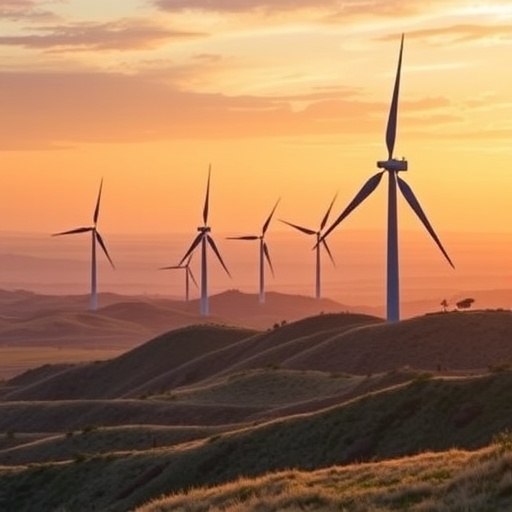
Wind energy stands as a cornerstone of Europe’s renewable energy ambitions, especially during winter months when electricity demand peaks. Despite this, wind power deployment faces significant expansion hurdles across many European regions. A central challenge is the frequent opposition from local communities whose concerns often revolve around the visual and aesthetic impact of wind turbines on cherished landscapes. This clash between the necessity for renewable energy and the preservation of scenic beauty has emerged as a pressing issue demanding sophisticated approaches that marry technological innovation with social acceptance.
Researchers from ETH Zurich and the Paul Scherrer Institute (PSI), under the guidance of Professor Russell McKenna, have embarked on an ambitious project to unravel the complexities underlying landscape beauty perceptions and integrate these insights into large-scale wind energy planning. The team’s work, presented in the journal Energy and AI, represents one of the most systematic attempts to date to analyze the interplay between wind energy development and landscape aesthetics across continental Europe.
Understanding landscape beauty has long been a notoriously subjective endeavor, shaped by diverse cultural, ecological, and personal factors. To bring rigor to this challenge, the research utilized a machine learning framework trained on an extensive crowdsourced dataset from Great Britain. This dataset included over 200,000 images of diverse landscapes, each scored by users on a scale from 1 to 10, providing a massive and nuanced repository of aesthetic judgements. Leveraging deep learning algorithms, the team identified key environmental features that strongly correlate with perceived scenic quality, revealing patterns hidden within the complexity of real-world landscapes.
Among the decisive factors influencing landscape beauty were types of land use, with glacial and rocky terrains emerging as highly rated scenic spaces. In contrast, intensive agricultural areas and settlement zones often received lower scores. Additionally, natural landscape quality, proximity to bodies of water, and the amount of sunlight emerged as critical variables positively affecting aesthetic perception. Such findings demonstrate how ecological characteristics profoundly affect human visual appreciation, and how these can be quantitatively embedded into predictive models.
Extending beyond national borders, the researchers applied their trained model to an expansive dataset covering all of Europe, resulting in the first high-resolution map depicting continental-scale scenicness. This pan-European mapping revealed diverse regional differences in landscape quality, providing planners with a geospatial tool to balance renewable energy development with conservation priorities. By integrating beauty metrics with wind resource assessments, the study provides invaluable guidance for siting wind turbines in ways that respect both environmental integrity and community values.
Notably, the incorporation of scenicness-based exclusions significantly reduces the available land suitable for wind power generation at the continental level. However, intriguingly, the overall cost of electricity produced remains broadly comparable to the European average. This is due to the spatial distribution of prime wind sites: many locations characterized by strong, consistent winds and accessible infrastructure fall outside territories considered highly scenic. Consequently, a significant proportion of electricity can be generated without compromising cherished landscapes, illustrating a promising pathway to reconcile ecological preservation with energy goals.
Despite these broad continental trends, the challenge grows acute upon closer inspection at regional scales. The study highlights “hotspots” such as the Alpine region and coastal Norway, where prime wind resources frequently overlap with areas esteemed for their natural beauty. In these locales, excluding scenic landscapes can drastically throttle wind energy potential and inflate generation costs due to the necessity of tapping into less efficient and more expensive sites. The iconic Swiss Alps serve as a prime example, where landscape conservation has contributed to persistent underutilization of promising wind resources.
The findings firmly indicate that large-scale, national, or European-wide planning frameworks are ill-equipped to resolve the intricate tensions between renewable energy infrastructure and visual landscape protection. Instead, the research advocates for finely tuned, hyper-localized planning strategies. Such approaches allow nuanced negotiations with local communities and enable tailored solutions responsive to specific geographic, cultural, and ecological contexts. This emphasis on localization marks a significant evolution in wind energy deployment philosophy, grounding technological expansion within the lived environment.
One practical measure discussed by the researchers to alleviate conflicts is “micro-siting,” a technique involving the careful positioning of individual turbines to minimize visual intrusion. By exploiting natural terrain features, such as situating turbines behind ridges or near existing infrastructures like power lines, planners can significantly reduce the landscape’s visual disruption. This refined siting approach not only preserves scenic value but also enhances social acceptance by demonstrating sensitivity to local priorities and perceptions.
Additionally, innovative turbine design adjustments hold potential to further diminish aesthetic impacts. Adaptations that allow wind turbines to blend seamlessly into the landscape palette—whether through color, form, or grouping strategies—could reduce their conspicuousness and visual footprint. Clustering turbines near existing infrastructure nodes has emerged as a preferred method for minimizing negative perceptions, signifying a practical synthesis of energy efficiency and landscape harmony.
While the study heralds an important step forward, its authors acknowledge some inherent limitations. The machine learning model’s training set, predominantly derived from British landscapes, may not fully capture the rich diversity of European biomes and land cover types. Consequently, some scenic characteristics unique to other regions might be underrepresented. Future research aims to expand the dataset by incorporating social media imagery and other sources from across Europe, thereby enhancing the model’s accuracy, representativeness, and robustness.
Beyond wind energy, the groundbreaking scenicness mapping framework has broad applicability across other critical infrastructure sectors. Alpine solar projects, grid expansions, and transportation networks could all benefit from integrating landscape beauty assessments into their planning matrices. This approach offers a promising avenue to advance infrastructure development while safeguarding the visual and ecological integrity that form a vital part of Europe’s cultural heritage.
In sum, this interdisciplinary work serves as a pioneering example of how artificial intelligence and large-scale data analytics can inform not just technological feasibility but also social and environmental dimensions of energy transition. By focusing on the visual relationship between humans and their environment, the researchers chart a path toward more sustainable, accepted, and harmonious renewable energy systems. Their findings emphasize that facilitating Europe’s green transformation requires solutions that are as sensitive to cultural landscapes as they are to wind maps and engineering models.
Efforts to harmonize wind energy development with landscape conservation are essential for securing public support and accelerating decarbonization targets. As the energy sector faces ever-increasing pressures to meet climate goals urgently, integrating aesthetic and social considerations provides a powerful tool for ensuring that the transition is inclusive and respectful of the natural environment. The research at ETH Zurich and PSI marks a crucial advance in this direction, opening new frontiers for energy planning that honor beauty as well as utility.
This study, augmented by contributions from the Jülich Research Centre in Germany, underscores the vital role of collaborative, cross-disciplinary research in addressing complex sustainability challenges. Its novel machine learning approach promises to inspire further innovation across policy, academia, and industry, helping to transform how renewable energy systems coexist with Europe’s treasured landscapes. As geopolitical dynamics and technological potentials evolve, culturally attuned, data-driven methodologies like this will become increasingly important foundations for shaping resilient and socially accepted energy futures.
Web References:
10.1016/j.egyai.2026.100752
Keywords
Wind energy, landscape aesthetics, scenicness mapping, machine learning, renewable energy planning, energy transition, artificial intelligence, onshore wind, sustainable infrastructure, social acceptance, micro-siting, landscape conservation
Cite Scienmag News
Faith Mcneil. (May 4, 2026). Harnessing Wind Energy Without Compromising Scenic Beauty: Advancing Sustainable Planning Strategies. Scienmag. https://scienmag.com/harnessing-wind-energy-without-compromising-scenic-beauty-advancing-sustainable-planning-strategies/
Faith Mcneil. "Harnessing Wind Energy Without Compromising Scenic Beauty: Advancing Sustainable Planning Strategies." Scienmag, 4 May 2026, https://scienmag.com/harnessing-wind-energy-without-compromising-scenic-beauty-advancing-sustainable-planning-strategies/. Accessed 3 September 2026.
Faith Mcneil. "Harnessing Wind Energy Without Compromising Scenic Beauty: Advancing Sustainable Planning Strategies." Scienmag. May 4, 2026. https://scienmag.com/harnessing-wind-energy-without-compromising-scenic-beauty-advancing-sustainable-planning-strategies/


