


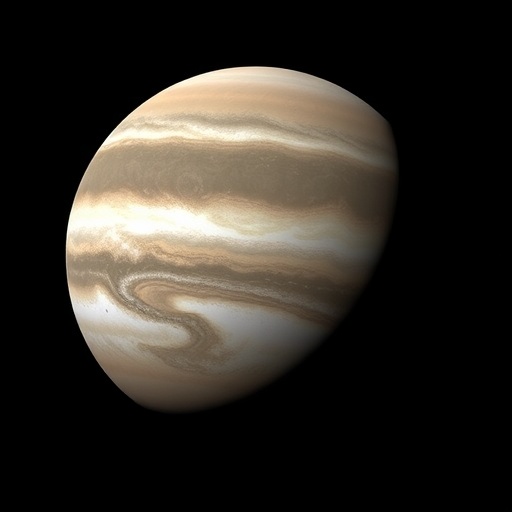
For over half a century, the scientific consensus on the size and shape of Jupiter, the largest planet in our solar system, has remained largely unchanged. Based on a mere six measurements from NASA’s Voyager and Pioneer missions in the 1970s, our understanding has now been revolutionized through cutting-edge data and analysis spearheaded by researchers at the Weizmann Institute of Science. Their groundbreaking study refines Jupiter’s dimensions with unprecedented precision, offering fresh insights into the giant planet’s atmospheric dynamics and interior structure.
Historically, measurements of Jupiter’s physical characteristics relied heavily on radio signals transmitted from early space probes flying past the planet. These initial missions provided a foundational dataset; however, the limited number of observations and the inherent challenges of measuring a dynamic gaseous giant meant uncertainties persisted. The latest research, led by Prof. Yohai Kaspi and a multinational team of scientists, harnesses the trove of data sent by NASA’s Juno spacecraft, which has orbited Jupiter since 2016. This represents the most comprehensive dataset ever used to assess Jupiter’s shape with an accuracy never before attained.
Juno’s unique orbital path, particularly following its mission extension in 2021, has enabled it to pass behind Jupiter relative to Earth—a vantage point unavailable to previous missions. When Juno is occulted by Jupiter, the planet’s dense atmosphere bends and partially blocks the spacecraft’s radio signals. By precisely monitoring how these radio waves are distorted, scientists glean detailed information about Jupiter’s atmospheric composition, density variations, and refractive properties. This interaction also provides crucial data on the planet’s radius, radius variation, and oblateness, leading to a refreshed and more accurate planetary profile.
The pioneering methodology emerged from the ingenuity of Maria Smirnova, a PhD student in Kaspi’s group, who devised advanced techniques to interpret Juno’s bending radio signals. Her work transformed raw communication data into refined maps delineating Jupiter’s atmospheric temperature gradients and density stratification. This approach illuminated that Jupiter is marginally smaller at its equator by approximately 8 kilometers and displays a greater flattening at the poles, about 24 kilometers more compressed, than previously recorded. Such subtle but significant differences call for updates in planetary science textbooks and models.
This refined planetary figure is not just an academic curiosity—it directly impacts our understanding of Jupiter’s internal dynamics. Dr. Eli Galanti, senior researcher on the team, emphasized that even small shifts in radius have notable consequences in modeling Jupiter’s interior. Accurate planetary dimensions help reconcile measurements of gravitational fields and atmospheric flows, ensuring that theoretical models mirror observational realities more closely. These adjustments provide a clearer portrayal of Jupiter’s density distribution and the depth of atmospheric motion beneath its iconic cloud tops.
One aspect largely neglected in earlier assessments was the influence of Jupiter’s powerful zonal winds. These super-rotating atmospheric jets reach immense speeds and extend deep into the planet’s interior layers. The current study incorporates these dynamic wind effects, resolving long-standing discrepancies between modeled and observed planetary properties. By accounting for the complex interaction between atmospheric winds and the planet’s shape, the researchers offer an integrated view of how Jupiter’s surface phenomena link to its vast, invisible interior.
Further investigations complementing this study demonstrated how Jupiter’s polar cyclones—immense, persistent storms encircling the planet’s poles—extend deep beneath the atmosphere. In related work recently published in the Proceedings of the National Academy of Sciences, Kaspi and co-researcher Nimrod Gavriel utilized Juno’s imaging and motion data to estimate the depth of these cyclonic systems. The vertical extension of these storms connects atmospheric layer observations with deeper planetary processes, offering new windows into the coupling of Jupiter’s atmosphere and interior.
The implications of these findings transcend Jupiter alone, informing the broader understanding of gas giant planets throughout the cosmos. Since Jupiter serves as the archetype for gas giants, precise measurements of its physical shape and atmospheric behavior enable better interpretations of distant exoplanets with similar characteristics. Refined models driven by accurate observational data enrich planetary formation theories and evolutionary pathways, fueling future explorations of planets outside our solar system.
The research also has significant bearings on planetary formation dynamics within our solar system. Jupiter’s status as the first planet to form gives it an outsized influence on solar system architecture. By unraveling the specifics of its inner composition and atmospheric dynamics, scientists obtain clues about the primordial environment from which Earth and its celestial neighbors emerged. Understanding Jupiter’s true shape helps decode how material accreted, differentiated, and evolved in the early solar nebula.
Looking ahead, the techniques developed for interpreting Juno’s data will be vital as the team advances their analysis of upcoming measurements from the European Space Agency’s JUICE (JUpiter ICy moons Explorer) mission, launched in 2023. The JUICE spacecraft carries state-of-the-art instruments designed by the Weizmann Institute that will probe Jupiter’s atmosphere and magnetosphere in even greater depth, promising to extend and refine our knowledge of the planet’s complex system.
This research represents a remarkable synergy of international expertise, featuring collaborators from institutions spanning Italy, the USA, France, and Switzerland. The study’s success underscores the collaborative spirit driving planetary science forward, combining advanced space missions, inventive data analysis, and sophisticated modeling to peel back the layers of the solar system’s largest planet.
Ultimately, by revising Jupiter’s size and shape with such precision, the Weizmann Institute-led team has opened new avenues for studying planetary atmospheres and interiors. The enhanced measurements allow scientists to refine theoretical models, better understand dynamic processes across gas giants, and pave the way for future discoveries about planetary systems both near and far. The dynamic, intricate portrait of Jupiter emerging now challenges previous assumptions and enriches our view of the planetary giants that populate the galaxy.
News Publication Date: 2-Feb-2026
Web References:
- https://www.nature.com/articles/s41550-026-02777-x
- https://www.nasa.gov/juno
- https://missionjuno.swri.edu/
- https://www.pnas.org/doi/10.1073/pnas.2503737122
- https://wis-wander.weizmann.ac.il/space-physics/across-universe-israeli-tech-reach-deep-space-first-time
References:
Kaspi et al., “The size and shape of Jupiter,” Nature Astronomy, 2026.
Kaspi and Gavriel, “Depth and dynamics of Jupiter’s polar cyclones,” Proceedings of the National Academy of Sciences, 2025.
Cite Scienmag News
Grant Pearson. (April 30, 2026). Slimmer Silhouette of Giant Planet Revealed. Scienmag. https://scienmag.com/slimmer-silhouette-of-giant-planet-revealed/
Grant Pearson. "Slimmer Silhouette of Giant Planet Revealed." Scienmag, 30 April 2026, https://scienmag.com/slimmer-silhouette-of-giant-planet-revealed/. Accessed 1 September 2026.
Grant Pearson. "Slimmer Silhouette of Giant Planet Revealed." Scienmag. April 30, 2026. https://scienmag.com/slimmer-silhouette-of-giant-planet-revealed/


