


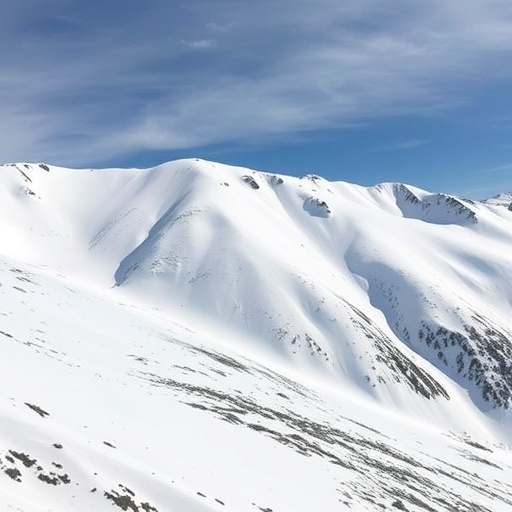
Renowned for its picturesque landscapes and vital freshwater resources, the mountainous regions of Greece are confronting a stark environmental transformation with snow cover diminishing drastically over the past forty years. This extensive reduction threatens the hydrological systems that sustain agriculture, communities, and ecosystems, particularly as the Mediterranean endures increasingly dry summers. Recent research spearheaded by the University of Cambridge sheds light on these alarming changes, revealing an unprecedented decline exceeding 50 percent in snow accumulation on Greece’s highest massifs, a deterioration largely attributed to regional warming.
Employing an innovative convergence of satellite data, climate records, topographic analyses, and advanced artificial intelligence, the international research team developed a cutting-edge tool named snowMapper to rigorously assess the spatiotemporal variations in snow cover from 1984 through 2025. This AI-driven approach fills pervasive observational gaps caused by cloud cover and shadows, providing daily high-resolution snow cover maps at 100-meter accuracy. The sophistication of their model lies in its training on comprehensive ground-truth snow observations from more extensively monitored European ranges, such as the Alps and Pyrenees, reinforcing its reliability in the less instrumented Greek context.
The study’s findings, recently published in the prestigious journal The Cryosphere, underscore a 58% contraction in snow cover, signaling not only a quantitative loss but also a qualitative shift in seasonal snow dynamics. The snow season’s onset has steadily delayed while its cessation has expedited, effectively shortening critical periods during which snowpack functions as a vital reservoir. This temporal compression exacerbates water scarcity during peak demand months, intensifying pressure on natural and human systems alike.
Central to these dynamics is the clear linkage between rising ambient temperatures and snow diminution, as identified by the researchers. Contrary to assumptions about precipitation decline, the volume of incoming moisture has remained relatively stable; however, the warming climate alters its phase, driving more precipitation towards rainfall rather than snow even at traditionally snowy altitudes. This shift undermines the slow-release hydrological benefits snow provides, accelerating downstream ecosystem exposure to fluxes and deficits.
Konstantis Alexopoulos, the study’s lead author from Cambridge’s Scott Polar Research Institute, eloquently analogizes snow’s role to a savings account where gradual melting functions as sustained withdrawal rather than an immediate expenditure. This analogy illustrates the fundamental hydrological importance of snowpack in buffering seasonal water supplies, mitigating drought risk, and stabilizing water resource availability for diverse uses such as irrigation, domestic consumption, and hydropower production.
The methodological rigor of the study extends beyond remote sensing, incorporating European climate datasets and digital terrain models to predict snow presence on days obscured by weather. Their machine learning framework assimilated a wide array of climatic and orographic parameters—including temperature variability, precipitation input, elevation gradients, and antecedent snow conditions—to faithfully reconstruct historical snow distributions. Such integration demonstrates the transformative potential of AI in resolving long-standing spatial and temporal data voids in cryospheric research.
Significantly, the accuracy of snowMapper’s depictions in Greek mountain ranges despite partial reliance on external training datasets indicates the model’s adaptability, suggesting it could fill data gaps in mountainous regions globally where sparse observation networks hinder comprehensive climate impact assessments. This robustness offers an important new capability for monitoring vulnerable, data-deficient ecosystems confronting climate perturbations.
The implications of these findings are profound, revealing Greece as disproportionately affected compared to other European mountain systems. This heightened susceptibility is linked to the Mediterranean’s unique climatic conditions, marginal winter temperatures hovering near freezing, and relatively modest watershed sizes, all of which amplify the hydrological consequences of even modest snow cover changes. The cascading effects to agriculture, natural ecosystems, and human livelihoods place this landscape at the nexus of climate vulnerability hotspots.
Professor Ian Willis, co-author and expert from Cambridge’s Scott Polar Research Institute, emphasized the critical temperature controls on snowfall composition and retention time, explaining that rising thermal baselines not only curtail snow accumulation but also accelerate melt rates. This dual pressure compresses the availability window for snowmelt water, disrupting established seasonal hydrological cycles and challenging adaptive water management strategies.
As the snowpack diminishes, the natural buffering capacity against Mediterranean summer droughts weakens, exposing water systems to greater volatility. This trend acts as a robust indicator of broader climate stress within sensitive mountain environments worldwide. By quantifying the extent and drivers of snow loss, the study provides foundational scientific knowledge essential for anticipating future water security challenges under warming scenarios.
Looking ahead, the research team aims to extend their analysis to quantify volumetric water changes within the hydrological system, bridging snow cover trends with river discharge, groundwater levels, and reservoir stocks. Such integration will refine projections for regional water availability towards the latter half of the 21st century, offering critical insights for policymakers and resource managers facing mounting climate pressures.
This transformative study brings together expertise from international institutions including the British Antarctic Survey, the National Observatory of Athens, and the Hellenic Mountain Observatory, reflecting a concerted global effort to unravel complex cryospheric phenomena in understudied regions. Funded by esteemed organizations such as the Bodossaki Foundation and the Royal Geographical Society, the research strengthens the nexus between advanced climate science, AI innovation, and environmental stewardship.
The revelations emanating from Greek mountains serve as a clarion call highlighting the urgent need to integrate climate adaptation into regional water governance. As temperatures continue their inexorable rise, the Mediterranean’s iconic snow-capped peaks face an uncertain future, fundamentally reshaping not just landscapes but the livelihoods and ecosystems they sustain.
News Publication Date: 30-Apr-2026
Web References: DOI link to article
Cite Scienmag News
Alan Morgan. (April 30, 2026). Study Reveals Snow Cover on Greek Mountains Has Declined by Over 50% in Four Decades. Scienmag. https://scienmag.com/study-reveals-snow-cover-on-greek-mountains-has-declined-by-over-50-in-four-decades/
Alan Morgan. "Study Reveals Snow Cover on Greek Mountains Has Declined by Over 50% in Four Decades." Scienmag, 30 April 2026, https://scienmag.com/study-reveals-snow-cover-on-greek-mountains-has-declined-by-over-50-in-four-decades/. Accessed 1 September 2026.
Alan Morgan. "Study Reveals Snow Cover on Greek Mountains Has Declined by Over 50% in Four Decades." Scienmag. April 30, 2026. https://scienmag.com/study-reveals-snow-cover-on-greek-mountains-has-declined-by-over-50-in-four-decades/


