


A rose by any other name is a rose, but what of a crystal? Osaka Metropolitan University-led researchers have found that single crystals of four anthracene derivatives with different substituents react differently when irradiated with light, perhaps holding clues to how we can use such materials in functional ways.

Credit: Osaka Metropolitan University
A rose by any other name is a rose, but what of a crystal? Osaka Metropolitan University-led researchers have found that single crystals of four anthracene derivatives with different substituents react differently when irradiated with light, perhaps holding clues to how we can use such materials in functional ways.
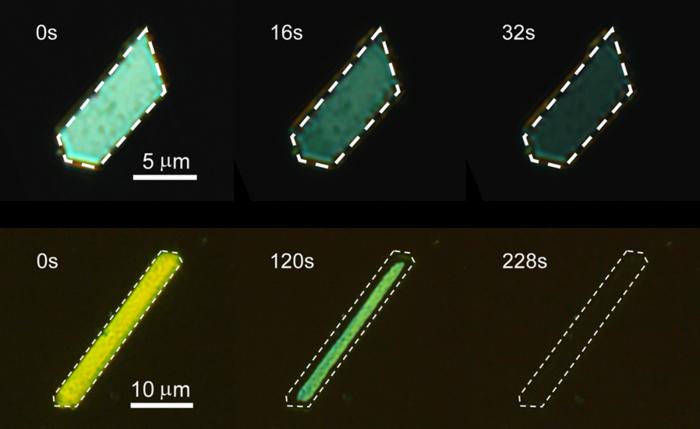
Graduate student Sogo Kataoka, Dr. Daichi Kitagawa, a lecturer, and Professor Seiya Kobatake of the Graduate School of Engineering and colleagues compared the photoreactions of the single crystals when the entire anthracene crystal was irradiated with light.
For two of the anthracene derivatives, the photoreaction proceeds uniformly throughout the crystal. For the other two, the photoreaction proceeds non-uniformly from the edge to the center of the crystal. The research team also found that in non-uniform photoreactions, the molecules must rotate significantly during the process, so the reaction proceeds from the edge of the crystal where sufficient rotational space is available.
“If we can control the arrangement and reactivity of molecules in crystals based on the findings of this research, it will be possible to make reactions proceed in a spatially selective manner and induce photoreactions only at the desired location,” Dr. Kitagawa explained. “In the future, we aim to shine a light on more detailed factors by conducting 3D simulations and design functional materials that can exhibit arbitrary behavior.”
The findings were published in Chemical Science.
###
About OMU
Established in Osaka as one of the largest public universities in Japan, Osaka Metropolitan University is committed to shaping the future of society through “Convergence of Knowledge” and the promotion of world-class research. For more research news, visit and follow us on social media: X, Facebook, Instagram, LinkedIn.
Journal
Chemical Science
Method of Research
Experimental study
Subject of Research
Not applicable
Article Title
Relationship between spatially heterogeneous reaction dynamics and photochemical kinetics in single crystals of anthracene derivatives
Article Publication Date
26-Jul-2024
COI Statement
There are no conflicts to declare.
Cite Scienmag News
Bethany Barker. (July 26, 2024). Shining light on similar crystals reveals photoreactions can differ. Scienmag. https://scienmag.com/shining-light-on-similar-crystals-reveals-photoreactions-can-differ/
Bethany Barker. "Shining light on similar crystals reveals photoreactions can differ." Scienmag, 26 July 2024, https://scienmag.com/shining-light-on-similar-crystals-reveals-photoreactions-can-differ/. Accessed 4 September 2026.
Bethany Barker. "Shining light on similar crystals reveals photoreactions can differ." Scienmag. July 26, 2024. https://scienmag.com/shining-light-on-similar-crystals-reveals-photoreactions-can-differ/

