


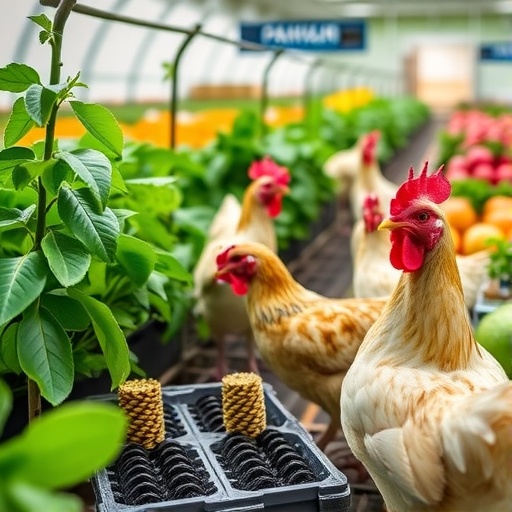
In recent years, the rise of antibiotic-resistant bacteria has emerged as a formidable challenge to global public health, with foodborne pathways increasingly recognized as critical conduits for transmission. A newly published study in Science in One Health introduces an innovative quantitative microbial risk assessment (QMRA) model that meticulously traces the journey of extended-spectrum β-lactamase (ESBL)-producing Escherichia coli from broiler litter application on farms to contamination of fresh lettuce, ultimately quantifying human health risks linked to consumption. This integrated, mechanistic framework reveals previously unseen connections within environmental compartments, offering actionable insights to curtail the dissemination of these resistant pathogens in agricultural systems.
The cornerstone of this research lies in bridging a knowledge gap about the intricate routes by which ESBL-producing E. coli—a subset of antibiotic-resistant strains capable of neutralizing a broad array of β-lactam antibiotics—transfers from poultry farming waste to ready-to-eat produce. Traditional assessments often considered these exposure points in isolation; however, by constructing a comprehensive, modular QMRA model, the study succeeds in capturing the dynamic interplay between farm management practices, soil microbiota, riverine ecosystems, and consumer behaviors. Such integration is pivotal in understanding how microbial populations persist, propagate, and pose risks throughout the agri-food continuum.
Delving deeper, broiler litter, a byproduct of intensive poultry production rich in nutrients yet laden with antibiotic residues and resistant bacteria, represents a focal contamination source. Upon land application as fertilizer, these residues facilitate the survival and movement of ESBL-producing E. coli within soil matrices, leading to eventual runoff or leaching into adjacent water bodies. The research quantifies bacterial loads at various stages, identifying a range of 1.7 to 7.6 × 10⁻³ colony-forming units (CFU) per 100 grams of fresh lettuce harvested from fields irrigated with such contaminated water, thereby affirming produce as a non-negligible reservoir for human exposure.
This minute bacterial presence belies its potential to influence public health substantially. Employing dose-response relationships grounded in epidemiological and microbiological studies, the QMRA translates environmental contamination into probabilistic infection risks. Specifically, it estimates urinary tract infection (UTI) risks attributable to ESBL-producing E. coli ingestion span from 4.6 × 10⁻¹² to 9.0 × 10⁻⁹ per serving, figures deceptively low but with profound implications when aggregated over large populations. Corresponding disability-adjusted life years (DALYs) highlight the incremental health burden, underscoring the necessity for proactive control measures.
The study’s sensitivity analyses illuminate soil-water partitioning coefficients and environmental decay rates as pivotal parameters dictating bacterial fate and transport. These factors govern bacterial persistence in soil and degradation in aqueous environments, modifying contamination profiles at the root level of human risk. Adjusting these ecological and physicochemical variables itself is challenging, which elevates the importance of overlaying practical intervention strategies within the corridors of microbial transmission.
Among intervention tactics, the efficacy of household washing emerges as a compelling discovery. Experimental simulations and model outputs concur that standard produce washing protocols achieve approximately 90% reduction in ESBL-producing E. coli loads on lettuce surfaces. This relatively simple consumer practice substantially mitigates exposure risk, emphasizing the power of behavioral interventions in complementing agricultural management reforms.
Equally consequential is the finding that extending the interval between broiler litter application and lettuce planting attenuates bacterial transfer substantially. This temporal buffer allows natural bacterial die-off processes in soil to diminish pathogen loads before crop uptake, addressing contamination at its source. The quantification of this delay’s impact equips growers and policymakers with evidence-based guidelines to optimize fertilizer schedules without compromising agronomic productivity.
This comprehensive model’s novelty also lies in its capability to simulate cumulative exposure pathways rather than discrete contamination nodes. By capturing the sequential transfer from litter to soil, riverine water, and finally edible produce, it integrates environmental microbiology with human risk assessment on an unprecedented scale. This holistic perspective transcends traditional siloed approaches, inviting a paradigm shift in tackling antimicrobial resistance (AMR) within food systems.
Moreover, these findings resonate within the broader context of One Health, a multidisciplinary framework recognizing the interdependence of human, animal, and environmental health. The manufactured convergence of resistant bacteria across ecosystem interfaces demands synchronized interventions spanning agricultural practice regulations, water quality monitoring, and consumer education. The adaptability and modular design of this QMRA platform position it as a versatile tool to evaluate various pathogens and commodities, enhancing its utility for global food safety challenges.
As antibiotic resistance escalates, compromises in treatment efficacy increasingly threaten healthcare outcomes worldwide. Foodborne dissemination channels such as the broiler-litter-to-lettuce pathway presented here exemplify critical, actionable reservoirs of resistance genes. By elucidating these mechanistic routes and quantifying associated human health burdens, this study pioneers an evidence-based foundation for mitigating AMR transmission to consumers, thereby reinforcing the integrity of the food supply chain and safeguarding public health.
The translation of such sophisticated modeling into practical applications requires multi-stakeholder collaboration and policy integration. Effective manure management protocols informed by these insights could significantly reduce bacterial reservoirs in agroecosystems. In parallel, reinforcing the implementation of routine irrigation water monitoring enhances early detection of pathogen incursion into croplands. Finally, amplifying public awareness about safe produce handling bridges the last mile of risk mitigation, converting scientific understanding into tangible health improvements.
In summation, the study serves as a clarion call to recognize and address the silent yet consequential journey of ESBL-producing E. coli within food production landscapes. Integrative QMRA models, such as the one unveiled here, embody the frontier of microbiological risk science—employing technical rigor to illuminate microbial pathways and inform strategically layered interventions. As humanity grapples with the antibiotic resistance crisis, such pioneering research charts essential routes toward resilient, safe food systems that protect consumers from invisible microbial threats.
News Publication Date: 11-Mar-2026
Web References: DOI: 10.1016/j.soh.2026.100152
Cite Scienmag News
William Thompson. (April 29, 2026). Tracing the Journey of Antibiotic-Resistant Bacteria: From Poultry Farms to Fresh Produce. Scienmag. https://scienmag.com/tracing-the-journey-of-antibiotic-resistant-bacteria-from-poultry-farms-to-fresh-produce/
William Thompson. "Tracing the Journey of Antibiotic-Resistant Bacteria: From Poultry Farms to Fresh Produce." Scienmag, 29 April 2026, https://scienmag.com/tracing-the-journey-of-antibiotic-resistant-bacteria-from-poultry-farms-to-fresh-produce/. Accessed 2 September 2026.
William Thompson. "Tracing the Journey of Antibiotic-Resistant Bacteria: From Poultry Farms to Fresh Produce." Scienmag. April 29, 2026. https://scienmag.com/tracing-the-journey-of-antibiotic-resistant-bacteria-from-poultry-farms-to-fresh-produce/


