


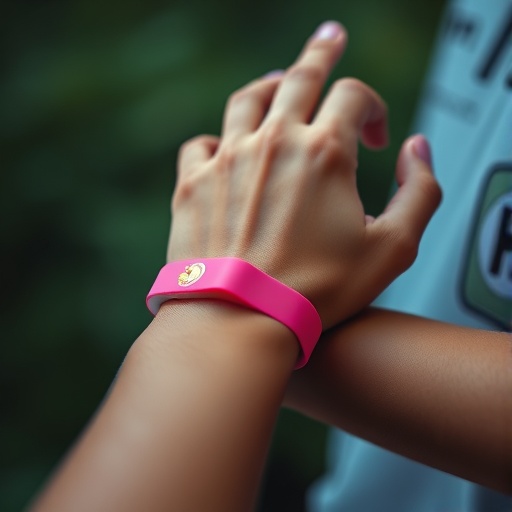
In recent years, the burgeoning field of personal environmental exposure assessment has witnessed a remarkable evolution in methodology, driven by increasingly sophisticated biosensing technologies. The latest breakthrough comes from a team of researchers led by Ferris, Riley, and Calero, whose 2026 study shines new light on the pervasive issue of phthalate exposure through an innovative combination of silicone wristbands and urinary biomarker analysis. This pioneering research, published in the Journal of Exposure Science and Environmental Epidemiology, offers fresh perspectives on how we can refine and personalize exposure measurement, potentially revolutionizing public health surveillance and regulatory science.
Phthalates, a class of commonly used plasticizers, are ubiquitous in consumer products and have raised concerns due to their endocrine-disrupting properties and potential links to various health problems including reproductive disorders and metabolic diseases. Their presence in everyday settings complicates accurate exposure assessments, which historically relied on environmental sampling or biomonitoring, each with inherent limitations. Environmental sampling can underestimate true personal exposure by failing to capture all exposure routes, while biomonitoring, typically through urinary biomarkers, though direct, presents challenges related to temporal variability and invasive sample collection.
Ferris and colleagues’ study introduces a promising approach that synergistically leverages silicone wristbands—worn continuously to passively adsorb ambient phthalates—and rigorous urinary biomarker quantifications. These dual modalities enable a more comprehensive and temporally resolved snapshot of phthalate exposure. Silicone wristbands possess unique physicochemical properties, making them excellent passive samplers for a broad range of semi-volatile organic compounds, including phthalates. Their ability to integrate exposure across various microenvironments renders them particularly attractive for real-world exposure assessment, as they capture not only inhalation but also dermal and incidental ingestion routes.
The research meticulously recruited participants from diverse demographic backgrounds, ensuring broad applicability of findings. Subjects were instructed to wear silicone wristbands for predefined durations while providing urine samples at intervals. Analytical chemistry techniques, including gas chromatography coupled with mass spectrometry, were employed to quantify individual phthalate metabolites in biological matrices and corresponding parent compounds in wristbands. This integrative strategy allowed the researchers to explore correlations between external exposure via the wristbands and internal dose reflected in urinary metabolites.
Initial findings revealed a significant concordance between the silicone wristband-derived phthalate concentrations and urinary biomarker levels, suggesting that wristbands serve as proxies for personal exposure. Interestingly, wristband data provided enhanced temporal resolution compared to spot urine samples, which often reflect acute exposure and suffer from temporal fluctuations. The research team also noted inter-individual variability in exposure profiles, which the wristband effectively captured, indicating its utility for personalized exposure assessment and potential for identifying exposure hotspots in individuals’ daily environments.
Beyond correlational analysis, the study interrogated the sensitivity and specificity of silicone wristbands compared to conventional biomonitoring. Results suggested that wristbands could detect lower-level exposures that might be missed by single biomarker measurements due to biological metabolism and excretion kinetics. This implies potential advantages in epidemiological studies aiming to link low-dose phthalate exposure with subtle health outcomes, where traditional biomonitoring might fall short due to exposure misclassification.
Ferris et al. also delved into the biochemical implications of their findings by examining how exposure patterns detected via wristbands align with known toxicodynamic behaviors of phthalates. Given that phthalates are metabolized rapidly and excreted within hours, the wristband’s ability to sample a cumulative environmental milieu over days provided a valuable integrative lens. This temporal integration overcomes the snapshot limitations of urine sampling, offering a stable metric against which physiological responses and health outcomes may be correlated in future longitudinal studies.
The approach developed in this study exemplifies a broader paradigm shift towards non-invasive, passive environmental sampling as a complement or alternative to traditional biospecimen collection. The simplicity and user compliance advantages of wristbands—being lightweight, unobtrusive, and requiring minimal participant burden—position them as ideal tools for large-scale population studies. Such scalability is crucial for advancing exposomic research, which seeks to characterize the totality of environmental exposures throughout the lifespan.
Moreover, the study’s multi-disciplinary approach, integrating environmental chemistry, toxicology, and epidemiology, underscores the potential for cross-sector collaboration in environmental health sciences. It paves the way for next-generation exposure monitoring frameworks that could inform personalized risk mitigation strategies and regulatory decision-making. Understanding personal exposure profiles with heightened accuracy and resolution may eventually translate into precision public health interventions tailored to unique environmental contexts.
The team also discussed potential limitations and challenges facing widespread adoption of silicone wristbands for exposure assessment. These include standardization of analytical protocols, understanding the kinetics of compound absorption to and desorption from wristband matrices, and ensuring the specificity of detected chemicals to personal versus ambient environments. Addressing such technical nuances is crucial to optimize data interpretation and comparability across studies and populations.
Future research directions proposed by Ferris and colleagues encompass expanding the chemical scope monitored by wristbands beyond phthalates to include other emerging contaminants such as flame retardants, pesticides, and volatile organic compounds. Additionally, integrating sensor technologies with wristbands could enable real-time monitoring and enhance data richness. Combining chemical exposure data with genomics and metabolomics may also unlock comprehensive insights into exposure-disease relationships.
This innovative study exemplifies the forward trajectory of exposure science, where synergy between novel passive sampling techniques and biomarker science fosters more accurate, comprehensive, and individualized exposure assessments. Such advancements hold promise not only for elucidating environmental determinants of health but also for empowering individuals and communities with actionable exposure knowledge. The work by Ferris et al. is thus a clarion call to embrace technological ingenuity in the quest to unravel the complex web of environmental influences shaping human health in the 21st century.
As scientific communities digest these findings, public health agencies and stakeholders may soon consider adopting silicone wristbands as complementary tools in exposure monitoring programs. This transition could catalyze the implementation of more nuanced exposure guidelines and interventions designed to mitigate the risks posed by phthalates and similar environmental contaminants. Ultimately, such strides bring us closer to a future where personalized environmental health is not an aspiration but a tangible reality, rooted in meticulous science and innovative methodologies.
In synopsis, the confluence of silicone wristband technology with urinary biomarker analysis represents a methodological leap forward. The precise yet non-invasive measurement of phthalate exposure crafted by Ferris and collaborators heralds a new era in environmental epidemiology. By bridging external exposure assessment and internal dose quantification, this integrated framework propels our understanding of chemical exposures in daily life and their implications on health, thereby setting the stage for improved risk assessment and impactful public health policies worldwide.
Ferris, A.J., Riley, K.W., Calero, L. et al. Evaluating the use of silicone wristbands and urinary biomarkers to assess personal exposure to phthalates. J Expo Sci Environ Epidemiol (2026). https://doi.org/10.1038/s41370-026-00899-y
Cite Scienmag News
Ophelia Keating. (April 29, 2026). Tracking Phthalate Exposure with Wristbands and Biomarkers. Scienmag. https://scienmag.com/tracking-phthalate-exposure-with-wristbands-and-biomarkers/
Ophelia Keating. "Tracking Phthalate Exposure with Wristbands and Biomarkers." Scienmag, 29 April 2026, https://scienmag.com/tracking-phthalate-exposure-with-wristbands-and-biomarkers/. Accessed 1 September 2026.
Ophelia Keating. "Tracking Phthalate Exposure with Wristbands and Biomarkers." Scienmag. April 29, 2026. https://scienmag.com/tracking-phthalate-exposure-with-wristbands-and-biomarkers/


