


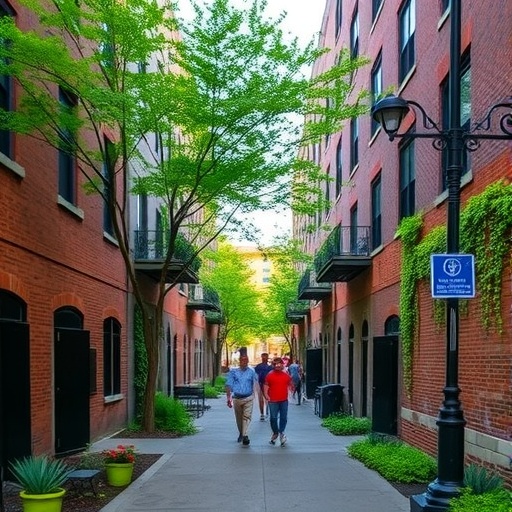
As urban landscapes continue to evolve, the concept of green alleys is emerging as a promising solution to enhance city living. These residential laneways, reimagined and retrofitted with vegetation and ecological considerations, aim to improve not only the aesthetics of neighborhoods but also residents’ quality of life, social bonds, and biodiversity. However, the precise definition and scope of green alleys remain fluid, with their forms and effects varying significantly from city to city. A groundbreaking study led by Isabella Richmond from Concordia University sheds light on these variances and their implications across Quebec’s urban environments.
The study, recently published in the prestigious journal Ecosystems and People, probes the multifaceted nature of green alleys, debunking the notion that they deliver uniform benefits regardless of context. Contrary to popular assumptions, these alleys do not inherently guarantee simultaneous gains in biodiversity and social cohesion. Their outcomes are deeply intertwined with specific design intentions and maintenance strategies. This nuanced understanding challenges urban planners and ecologists to rethink a one-size-fits-all approach to urban greening.
By examining two distinct municipal models—the community-driven initiatives in Montreal and the more standardized, city-managed program in Trois-Rivières—the study unearths key insights into how operational frameworks influence ecological and social outcomes. Montreal’s approach, characterized by diverse resident-led projects, ranges from installing children’s play areas and murals to completely replacing concrete surfaces with trees and plants. This diversity reflects a broad array of community priorities but also results in heterogeneous ecological and social impacts.
Trois-Rivières, on the other hand, employs a carefully managed model focusing on stormwater control and accessibility, ensuring alleys remain navigable for vehicles including garbage trucks. Vegetation here follows a more regulated pattern emphasizing grass cover and concrete pathways to balance functionality with greenery. This approach seems to produce consistent environmental outcomes, such as reliable reductions in nocturnal temperatures, which speak to the alleys’ microclimatic regulation potential.
Yet, as the study highlights, the Trois-Rivières model’s rigidity can overlook local residents’ ecological desires, such as increasing tree density and canopy size. In Montreal, this dynamic is evident; while tree counts in certain green alleys surpass those of surrounding areas, the prevalent use of smaller trees limits shade provision and associated cooling benefits. Some alleys in Montreal paradoxically exhibit lower canopy coverage than adjacent gray streets, signaling the complex interplay between biodiversity enhancement and urban functionality.
Crucially, temperature measurements taken every fifteen minutes over weeks in the study reveal that green alleys’ cooling effects are inconsistent. Some even matched or underperformed relative to conventional gray alleys during specific daily intervals, challenging the oft-cited assumption that urban greening invariably combats heat island effects. These findings press the need for a more granular understanding and tailored vegetation strategies that consider local microclimates and user interactions.
Ecological indicators extended beyond vegetation metrics. Richmond and collaborators innovatively tracked firefly populations within Montreal alleys to assess habitat quality. Fireflies, sensitive to environmental alterations, serve as a bioindicator bridging community ecology with urban landscaping. This interdisciplinary lens enriches the dataset, bringing to the fore biodiversity dimensions rarely prioritized in urban greening projects.
Methodologically, the research team conducted extensive fieldwork across 152 sites, including 53 green alleys, 23 gray conventional laneways, and 76 neighboring street segments in the boroughs of Villeray-St-Michel-Park-Extension and Trois-Rivières. They performed detailed species inventories, analyzed multiple vegetation strata, and scrutinized the presence of invasive versus native plant species. Coupling these quantitative data with resident interviews during neighborhood walks, the study intricately documents perceived benefits such as shade, aesthetic appeal, and green space accessibility.
An emergent theme in the findings is the critical role of sustained funding and maintenance in the longevity and efficacy of green alley projects. Both municipalities exhibited degradation of green infrastructure over time, often because long-term upkeep costs fall disproportionately on local residents. This financial burden threatens the durability of such urban interventions, underscoring the necessity for municipal commitment to ongoing management and resource allocation.
Isabella Richmond elucidates that the divergence in municipal strategies offers trade-offs: Trois-Rivières achieves quicker canopy expansion aligning with citywide greening targets, while Montreal provides residents autonomy to tailor alleys to their preferences. This balance between ecological performance and social relevance forms the crux of effective green alley implementation. It points to envisioning hybrid models that blend community empowerment with technical guidance and assured funding.
Importantly, the research advocates green alleys as vital tools in greening dense urban areas, spaces traditionally constrained by limited open land. These alleys offer rare opportunities to enhance urban biodiversity, facilitate social interactions, and mitigate environmental stressors like heat and stormwater runoff. However, realizing their full potential hinges on integrated planning accommodating both ecological functions and human dimensions.
The insights gained from this research lay a framework for future urban policies aimed at creating multifunctional green infrastructures. Urban ecologists, planners, and local governments must co-develop adaptable, scalable models that respond to unique neighborhood dynamics while maintaining ecological integrity. Such interdisciplinary collaboration is imperative to advance resilient, livable cities attuned to the complexities of socio-ecological systems.
In conclusion, the study led by Isabella Richmond significantly broadens our understanding of green alleys, urging a shift from monolithic conceptions to context-sensitive paradigms. The variable ecological and social outcomes observed in Quebec serve as valuable instructive cases for cities worldwide striving to reconcile urban development with sustainability goals. By fostering participatory design, securing long-term investments, and employing scientific rigor, green alleys can evolve into vibrant urban ecosystems integral to future cityscapes.
News Publication Date: 23-Feb-2026
Web References:
- https://www.tandfonline.com/doi/full/10.1080/26395916.2026.2624451
- http://dx.doi.org/10.1080/26395916.2026.2624451
References:
Richmond, I., Ziter, C., et al. (2026). Green alleys in Quebec provide variable biodiversity support and ecosystem services. Ecosystems and People. DOI: 10.1080/26395916.2026.2624451
Cite Scienmag News
Courtney Benton. (April 28, 2026). Concordia Study Reveals Design and Purpose Key to Green Alley Effectiveness. Scienmag. https://scienmag.com/concordia-study-reveals-design-and-purpose-key-to-green-alley-effectiveness/
Courtney Benton. "Concordia Study Reveals Design and Purpose Key to Green Alley Effectiveness." Scienmag, 28 April 2026, https://scienmag.com/concordia-study-reveals-design-and-purpose-key-to-green-alley-effectiveness/. Accessed 1 September 2026.
Courtney Benton. "Concordia Study Reveals Design and Purpose Key to Green Alley Effectiveness." Scienmag. April 28, 2026. https://scienmag.com/concordia-study-reveals-design-and-purpose-key-to-green-alley-effectiveness/


