


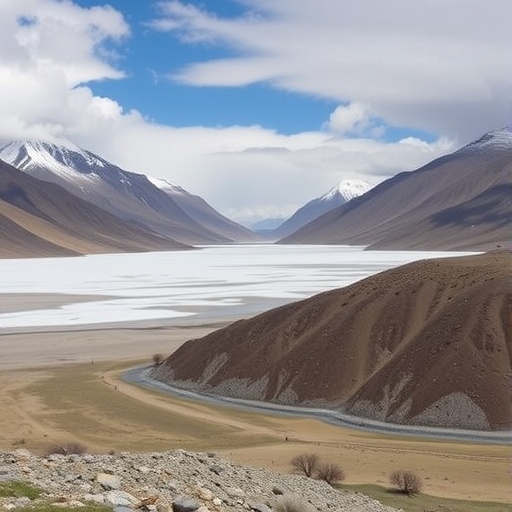
Lakes on the Tibetan Plateau are undergoing an unprecedented ecological shift that holds profound implications for global climate dynamics. Once characterized as stable carbon sinks, these high-altitude aquatic ecosystems are rapidly transforming into significant sources of greenhouse gases. This climatic reversal is largely driven by accelerating warming trends across the region, which exacerbate permafrost thaw and glacier retreat—processes that were meticulously reviewed in a comprehensive analysis published recently in Fundamental Research. The study synthesizes data from nearly 400 scientific investigations, shedding light on the intricate microbiological and biogeochemical mechanisms underlying this phenomenon.
The Tibetan Plateau, often called the “Third Pole” due to its vast ice reserves, harbors thousands of lakes that have historically sequestered large quantities of carbon, thus mitigating atmospheric greenhouse gas concentrations. However, rising temperatures have triggered widespread degradation of permafrost soils and accelerated glacier melting. These processes catalyze the formation of thermokarst lakes—depressions filled with water due to the thawing of ice-rich permafrost. Thermokarst lakes function as potent emitters of ancient carbon trapped over millennia, releasing it predominantly as carbon dioxide (CO₂) and methane (CH₄). Methane is particularly alarming as a greenhouse gas given its global warming potential is approximately 28 times greater than that of CO₂ over a century timescale.
Dr. Yang Liu, the lead author of the study, emphasizes the heterogeneity in lake dynamics across the plateau. “Our findings illustrate a complex spectrum where certain lakes continue to act as carbon sinks, while others, especially thermokarst lakes, have become powerful carbon sources,” Liu states. This spatial and functional variability demands nuanced frameworks for assessment and management, diverging from previously simplistic carbon budget models. The research advocates for adopting typology-based approaches that classify lakes based on their emission profiles and underlying microbial processes.
Central to this paradigm shift is the role of microbial communities in driving biogeochemical transformations. Microorganisms serve as the “core engine” facilitating organic matter decomposition and nutrient cycling involving carbon, nitrogen, and sulfur compounds. Warming conditions extend the growing season and productivity of algal populations, which enhances CO₂ uptake via photosynthesis. Paradoxically, this increased primary productivity is counterbalanced—and often overwhelmed—by intensified microbial respiration and decomposition activities, which release greenhouse gases back into the atmosphere. This dynamic interplay fosters a precarious balance that may tip the lake ecosystems from net carbon sinks to net carbon sources.
The study uniquely integrates microbial functional gene data to elucidate how warming influences specific biochemical pathways linked to greenhouse gas emissions. Genes involved in methanogenesis and methane oxidation show spatial and temporal variability, reflecting how microbial assemblages adapt to changing environmental conditions. Similarly, nitrogen and sulfur cycling genes indicate alterations in nutrient coupling processes that further modulate greenhouse gas fluxes. This molecular insight is paramount to understanding and predicting lake responses under future climatic scenarios.
Current global climate models frequently lack the resolution and complexity necessary to capture these microbial and nutrient-mediated feedback mechanisms in permafrost-affected lake systems. The authors propose developing integrated, multi-factor models that incorporate microbial functional gene expression, coupled nutrient cycles, and climatic drivers such as temperature and precipitation patterns. This holistic modeling approach aims to refine predictions of greenhouse gas emissions from plateau lakes and inform adaptive management strategies.
Implementing “lake-type zoning” principles is highlighted as a critical management strategy. This concept involves identifying and categorizing lakes based on their carbon flux profiles and susceptibility to microbial-driven emissions. Lakes that remain carbon sinks would be prioritized for conservation, while mitigation efforts would target thermokarst and other lakes exhibiting elevated greenhouse gas outputs. Such targeted management could mitigate feedback loops reinforcing regional and global warming trends.
The review also underscores the urgent need for sustained monitoring networks equipped with advanced molecular and biogeochemical tools. Systematic sampling of microbial community structures, functional gene abundance, and greenhouse gas fluxes across representative lake types will enhance baseline data availability. This information is essential to validate predictive models and guide evidence-based interventions aligned with regional green development initiatives and global carbon neutrality goals.
Moreover, the Tibetan Plateau’s unique ecological and geological context amplifies the significance of this research. As a critical water tower supplying major Asian rivers and supporting diverse ecosystems and human populations, the plateau’s changing carbon dynamics may precipitate wide-reaching socio-environmental impacts. The linkage between microbial activity and methane emissions particularly highlights a feedback mechanism that could accelerate climate warming if unchecked.
The findings also resonate with global efforts to better understand permafrost-climate feedbacks in polar and high-altitude environments. While research has traditionally focused on Arctic systems, this study illuminates parallel processes occurring on the Tibetan Plateau, providing comparative insights into permafrost degradation impacts. The integration of microbiological data across such regions is imperative to construct a comprehensive picture of global carbon cycling under climate stress.
In summary, this systematic review catalogs critical advances in microbiological research elucidating greenhouse gas emissions from Tibetan Plateau lakes. It demystifies the dualistic nature of these ecosystems as both carbon sinks and sources, depending on complex interactions among temperature trends, permafrost dynamics, microbial metabolism, and nutrient cycling. The research calls for paradigmatic shifts in both scientific modeling and environmental management to harness these insights towards mitigating climate change.
In light of this work, translating molecular-scale discoveries into actionable regional policies offers a promising avenue for addressing one of the most pressing anthropogenic challenges. The urgency for refined, interdisciplinary studies is clear, with microbial ecology taking center stage in the global climate discourse. Ultimately, recognizing and managing the microbiome-driven feedback loops within high-altitude lake systems could influence the trajectory of greenhouse gas emissions on a planetary scale.
Web References: http://dx.doi.org/10.1016/j.wsee.2026.03.001
Cite Scienmag News
Miles Greystone. (April 28, 2026). Thawing Lakes in Tibet Speed Up Greenhouse Gas Emissions. Scienmag. https://scienmag.com/thawing-lakes-in-tibet-speed-up-greenhouse-gas-emissions/
Miles Greystone. "Thawing Lakes in Tibet Speed Up Greenhouse Gas Emissions." Scienmag, 28 April 2026, https://scienmag.com/thawing-lakes-in-tibet-speed-up-greenhouse-gas-emissions/. Accessed 30 August 2026.
Miles Greystone. "Thawing Lakes in Tibet Speed Up Greenhouse Gas Emissions." Scienmag. April 28, 2026. https://scienmag.com/thawing-lakes-in-tibet-speed-up-greenhouse-gas-emissions/


