


Downbursts represent one of the most violent and less understood meteorological phenomena associated with thunderstorms. These intense, localized downdrafts accelerate rapidly when they reach the ground, spreading out radially and producing extraordinarily high wind speeds that can exceed design specifications of many man-made structures. Despite their destructive potential, downbursts receive relatively little attention in academic research due to their transient nature and unpredictability, creating a persistent gap in knowledge about their precise dynamics and impacts.
A groundbreaking analytical model developed recently by a collaborative team of researchers from Manchester Metropolitan University and the University of Birmingham may bridge this knowledge gap. Published in Advances in Wind Engineering, their study presents a comprehensive mathematical framework that simulates the complex wind field structure within a downburst. A notable achievement of their model is its ability to reproduce the distinctive “nose-shaped” profile of vertical wind speeds observed during downbursts, a feature that underscores the intricate fluid mechanics involved in these events.
Central to the study was the challenge of modeling the interactions between a moving train and the transient, heterogeneous wind field produced by a downburst. According to Aleksander Pistol, the corresponding author, understanding this relative motion was critical. The team carefully accounted for variables including the speed of the train, the velocity and spatial characteristics of the downburst, the lateral offset between the train path and the downburst core, and the angular relationship between the train’s trajectory and the wind flow direction.
Employing this model, the researchers embarked on a detailed risk assessment related to the potential for train overturning caused by downburst-induced wind loads. One unexpected finding emerged from incorporating dynamic effects due to the acceleration of the airflow: rather than exacerbating overturning forces, these dynamic components actually reduce peak wind pressures. This counterintuitive result is attributed to a sharp deceleration in relative wind speeds precisely at the point where lateral wind forces are maximized, demonstrating the nuanced interplay between unsteady aerodynamic forces and structural responses.
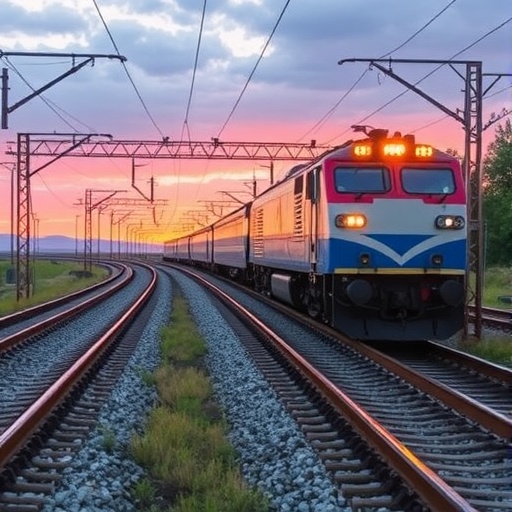
The implications of this framework extend beyond theoretical modeling, offering practical pathways to enhance railway safety protocols. The analysis distinctly highlights train speed as the most critical factor influencing overturning risk, suggesting that slower operational speeds during severe weather events may significantly mitigate hazards. Moreover, the study indicates that freight cars with lower mass and less aerodynamic stability are particularly susceptible compared to heavier, more streamlined passenger trains, calling attention to vehicle-specific vulnerabilities.
However, the researchers caution that deploying this analytical framework in real-world railway operations depends heavily on the availability of detailed meteorological and operational data. Reliable statistics on downburst occurrence, intensity, and spatial distribution remain sparse, especially on a regional scale. This data scarcity presents a significant hurdle to integrating downburst risk assessments into routine railway safety management and emergency preparedness strategies.
Downbursts, often overshadowed by their more infamous counterpart tornadoes, pose uniquely severe risks in many parts of Europe and beyond. Their damage footprint is characterized by rapid intensification and highly localized effects, often affecting infrastructure close to the ground level where human activity is concentrated. This underscores the importance of developing meteorological models that accurately reflect ground-level wind behaviors, which current models frequently fail to capture with sufficient fidelity.
The model introduced by the Manchester and Birmingham team thus fills a critical void by addressing the near-surface wind dynamics that govern the interaction between downbursts and infrastructure. Their approach relies on fundamental mechanical principles of fluid dynamics, eschewing overly complex numerical simulations in favor of an analytically tractable solution that retains essential physical realism. This balance allows for faster analyses that can be more easily implemented in operational decision-making contexts.
From an engineering perspective, the findings suggest new avenues for designing and retrofitting railway systems to better withstand downburst impacts. Insights into the forces exerted on trains moving at varying speeds and positions relative to the wind field could inform adjustments in scheduling, vehicle design standards, and safety procedures. The enhanced predictive power offered by the model also opens possibilities for real-time adaptation to impending downburst conditions using meteorological monitoring and early warning systems.
Beyond railway applications, the analytic framework has potential relevance for other sectors vulnerable to sudden wind events, such as aviation, emergency response logistics, and urban infrastructure resilience. By advancing understanding of downburst mechanics and their interaction with moving objects, the study contributes a valuable tool for meteorologists and engineers grappling with the challenges posed by increasingly volatile weather phenomena in a changing climate.
The study’s authors emphasize the need for further research to complement their model with robust empirical data and expanded simulations. Collecting high-resolution meteorological observations during downburst events and correlating these with structural response data will be essential to validate and refine the framework. Moreover, interdisciplinary collaboration across meteorology, civil engineering, and transportation sectors will be crucial to translate these scientific advances into tangible safety improvements.
In summary, the analytical downburst model developed by this UK-based research team signifies an important advance in the field of wind engineering. By elucidating the transient and uneven wind flows characteristic of downbursts, and their interaction with moving trains, this work lays the groundwork for enhanced risk evaluations and safety measures. As extreme weather events become more frequent, such innovative approaches could prove invaluable for protecting lives and infrastructure from nature’s sudden onslaughts.
Web References: DOI: 10.1016/j.awe.2026.100100
Cite Scienmag News
Russell Cooper. (April 28, 2026). Addressing the Threat of Transient Windstorms to Railroad Transport: Innovative Solutions Explored. Scienmag. https://scienmag.com/addressing-the-threat-of-transient-windstorms-to-railroad-transport-innovative-solutions-explored/
Russell Cooper. "Addressing the Threat of Transient Windstorms to Railroad Transport: Innovative Solutions Explored." Scienmag, 28 April 2026, https://scienmag.com/addressing-the-threat-of-transient-windstorms-to-railroad-transport-innovative-solutions-explored/. Accessed 5 September 2026.
Russell Cooper. "Addressing the Threat of Transient Windstorms to Railroad Transport: Innovative Solutions Explored." Scienmag. April 28, 2026. https://scienmag.com/addressing-the-threat-of-transient-windstorms-to-railroad-transport-innovative-solutions-explored/


