


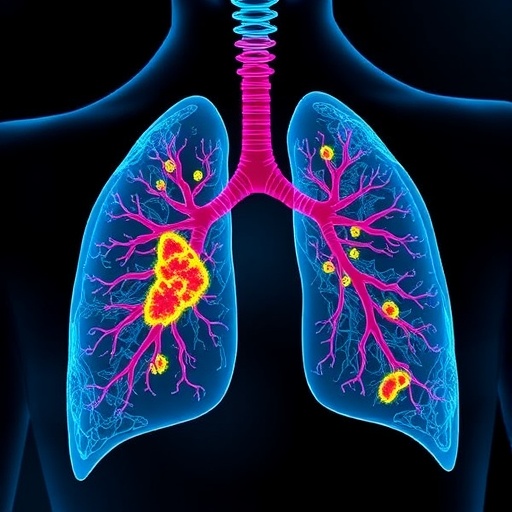
Brussels, April 27, 2026 — A groundbreaking study from researchers at VIB and VUB unveils a radically improved platform to examine the immune microenvironment within lung tumors. This investigation merges a highly patient-relevant orthotopic lung adenocarcinoma model with advanced single-cell sequencing technologies, generating one of the most intricate immune landscapes ever charted in lung cancer research. Published in Nature Communications, the study marks a pivotal advance in recreating the complex cellular interactions and immune dynamics observed in human lung adenocarcinoma.
At the heart of this innovation lies the development of an orthotopic tumor model wherein lung adenocarcinoma grows directly within the pulmonary tissue, closely emulating the natural progression of tumors in patients. Traditional preclinical models typically implant cancer cells subcutaneously, a method that fails to replicate the lung’s distinctive immunological milieu. By situating tumors in the lung’s native microenvironment, the new model permits an authentic exploration of immune cell behaviors within the tumor niche, including the dissection of tumor nodules from adjacent healthy lung tissue, paralleling clinical sampling strategies.
One of the most transformative aspects of this research is the introduction of SEPARATE-Seq — Streptavidin Enabled PARtitioning And Tag Evaluation for RNA-Sequencing. This novel technique surmounts a longstanding limitation in single-cell analysis: the inability to distinguish immune cells embedded within tumor tissues from those transiently circulating in tumor-associated blood vessels. SEPARATE-Seq achieves this by selectively labeling immune cells within the bloodstream, enabling precise discrimination of their spatial localization at single-cell resolution.
The utility of SEPARATE-Seq is expansive. In organs like the lung, where immune cells populate multiple compartments—vascular, parenchymal, and airway spaces—traditional transcriptomic methods conflate transient and infiltrating populations, blurring insights into tumor-immune interactions. By accurately resolving this spatial heterogeneity, SEPARATE-Seq empowers researchers to decode how immune surveillance, immune suppression, and tumor-driven immune remodeling differ by compartment, illuminating the fundamental processes of tumor immunology with unprecedented clarity.
Applying this integrated platform, the team performed comprehensive immune profiling coupled with spatial transcriptomics, which simultaneously reveals cellular identities and their precise anatomical locations in the tumor microenvironment. This multifaceted approach uncovered striking spatial organization patterns within lung adenocarcinomas. Notably, lipid-associated tumor-associated macrophages (TAMs) form a distinct ring at the tumor periphery, orchestrating local immune responses, while specialized interferon-stimulated hubs enriched with discrete dendritic cell subsets arise within the tumor core, suggesting compartmentalized immunomodulation.
Furthermore, the analyses detected increased infiltration by hypoxic neutrophils and plasma cells within tumors, underscoring a complex interplay of immune subsets under physiologically relevant stress conditions. Natural killer (NK) cells exhibited a marked transition toward an immature and dysfunctional phenotype upon tumor entry, echoing observations from human lung cancer samples. These spatial and functional reprogramming events highlight the tumor microenvironment’s profound influence in sculpting immune responses, often to the detriment of effective antitumor immunity.
Aligning the murine model’s immune architecture with human lung adenocarcinoma datasets confirmed its translational fidelity. The capture of hallmark immune features—including dysfunctional NK populations and regulatory/exhausted T cell enrichment—reinforces this model as a high-fidelity surrogate for patient tumors. Such congruence bridges the gulf between in vitro/in vivo preclinical research and clinical reality, providing a robust foundation for therapeutic testing.
This comprehensive immune atlas generated by the team extends beyond a mere descriptive resource. By making the multiomics dataset accessible via an interactive online tool, the researchers have created a dynamic platform for the broader scientific community to explore lung tumor immunobiology. This democratization of data spurs collaborative discovery, fosters hypothesis generation, and expedites the identification of novel immunotherapeutic targets, which are critically needed given lung cancer’s status as the foremost cause of cancer mortality worldwide.
The implications of this work resonate across multiple dimensions of cancer biology and treatment. Current immunotherapies’ effectiveness often hinges on the heterogeneous behavior of immune cells within complex tumor microenvironments. Models lacking this cellular and spatial nuance risk misleading conclusions and failed clinical translation. By authentically reflecting patient biology, the combined approach of orthotopic modeling and SEPARATE-Seq technology charts a new course for immuno-oncology, one that respects the spatial and functional intricacies dictating therapeutic outcomes.
Delving deeper, this study exemplifies the power of integrating cutting-edge experimental methodologies to unravel biological complexity. The utilization of single-cell RNA sequencing refined by compartment-specific cell labeling, coupled with spatial transcriptomics, represents a paradigm shift. It not only enables high-resolution molecular profiling but situates each cell within its native anatomical and functional context, an indispensable factor for understanding immune cell specialization and plasticity amidst tumor-driven pressures.
In closing, the researchers articulate a clear vision: bridging preclinical experimentation and patient treatment through models that faithfully replicate the tumor immune landscape. Their efforts underscore the necessity of ecological validity in model systems to uncover genuine mechanisms underpinning tumor immunity. As Prof. Damya Laoui states, therapeutic success or failure fundamentally depends on understanding immune cell behavior within the tumor’s intricate environment, a resolution this work significantly advances.
This milestone research heralds a new chapter in lung cancer immunology, offering an extraordinary toolkit and dataset to dissect immune dynamics with unparalleled precision. It sets a gold standard for future studies aiming to unravel the multifaceted spatial and molecular reorganization of immune populations in cancer, advancing the ultimate goal of designing effective, personalized immunotherapies that save lives.
Cite Scienmag News
Rowan B. (April 27, 2026). New Lung Cancer Model Uncovers How Tumor Location Influences Immune Response. Scienmag. https://scienmag.com/new-lung-cancer-model-uncovers-how-tumor-location-influences-immune-response/
Rowan B. "New Lung Cancer Model Uncovers How Tumor Location Influences Immune Response." Scienmag, 27 April 2026, https://scienmag.com/new-lung-cancer-model-uncovers-how-tumor-location-influences-immune-response/. Accessed 28 August 2026.
Rowan B. "New Lung Cancer Model Uncovers How Tumor Location Influences Immune Response." Scienmag. April 27, 2026. https://scienmag.com/new-lung-cancer-model-uncovers-how-tumor-location-influences-immune-response/


