

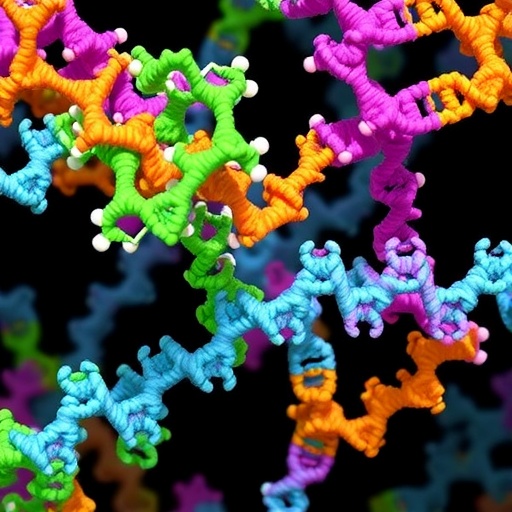
In the intricate landscape of cellular biology, intrinsically disordered proteins and regions (IDPs/IDRs) represent a frontier rich with complexity and significance. These biomolecules defy traditional paradigms of protein structure and function, existing in dynamic ensembles rather than fixed conformations. Their behavior is pivotal both in maintaining normal cellular functions and in the pathogenesis of numerous neurodegenerative diseases. The recent study from Peking University, spearheaded by Prof. Huan Wang’s group, marks a significant advancement in visualizing the elusive early stages of liquid-liquid phase separation (LLPS), a fundamental process by which IDPs/IDRs compartmentalize biochemical reactions within membraneless organelles (MLOs).
The research confronts the long-standing challenges in deciphering the nucleation and growth mechanisms that govern the phase separation of disordered proteins. Historically, classical nucleation theory (CNT) has been the prevailing framework describing phase transitions. However, increasing experimental and theoretical evidence underscores its limitations, especially in biologically relevant macromolecular systems where multistep and nonclassical nucleation pathways prevail. The work from Wang’s team delineates a multi-step journey in LLPS, progressing from monomeric IDP/IDR molecules to small oligomers, which then cluster into networked assemblies, and at a critical concentration threshold, transition into a dense liquid phase.
Central to capturing these molecular dynamics is the innovative application of liquid-phase transmission electron microscopy (LP-TEM). This cutting-edge imaging technique breaks traditional barriers by enabling real-time nanoscale visualization of biomolecules in their native aqueous environments, with millisecond temporal precision. The integration of LP-TEM with advanced molecular dynamics (MD) simulations, contributed by collaborators including Prof. Yiqin Gao and researcher Yihao Niu, provides a robust platform for observing and interpreting the conformational fluctuations and intermolecular interactions underlying LLPS.
In the experimental setup, the low-complexity domain of the Fused in Sarcoma protein (FUS-LCD), a prototypical IDP linked to amyotrophic lateral sclerosis, was encapsulated within a graphene liquid cell (GLC). This innovative encapsulation minimizes electron beam damage and maintains the biomolecular integrity necessary to faithfully observe dynamic oligomerization and clustering processes. The LP-TEM images captured both the early oligomer formation and their coalescence into denser clusters. Importantly, these visualizations unveiled that even below the classical saturation concentration, clusters existed, suggesting that phase separation initiates through a network of transient interactions that classical theories do not fully account for.
Quantitative analyses of the LP-TEM data, enhanced by neural network-based image segmentation, enabled precise determination of the critical concentration for dense phase formation and a deeper understanding of the biophysical forces driving phase transition. The findings reinforce a sticker-spacer model wherein specific “stickers” — amino acid sequences within IDRs capable of mediating reversible interactions — promote oligomerization, while “spacer” regions modulate the overall polymer dynamics. This molecular grammar directs the stepwise assembly from individual monomers to supramolecular dense phases.
Moreover, the study extended its observations beyond FUS-LCD to other key IDPs/IDRs, such as full-length FUS protein (FL-FUS) and Tau protein, a microtubule-associated protein implicated in Alzheimer’s disease. The consistent patterns of dense phase transitions across these proteins indicate a common mechanistic underpinning of LLPS in cellular biology. This universality challenges reductionist approaches and underscores the need for refined, non-classical models that accommodate the complex interplay of multivalent interactions shaping biomolecular condensates.
The implications of this research extend far beyond fundamental biology. By providing a detailed mechanistic picture of early LLPS events, the study lays a foundation for therapeutic strategies targeting pathological phase transitions implicated in neurodegeneration and protein aggregation diseases. Moreover, the insights gleaned about controlled phase separation have potential applications in synthetic biology, where designing biomimetic condensates able to modulate reaction environments could revolutionize intracellular engineering.
Technologically, the development and deployment of LP-TEM in this context highlight its transformative power to address questions that have remained intractable due to limitations in spatial and temporal resolution. Traditional fluorescence microscopy and cryo-electron microscopy offer valuable information but fall short in capturing the rapid, transient assemblies characteristic of IDPs in liquid environments. Here, LP-TEM fills a crucial gap, enabling the visualization of individual molecules assembling and disassembling in situ, thereby unlocking the dynamic choreography of protein phase behavior.
Collectively, these findings advocate a paradigm shift towards recognizing LLPS as a finely tuned, multi-stage process driven by complex, reversible interactions, rather than a simple, abrupt transition described by classical nucleation. The study provides compelling experimental validation that the nucleation and growth of biomolecular condensates involve oligomeric intermediates and networked clusters that prefigure the dense phase.
In sum, this groundbreaking research not only enriches our molecular understanding of IDP/IDR behavior but also sets a new standard for investigating phase separation phenomena. It bridges structural biology, biophysics, and materials science, offering a comprehensive view of how cellular architecture orchestrates itself through dynamic, multivalent protein interactions.
The future horizons opened by this methodological and conceptual innovation are vast. Further exploration of LLPS kinetics and molecular determinants across a wider range of IDPs/IDRs, coupled with advances in computational modeling, will undoubtedly shed light on the nuanced regulatory mechanisms cells employ to harness phase separation for physiological functions and how disruptions therein contribute to disease. As the field progresses, the integration of LP-TEM with complementary biophysical techniques promises to unveil the full spectrum of molecular events that underpin life’s most fundamental organizational principle.
Web References: https://doi.org/10.1093/nsr/nwag107
Keywords
intrinsically disordered proteins, liquid-liquid phase separation, liquid-phase transmission electron microscopy, oligomerization, dense phase transition, FUS-LCD, molecular dynamics simulations, membrane-less organelles, non-classical nucleation, sticker-spacer model, neurodegenerative diseases, biomolecular condensates
Cite this news
SCIENMAG. (April 24, 2026). Unveiling Non-Classical Nucleation in Intrinsically Disordered Proteins: From Oligomers and Clusters to Dense Phases. https://scienmag.com/unveiling-non-classical-nucleation-in-intrinsically-disordered-proteins-from-oligomers-and-clusters-to-dense-phases/
SCIENMAG. "Unveiling Non-Classical Nucleation in Intrinsically Disordered Proteins: From Oligomers and Clusters to Dense Phases." Scienmag, 24 April 2026, https://scienmag.com/unveiling-non-classical-nucleation-in-intrinsically-disordered-proteins-from-oligomers-and-clusters-to-dense-phases/. Accessed 28 August 2026.
SCIENMAG. "Unveiling Non-Classical Nucleation in Intrinsically Disordered Proteins: From Oligomers and Clusters to Dense Phases." Scienmag. April 24, 2026. https://scienmag.com/unveiling-non-classical-nucleation-in-intrinsically-disordered-proteins-from-oligomers-and-clusters-to-dense-phases/


