


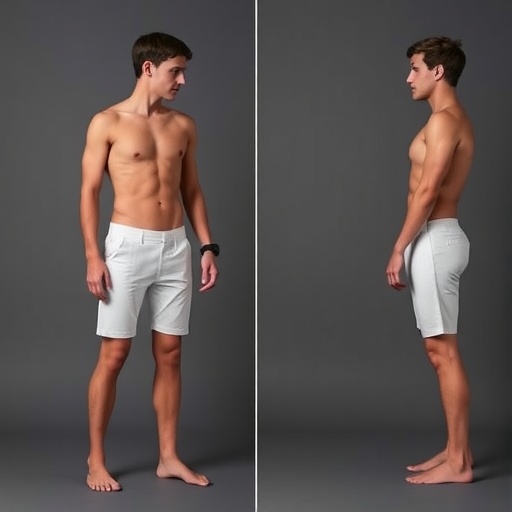
A groundbreaking study led by Shiguang Shan and his team has unveiled a novel approach to estimating human body height and weight from a single, non-frontal face image—a notoriously challenging problem in computer vision. Traditional methods have struggled due to the significant variation in face poses and the scarcity of comprehensive labeled data. To overcome these obstacles, the researchers introduced a sophisticated framework that combines auxiliary tasks and pose disentanglement, dramatically enhancing estimation accuracy and robustness.
The heart of the problem lies in the fact that facial images captured from various angles introduce distortions and occlusions, complicating reliable extraction of features relevant to physical attributes like height and weight. Unlike frontal face images frequently used in biometric analysis, non-frontal images add an extra layer of complexity. Shan’s team proposed leveraging correlated auxiliary tasks—namely gender and age estimation—to enrich the learning process. These attributes are biologically and statistically correlated with height and weight, providing valuable context that improves the primary prediction tasks.
Age and gender are crucial because body morphology evolves over time and differs between sexes. As individuals age, changes in bone density, fat distribution, and muscle mass manifest subtly in facial features, which may be indicative of height and weight shifts. Similarly, male and female bodies typically differ in muscle mass and bone composition, influencing facial structure and texture. By integrating age and gender as auxiliary tasks, the model learns shared representations that encapsulate these underlying biological signals, fostering more precise estimations.
A pivotal innovation in the study is the employment of pose disentanglement. This technique isolates and removes pose-relevant features from the extracted facial representations. Since attributes like age, gender, height, and weight do not inherently change with the orientation of the face, pose-induced variations constitute noise that hampers the learning process. By suppressing these pose-related influences, the model focuses on intrinsic facial characteristics that truly correlate with physical dimensions, thereby improving generalization across diverse face angles.
The architecture of the proposed framework begins with convolutional layers that extract broad facial features from the input image. These features undergo a pose disentanglement module, which filters out pose information and yields pose-invariant encodings. Subsequently, auxiliary branches dedicated to gender and age estimation learn specialized features, which are then fused with the pose-irrelevant representations. This fusion enhances the richness of the feature space before passing through fully connected layers tasked with producing height and weight predictions.
Crucially, the model is trained end-to-end using multi-task loss functions that jointly optimize all tasks. This strategy encourages the network to find representations beneficial across multiple objectives, reinforcing the correlations between auxiliary and primary tasks. By synchronizing the learning of gender, age, height, and weight, the system attains a more holistic understanding of facial cues linked to bodily measures.
The research team conducted extensive experiments on two public datasets: VIP-attributes and VIPL-MumoFace-WH. These datasets contain face images with varying poses and accompanying physical attribute labels. Results consistently demonstrated that their method outperformed baseline models that did not incorporate auxiliary tasks or pose disentanglement. The approach proved particularly effective on images with large pose variations, showcasing its robustness under real-world conditions where face angles are seldom frontal.
Analyses reveal that pose disentanglement substantially reduces the feature space’s confounding factors, highlighting the importance of isolating pose effects. Simultaneously, the auxiliary tasks provide contextually rich signals guiding the model toward more accurate estimations of height and weight. This synergy presents a compelling paradigm for tackling challenges where target attributes are indirectly manifested in complex visual data.
This innovative approach marks a significant advancement in biometric analysis and has potential applications across healthcare, security, and personalized services. For instance, accurate body measurements derived from casual photographs could streamline medical diagnostics, enhance fitness tracking, or improve virtual try-on technologies in retail. Moreover, the principles of multi-task learning and disentanglement outlined here can inspire solutions in other domains dealing with intertwined attributes and noisy inputs.
The study’s implications extend beyond the immediate application, suggesting that harnessing correlated auxiliary information and disentangling nuisance factors can unlock new frontiers in computer vision research. By addressing pose variability—a perennial problem in face-based analysis—the researchers provide a blueprint for more resilient and context-aware models in the future.
In summary, the team led by Shiguang Shan presents a sophisticated model that leverages the natural correlations among gender, age, height, and weight, while methodically eliminating pose interference. This integrated approach achieves state-of-the-art results in height and weight estimation from non-frontal facial images. Their work underlines the power of combining biological insights with advanced machine learning techniques to push the boundaries of what can be inferred from visual data.
As technology continues to evolve, such innovations will no doubt enhance human-computer interactions, delivering more seamless, intelligent, and personalized experiences. The publication in Frontiers of Computer Science heralds a promising step forward in the quest to decode the human form through the lens of a single image.
Cite Scienmag News
Celia Amberley. (April 24, 2026). Enhancing Height and Weight Estimation through Pose-Disentangled Auxiliary Tasks. Scienmag. https://scienmag.com/enhancing-height-and-weight-estimation-through-pose-disentangled-auxiliary-tasks/
Celia Amberley. "Enhancing Height and Weight Estimation through Pose-Disentangled Auxiliary Tasks." Scienmag, 24 April 2026, https://scienmag.com/enhancing-height-and-weight-estimation-through-pose-disentangled-auxiliary-tasks/. Accessed 28 August 2026.
Celia Amberley. "Enhancing Height and Weight Estimation through Pose-Disentangled Auxiliary Tasks." Scienmag. April 24, 2026. https://scienmag.com/enhancing-height-and-weight-estimation-through-pose-disentangled-auxiliary-tasks/


