


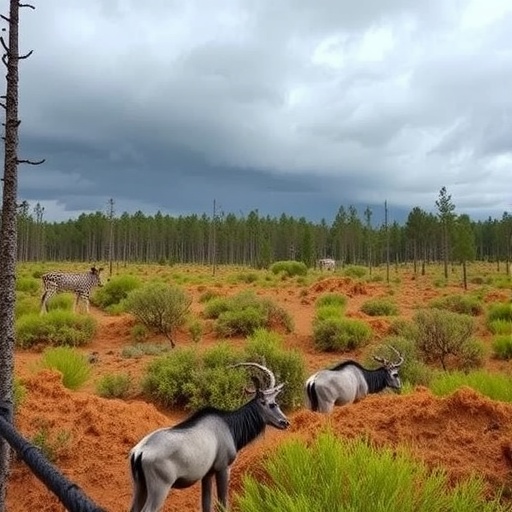
By the year 2085, an alarming 36 percent of the current terrestrial habitats for land vertebrates could be subjected to multiple climate-driven extreme events, including heatwaves, wildfires, and floods, if global warming continues unabated into the latter half of this century. This finding emerges from an innovative study spearheaded by the Potsdam Institute for Climate Impact Research (PIK) and published in the prestigious journal Nature Ecology & Evolution. The research underscores the compounded threats posed by overlapping climate extremes to biodiversity at a planetary scale.
Unlike previous assessments that often focused on gradual temperature increases, this study shifts attention toward the episodic, yet increasingly frequent, extreme events that can devastate ecosystems rapidly. Lead author Stefanie Heinicke, a postdoctoral researcher at PIK, emphasizes that conservation strategies thus far have underestimated the potential severity and complexity of rapidly succeeding extreme climate phenomena. These episodic shocks—whether they be heatwaves, floods, or wildfires—can trigger abrupt declines in animal populations, with impacts mounting swiftly when multiple extremes converge in the same regions.
The compound nature of these threats is particularly troubling because consecutive climate extremes interact synergistically, intensifying their detrimental effects on habitats. The study cites the example of the 2019-2020 Australian wildfires, where regions previously afflicted by severe drought saw amplified declines in plant and animal species by an estimated 27 to 40 percent compared to areas without such antecedent dry conditions. This exemplifies how a sequence of climatic stressors can cause cascading impacts that outstrip the effects of isolated events.
Nevertheless, the research tentatively offers a note of hope: stringent and immediate reductions in greenhouse gas emissions could substantially mitigate these climate risks. Modeling scenarios where global warming reverses during the latter part of the century suggest that only about 9 percent of land animal habitats would then face exposure to multiple extreme events by 2085. This significantly reduced figure highlights the transformative difference that aggressive climate action could make to biodiversity preservation.
This novel study employs advanced computational simulations integrating climate impact models, enabling more nuanced projections that extend beyond simple temperature increases to incorporate spatially explicit data on wildfire occurrences, flood extents, and heatwave frequency. By parsing these overlapping hazards, the researchers chart a multidimensional risk landscape for global biodiversity, pinpointing areas of heightened vulnerability in species-rich regions across the Amazon basin, African tropics, and Southeast Asia.
Specifically for the projection year 2050, results suggest that if warming continues unchecked, an estimated 74 percent of current land animal habitats could endure intense heatwaves, 16 percent might be exposed to wildfires, 8 percent to drought conditions, and 3 percent to riverine flooding. These alarming statistics paint a stark picture of how pervasive and multifaceted climate extremities are set to become over coming decades.
A particularly salient insight from the study is the outsized role of wildfires in shaping future exposure risks. Co-author Katja Frieler, head of research at PIK and leader of the Inter-Sectoral Impact Model Intercomparison Project, points out that wildfire exposure for terrestrial animals has been a conspicuous blind spot in prior research. The new projections reveal that fire danger supersedes drought in some critical habitats, underscoring the urgency of integrating wildfire risk assessments into biodiversity conservation planning.
In dissecting the multi-risk scenarios, the study also highlights how certain ecosystems could face overlapping stressors simultaneously, challenging species’ adaptive capacities. For instance, increased heatwave intensity and duration exacerbate wildfire susceptibility, while flooding events can disrupt post-fire regeneration processes and habitat connectivity. Such complex, interacting disturbances could surpass thresholds beyond which ecosystems suffer irreversible degradation or species face extinction.
Methodologically, the study’s integration of cross-sectoral climate impact models marks a significant advancement in environmental risk assessment. By harmonizing projections for multiple extreme events within spatially explicit frameworks, the researchers provide decision-makers with a powerful tool to prioritize intervention hotspots and tailor conservation responses to dynamic climate realities. This approach elevates biodiversity impact forecasting into a more holistic, systems-level understanding.
Importantly, the findings amplify calls for urgent climate action as an effective conservation lever. By demonstrating that emission cuts can drastically reduce the fraction of habitats facing compounded exposures, the research provides empirical evidence supporting international climate agreements aiming for net-zero emissions. It also stresses that protecting biodiversity under climate change is inseparable from broader mitigation and adaptation efforts.
The study’s timing is critical, arriving as global ecosystems are already contending with intensified climate extremes and their cascading ecological effects. It challenges researchers, policymakers, and conservationists to rethink prevailing paradigms centered on gradual changes and to recognize the profound implications of extreme, episodic, and overlapping climatic disturbances on the future viability of terrestrial vertebrate species worldwide.
The interweaving of computational modeling with ecological impact assessments exemplifies how synthetic, multidisciplinary science can inform global environmental stewardship under conditions of uncertainty. In doing so, this research illuminates both the scale of the biodiversity crisis driven by climate extremes and the pathways toward mitigating its worst effects through proactive, emissions-focused strategies.
In sum, the study paints a compelling, and cautionary, picture of a future where without swift climate mitigation, a growing proportion of Earth’s terrestrial vertebrate habitats will face a perilous cocktail of heatwaves, wildfires, droughts, and floods. Its methodological innovations and clarion call for urgent emissions reductions resonate deeply within the scientific and conservation communities, framing a critical narrative for confronting climate-biodiversity nexus challenges head-on.
News Publication Date: 24-Apr-2026
Web References:
10.1038/s41559-026-03050-0
Cite Scienmag News
Jasper A. (April 24, 2026). By 2085, One-Third of Terrestrial Animal Habitats May Face Multiple Extreme Events, Study Finds. Scienmag. https://scienmag.com/by-2085-one-third-of-terrestrial-animal-habitats-may-face-multiple-extreme-events-study-finds/
Jasper A. "By 2085, One-Third of Terrestrial Animal Habitats May Face Multiple Extreme Events, Study Finds." Scienmag, 24 April 2026, https://scienmag.com/by-2085-one-third-of-terrestrial-animal-habitats-may-face-multiple-extreme-events-study-finds/. Accessed 29 August 2026.
Jasper A. "By 2085, One-Third of Terrestrial Animal Habitats May Face Multiple Extreme Events, Study Finds." Scienmag. April 24, 2026. https://scienmag.com/by-2085-one-third-of-terrestrial-animal-habitats-may-face-multiple-extreme-events-study-finds/


