


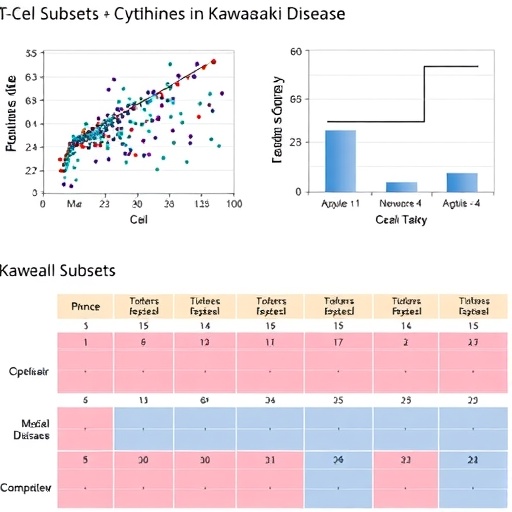
Kawasaki disease (KD) has long posed a perplexing challenge within pediatric inflammatory disorders, marked notably by its acute febrile presentation and systemic vasculitis primarily afflicting young children. Despite decades of clinical observation and research, the precise origin and pathogenic pathways underlying KD remain only partially understood. Recent advances, however, have brought into sharp focus the pivotal role of the immune system, and particularly T lymphocytes, in orchestrating the inflammatory cascade characteristic of KD. A groundbreaking review by Zhu and Xi, published in Pediatric Research in April 2026, meticulously dissects the dynamic interplay of T cell subsets and their cytokine networks, reshaping our grasp of KD’s immunopathology.
Historically, KD has been associated with an enigmatic trigger, potentially infectious agents, that provokes an aberrant immune response. This response culminates in systemic vasculitis—widespread inflammation of the vascular endothelium—which can have devastating cardiovascular sequelae, including coronary artery aneurysms. Although initial investigations focused primarily on innate immune cells such as macrophages and neutrophils, burgeoning evidence highlights adaptive immunity—specifically T cells—as key drivers in the disease process. T cells not only contribute to inflammation through cytokine secretion but also appear critical in modulating the autoimmune components that exacerbate vascular injury.
The review by Zhu and Xi provides an intricate overview of the subsets of T cells implicated in KD, emphasizing the complexities of Th1, Th17, and regulatory T cells (Tregs) and their evolving roles during the disease course. Th1 cells, known for their production of interferon-gamma (IFN-γ), have been associated with pro-inflammatory responses that perpetuate endothelial damage. Conversely, Th17 cells, producers of interleukin-17 (IL-17), are increasingly recognized for their potent inflammatory potential, stimulating the recruitment of neutrophils and amplifying tissue injury. The documented elevation of both Th1 and Th17 responses in acute KD phases underscores their probable synergy in driving the cytokine storm phenomenon.
In stark contrast to these inflammatory T cell subsets, Tregs serve a fundamentally immunoregulatory and protective role. Characterized by their secretion of anti-inflammatory cytokines such as IL-10 and transforming growth factor-beta (TGF-β), Tregs act as critical brakes on immune activation. The review details evidence that KD patients exhibit a numerical and functional deficit in Tregs, creating an imbalance favoring unchecked inflammation. This skewed ratio between pro-inflammatory and regulatory T cell populations is hypothesized to be a central mechanism by which immune tolerance collapses in KD, permitting autoimmunity and vascular damage to ensue.
The molecular underpinnings that contribute to this T cell dysregulation in KD are explored in depth. Zhu and Xi elaborate on intricate signaling pathways, including those mediated by cytokines, costimulatory molecules, and transcription factors, which collectively govern T cell differentiation and effector functions. Cytokines such as IL-6 play a dual role, promoting Th17 differentiation while simultaneously dampening Treg development, thus tipping the immune balance toward a pro-inflammatory state. Additionally, alterations in pathways such as STAT3 and NF-κB have been implicated in amplifying T cell-mediated responses that exacerbate vascular inflammation.
One of the most striking aspects highlighted in the review is the concept of a “cytokine storm”—a hyperinflammatory state propelled by T cells that inundates the vascular system with an excess of pro-inflammatory mediators. This storm precipitates widespread endothelial activation, vascular leakage, and recruitment of additional immune effectors, establishing a vicious cycle of inflammation and tissue injury. The authors meticulously connect the dots between the surge of T cell-derived cytokines and the pathogenic remodeling of coronary arteries, which is the cardinal complication of KD and a leading cause of acquired heart disease in children.
Beyond the conventional inflammatory pathways, the review delves into the emerging evidence of autoimmunity triggered by unconventional T cell mechanisms in KD. Autoantigens released during endothelial injury may be aberrantly presented to T cells, fostering pathogenic autoimmune responses. Such mechanisms could explain the persistence of vascular inflammation even after the resolution of the initial infectious-like trigger. This paradigm shift sheds light on why some patients fail to respond adequately to standard therapies and continue to exhibit progressive vascular damage.
Recognizing these immunological insights, Zhu and Xi’s review also provides a forward-looking perspective on therapeutic interventions targeting T cells. Conventional treatment strategies for KD, including intravenous immunoglobulin (IVIG) and aspirin, primarily aim to suppress immune activation and inflammation broadly. However, the nuanced understanding of T cell subset dynamics unveils potential novel therapies, such as biologics targeting IL-17 or interventions designed to restore Treg function. These focused approaches promise to optimize therapeutic efficacy by directly modulating the aberrant immune circuits driving KD pathogenesis.
The therapeutic landscape in KD is on the cusp of transformation, driven by the convergence of immunology and clinical medicine. Zhu and Xi articulate the utility of drugs like abatacept, which inhibits T cell costimulation, and monoclonal antibodies against pro-inflammatory cytokines, as promising adjuncts or alternatives to conventional therapy. Early clinical trials and experimental models cited in the review affirm that selectively dampening Th1 and Th17 activity or amplifying Treg responses can significantly reduce vascular inflammation and improve outcomes.
Moreover, the review underscores the importance of timing in T cell-targeted interventions. Given the dynamic nature of T cell subsets during different disease phases, timely modulation of the immune response could prevent the progression from acute inflammation to chronic vascular remodeling. This temporal dimension in treatment strategy design represents a sophisticated approach aimed at precision medicine tailored to the immunological profile of each patient.
The authors also contemplate future research directions that could illuminate unexplored aspects of T cell biology in KD. Single-cell sequencing technologies and advanced immunophenotyping promise to unravel previously unrecognized T cell heterogeneity and functional states within inflamed tissues. Such insights will further refine the identification of pathogenic T cell clones and the delineation of molecular pathways critical to their activation and survival.
A crucial implication of this review is the necessity for interdisciplinary collaboration, bridging immunology, cardiology, and pediatric research in the quest to demystify KD’s complex pathophysiology. Integrative studies combining clinical data, laboratory findings, and computational modeling will be pivotal in translating T cell biology into tangible clinical benefits.
In summary, Zhu and Xi’s comprehensive review revolutionizes our understanding of Kawasaki disease by positioning T cells at the epicenter of its immunopathogenesis. Through meticulous analysis of T cell subsets and their cytokine milieus, the review not only clarifies longstanding questions about KD but also pioneers a roadmap for novel therapeutic avenues. This work galvanizes the medical community to harness the power of immunomodulation, promising improved prognosis for children afflicted by this enigmatic and potentially devastating disease.
Cite Scienmag News
Kristina Jarvis. (April 24, 2026). T-Cell Subsets and Cytokines in Kawasaki Disease. Scienmag. https://scienmag.com/t-cell-subsets-and-cytokines-in-kawasaki-disease/
Kristina Jarvis. "T-Cell Subsets and Cytokines in Kawasaki Disease." Scienmag, 24 April 2026, https://scienmag.com/t-cell-subsets-and-cytokines-in-kawasaki-disease/. Accessed 4 September 2026.
Kristina Jarvis. "T-Cell Subsets and Cytokines in Kawasaki Disease." Scienmag. April 24, 2026. https://scienmag.com/t-cell-subsets-and-cytokines-in-kawasaki-disease/


