


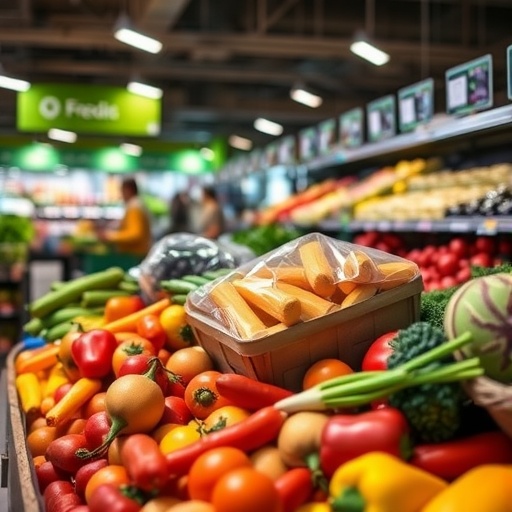
An alarming fraction of the food produced globally—nearly one-third—is lost or wasted annually, imposing a staggering economic burden estimated at approximately one trillion US dollars. Within this massive waste, retail sectors globally are significant contributors, discarding vast quantities of food that remain perfectly edible. Beyond the moral and ecological implications, this inefficiency equates to considerable financial drains on retailers. They not only face the opportunity costs of unsold products but also incur additional expenses related to waste management and disposal.
A groundbreaking analysis conducted by researchers at the University of Copenhagen sheds new light on the economic dimensions underpinning food waste within Danish retail chains. The study focuses on the financial calculus that retailers engage in regarding surplus food: whether to sell it at a discount, donate it, or discard it altogether. Notably, the findings reveal that more than half of such surplus food currently ends up as waste, a practice that is not only detrimental to sustainability goals but also less cost-effective than commonly assumed.
The research dismantles the widespread perception that donating surplus food is merely an altruistic gesture without financial incentive. It demonstrates that donating food often presents a more economically rational option compared to disposal, especially once product sales prospects decline. By doing so, retailers may mitigate losses and reduce the expenses associated with waste handling, thereby improving their operational efficiency while simultaneously contributing to social welfare.
Central to the study’s findings is the strategy of early price reduction, which emerges as the most lucrative approach for managing surplus inventory. Retailers who proactively discount products days before their expiration date benefit from transformed potential losses into tangible gains. Specifically, modest price cuts—typically around 15%—can substantially incentivize consumer purchases, increasing turnover and curbing waste. Such a strategy requires precise inventory management and timely decision-making but promises significant financial upside.
The economic impact of early markdowns varies across product categories. Fresh meat, fish, and processed meat products are among the most responsive to discounts, with retailers realizing net financial gains exceeding €1.3 per kilogram in some instances. In contrast, liquid dairy products and dry goods display minimal profitability from such reductions. On average, most product groups yield net returns ranging from €0.3 to €0.8 per kilogram, underscoring the potential for enhanced revenue through smarter pricing tactics.
When products approach their expiry thresholds and selling them becomes nonviable, the study identifies that donation to food redistribution organizations is usually more cost-effective than discarding. Disposal costs, including waste handling, typically amount to €0.27 to €0.36 per kilogram, whereas donation expenses range moderately lower, around €0.14 to €0.23 per kilogram. This differential represents a direct financial saving for retailers, reinforcing the case for donation as a pragmatic alternative to waste.
Mechanistically, the logistics of donation closely resemble those of disposal. Food placed on pallets for collection by charitable organizations can be managed with similar operational ease as goods sent for biogas production or composting. This near equivalence in handling diminishes perceived barriers to donation, making it an accessible option for retail stores with minimal need for additional infrastructure or processes.
Retailers’ decisions regarding surplus food management transcend mere economics—they also carry profound social implications. By diverting edible food to vulnerable populations via donation channels, stores bolster community support systems and alleviate food insecurity. The research quantifies this social benefit, estimating that donated food creates societal value between €1 and €5 per kilogram when channelled to shelters, drop-in centers, and social aid programs, thereby reinforcing their critical role in social sustainability.
A striking observation from the Danish retail context is the disproportionate volume of surplus food concentrated in particular categories: bread, fruit, and vegetables make up approximately 65% of surplus quantities. Despite this, only a tiny fraction—0.1 to 0.2%—of surplus food is currently donated, highlighting a significant gap between potential and current practice. The dominant disposal of surplus points to missed opportunities for both economic efficiency and social impact.
Emerging sales models, such as food waste platforms epitomized by “Too Good To Go,” offer innovative avenues to capitalize on surplus food. These platforms not only reduce waste but can also generate superior financial returns compared to traditional donation channels, particularly for perishable commodities like fruit, vegetables, and bread. The economic upside for retailers using such platforms can reach €0.5 to €0.7 per kilogram. The analysis suggests untapped markets for these technologies in higher-value products, such as meat, indicating fertile ground for business innovation.
This university-backed study integrates extensive data from 2019, employing an economic modeling framework which combines quantitative industry metrics with qualitative insights from retailer interviews and organizational case studies. It leverages publicly accessible pricing and accounting information to create a robust, evidence-based understanding of the incentives shaping surplus food management in a Northern European supermarket context while providing prescriptive recommendations for practical applications.
The findings also resonate against the backdrop of Denmark’s national food waste profile, where an estimated 881,062 tonnes of food are wasted annually. Nearly 104,000 tonnes originate from the retail and wholesale sectors, highlighting their pivotal role in the nation’s food sustainability challenges. The study’s implications are timely, advocating for education and awareness-raising among retail staff to incorporate improved surplus management practices and avoid inadvertent wastage.
At its core, this study offers a powerful reframing of food waste from a problem purely of environmental ethics to one of economic strategy. The dual objective of reducing waste and enhancing retail profitability need not conflict; rather, they can be synergistically advanced. This reframing invites retailers, policy makers, and social organizations to collaboratively redesign surplus food supply chains and incentives, harnessing financial logic to achieve sustainable food ecosystems.
This research stands as an important reference point for international stakeholders eager to reconcile profitability with sustainability in retail food systems. It underscores the necessity of early intervention, nuanced pricing strategies, and embracing donation or innovative sales models to unlock hidden value. Ultimately, it confirms a hopeful premise: with informed approaches, reducing food waste not only serves societal and environmental interests but also fosters stronger economic outcomes for businesses in the food sector.
News Publication Date: 20-Nov-2025
Web References: http://dx.doi.org/10.1080/10454446.2025.2584844
References: University of Copenhagen; Journal of Food Products Marketing; Danish Environmental Protection Agency
Cite Scienmag News
Courtney Benton. (April 23, 2026). Reducing Food Waste: How Supermarkets Save Money by Donating Surplus Produce. Scienmag. https://scienmag.com/reducing-food-waste-how-supermarkets-save-money-by-donating-surplus-produce/
Courtney Benton. "Reducing Food Waste: How Supermarkets Save Money by Donating Surplus Produce." Scienmag, 23 April 2026, https://scienmag.com/reducing-food-waste-how-supermarkets-save-money-by-donating-surplus-produce/. Accessed 4 September 2026.
Courtney Benton. "Reducing Food Waste: How Supermarkets Save Money by Donating Surplus Produce." Scienmag. April 23, 2026. https://scienmag.com/reducing-food-waste-how-supermarkets-save-money-by-donating-surplus-produce/


