

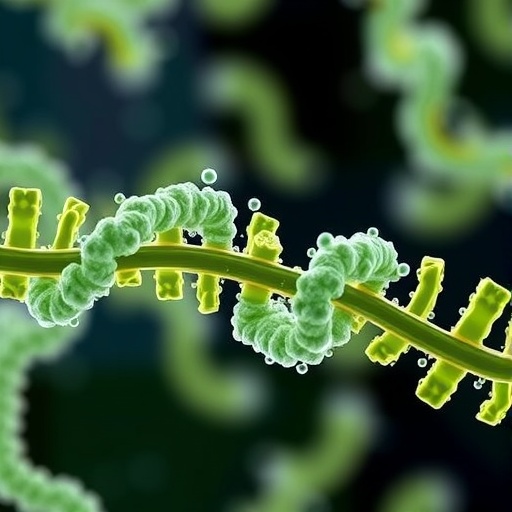
In a groundbreaking study spearheaded by researchers at Baylor College of Medicine and their collaborators, new analytical methods have profoundly advanced our understanding of bacterial DNA management, particularly the nuanced interplay between DNA gyrase and the physical properties of DNA itself. Published in the prestigious journal Nature Communications, this research sheds new light on how the sequence, three-dimensional shape, and flexibility of DNA contribute to the enzyme’s targeting and function—redefining earlier perspectives that placed sole importance on DNA gyrase’s enzymatic activity without consideration of DNA’s structural characteristics. This revelation holds significant promise for the future design of antibiotics targeting bacterial DNA management mechanisms.
DNA supercoiling is a fundamental biophysical state wherein the DNA helix coils upon itself, much like the tightly wound cord of an old-fashioned landline telephone handset. The regulation of this supercoiling is critical to essential cellular processes such as transcription, replication, and chromosome segregation. In bacterial cells, DNA gyrase is the primary enzyme that modulates this supercoiling, ensuring the dynamic equilibrium necessary for cellular function is maintained. However, despite decades of research, the precise mechanisms by which gyrase recognizes and acts on specific DNA sites have remained enigmatic.
Prior investigations have demonstrated that DNA gyrase operates within loops of supercoiled DNA, enshrouding itself within such loops as an initial step to relieve or introduce supercoils. Yet what guides gyrase to these specific DNA loci was unclear. Traditional models posited that DNA gyrase recognizes distinct nucleotide sequences to execute its function. The latest study challenges this dogma, illustrating that gyrase’s site-specific activity transcends simple sequence recognition, instead relying significantly on the inherent shapes and mechanical properties of DNA segments—factors directly derived from the nucleotide sequence but encoded in three-dimensional form.
The research team built upon high-resolution cryogenic electron microscopy (cryoEM) structures they had previously resolved of gyrase bound to small circular DNA molecules. These structures revealed two distinct conformations: one where the DNA was tightly wrapped around a domain of gyrase and another where DNA binding occurred with minimal wrapping. However, due to limited resolution, the identity of the DNA sequences engaged in these complexes had not been definitively mapped, posing a challenge to understanding the determinants of site specificity.
To overcome this barrier, the scientists developed an innovative computational approach that allowed them to discern the precise DNA sequences at gyrase binding sites within these cryoEM complexes despite resolution constraints. This analysis revealed an unexpected symmetry: gyrase could bind the same DNA region from two opposing orientations—one associated with the wrapped DNA conformation and the other with an unwrapped binding mode. This discovery suggests a previously unappreciated structural plasticity in gyrase-DNA interactions, which may underlie the enzyme’s ability to act at a broad range of genomic sites.
Crucially, the wrapped DNA structure was found to be characterized by adjacent DNA segments with distinct physical properties. The DNA region immediately flanking the gyrase-binding site exhibited high flexibility, facilitating the wrapping necessary for effective enzyme function. This flexibility enables the DNA to undergo bending and twisting reminiscent of a human elbow bending while the hand wraps around a ball—an apt metaphor used by the researchers. Without this flexibility in the “adjacent” DNA region, gyrase loses its efficacy in manipulating DNA supercoiling.
Further computational and structural analyses anchored these findings by systematically evaluating DNA deformability across a vast array of sequence contexts, drawing on decades of experimentally determined structural data. The team identified specific motifs and regions exhibiting maximal flexibility, supporting the conclusion that gyrase’s DNA recognition is deeply influenced by the capacity of the DNA helix to bend, twist, and wrap—a paradigm shift from linear sequence recognition to recognition of sequence-dependent shape and mechanics.
This dual dependence on DNA physical properties and sequence-encoded structural potential has profound implications. It suggests that gyrase, and potentially other DNA-binding enzymes, read the genome not only as a biochemical code but also as a physical landscape, navigating the genome’s three-dimensional form to locate functional sites efficiently. Such insights enrich our broader understanding of DNA-protein interactions and genome regulation in bacteria, deepening our grasp of molecular biology’s fundamental principles.
From a therapeutic perspective, DNA gyrase is one of the primary targets of several classes of antibiotics used in clinical settings. Compounds like fluoroquinolones inhibit gyrase activity, thereby disrupting bacterial DNA supercoiling and ultimately bacterial viability. The new mechanistic insights into how gyrase selects its binding sites open new avenues for designing more precise and potent antibacterial agents, which could exploit or disturb gyrase’s dependence on DNA shape and flexibility. This could help circumvent growing resistance mechanisms and yield antibiotics with novel modes of action.
The interdisciplinary approach of integrating cryoEM structural biology, computational modeling, and biophysical characterization underscores the power of modern techniques to unravel complex biomolecular interactions. Contributions came from experts across multiple institutions, showcasing a collaborative effort spanning biochemistry, molecular biology, computational biosciences, and structural biology. The study’s robust methodology and novel approach exemplify how computation can complement and extend the reach of experimental structural determination, offering atomic-level insights that were previously unattainable.
Ultimately, the findings highlight how the double-helical DNA’s physical and mechanical landscape, sculpted by its nucleotide sequence, serves as an essential framework guiding enzymatic activities beyond genetic coding. Dr. Lynn Zechiedrich, the study’s corresponding author, posits that this refined understanding not only demystifies gyrase function but also encourages reevaluation of how other DNA-modifying enzymes, such as topoisomerases, nucleases, and transcription factors, might similarly exploit DNA’s structural properties for site-specific function.
This research was supported by multiple grants from the National Institutes of Health (NIH) and the Welch Foundation, alongside international funding from the Agence Nationale de la Recherche. Such support underscores the significant interest and investment in decoding bacterial DNA dynamics, emphasizing the importance of foundational research for translational applications in medicine and biotechnology.
Other key contributors to this insightful study included Ryan A. Eckerty, Jonathan M. Fogg, Marlène Vayssières, Nils Marechal, Valérie Lamour, and Wilma K. Olson, representing diverse expertise from Baylor College of Medicine, University of Texas Health Sciences Center at Houston, the Georgia Institute of Technology, Université de Strasbourg, Hôpitaux Universitaires de Strasbourg, and Rutgers University. Together, their multidisciplinary collaboration has not only expanded our molecular understanding of DNA gyrase but has also laid groundwork for future innovations in antibiotic development.
News Publication Date: 20-Apr-2026
Web References:
- Nature Communications Article
- Baylor College of Medicine
- Quantitative and Computational Biosciences Program
- Zechiedrich Lab
References:
- Baker, M. et al. DNA deformability in sequence-dependent capture of E. coli gyrase, Nature Communications, 2026. DOI: 10.1038/s41467-026-71884-0
Cite this news
SCIENMAG. (April 22, 2026). Fresh Discoveries Reveal How Bacteria Control Their DNA. https://scienmag.com/fresh-discoveries-reveal-how-bacteria-control-their-dna/
SCIENMAG. "Fresh Discoveries Reveal How Bacteria Control Their DNA." Scienmag, 22 April 2026, https://scienmag.com/fresh-discoveries-reveal-how-bacteria-control-their-dna/. Accessed 27 August 2026.
SCIENMAG. "Fresh Discoveries Reveal How Bacteria Control Their DNA." Scienmag. April 22, 2026. https://scienmag.com/fresh-discoveries-reveal-how-bacteria-control-their-dna/


