


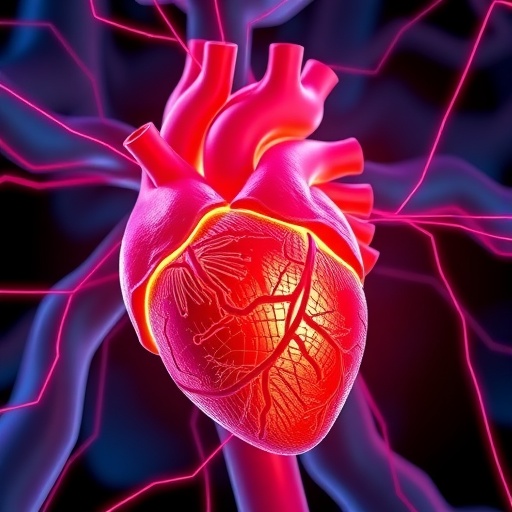
Calcium ions (Ca²⁺) have long been recognized as critical messengers in the physiology of cardiac muscle cells, yet recent advances in cellular imaging and molecular biology have brought a new level of clarity to their highly localized roles within cardiomyocytes. These localized Ca²⁺ signals occur within specialized microdomains—subcellular compartments meticulously organized to compartmentalize and streamline calcium signaling processes that govern a spectrum of cardiac functions. This nuanced picture transcends the traditional conception of calcium as merely a trigger for contraction, revealing it also as a vital nexus connecting mechanical activity, gene expression, and energy metabolism in the heart.
At the heart of excitation–contraction coupling lies the dyad, a specialized junction where the plasma membrane’s L-type Ca²⁺ channels and the sarcoplasmic reticulum’s ryanodine receptor 2 (RYR2) clusters are juxtaposed with astonishing precision. This intimate arrangement facilitates the phenomenon known as Ca²⁺-induced Ca²⁺ release (CICR), an exquisitely efficient mechanism whereby a small influx of extracellular calcium into the cell triggers the release of a much larger quantity of Ca²⁺ from internal stores. The resulting cytosolic calcium surge orchestrates the contraction of myofibrils, the fundamental contractile units of the heart muscle cells, enabling the heartbeat. Research increasingly emphasizes that the precise nanoscale geometry and molecular composition of the dyad are not static but dynamically regulated structures, responsive to intracellular and extracellular cues.
This dynamic nature of dyads becomes markedly apparent under physiological stress, such as heightened adrenergic stimulation. β-adrenergic signaling pathways, which mediate the ‘fight or flight’ response, instigate rapid remodeling within dyadic microdomains. This remodeling enhances the efficiency of CICR and, consequently, the force of cardiac contraction. However, these adaptations are a double-edged sword; when pervasive or chronic, such changes can precipitate maladaptive remodeling at the molecular level. Dysregulation of dyadic structure and function is increasingly implicated in the pathogenesis of heart failure and arrhythmias, underscoring the delicate balance that governs Ca²⁺ homeostasis in cardiomyocytes.
Beyond their fundamental role in driving contraction, calcium ions also participate in excitation–transcription coupling, a more protracted and subtle regulatory axis controlling gene expression. Nuclear calcium signals have emerged as key regulators of hypertrophic gene programs, influencing the expression of genes encoding calcium channels, transporters, and various contractile elements. Such transcriptional regulation is crucial in maintaining cardiac adaptability but may become detrimental when distorted in disease conditions. This duality highlights calcium’s multifaceted nature: beyond its immediate mechanical role, it functions as an intracellular messenger directing long-term phenotypic changes in myocardial cells.
Another layer of complexity involves cardiac mitochondrial function, where calcium fluxes modulate bioenergetic processes. The term excitation–bioenergetics coupling has been coined to reflect the role of intracellular calcium signaling in aligning energy supply to the mechanical demands of the heart. Microdomains strategically position mitochondria in close proximity to calcium release sites, enabling rapid Ca²⁺ uptake by the organelles. This uptake finely tunes mitochondrial metabolism, influencing ATP synthesis rates required to sustain efficient contraction cycles. Such spatial and functional coupling is vital not only for normal cardiac physiology but also in the pathological context, where disrupted calcium signaling can impair energy metabolism and contribute to cellular dysfunction.
Pathological remodeling in heart failure profoundly disrupts these tightly regulated calcium microdomains. Dyadic disorganization leads to impaired CICR, diminished contractile force, and a propensity for dangerous arrhythmias. The ultrastructural alterations include a loss of dyad density and mislocalization of key calcium handling proteins, which weaken the fidelity of calcium transients. Furthermore, maladaptive shifts in nuclear calcium signaling exacerbate the pathological gene expression patterns contributing to hypertrophy and fibrosis. Interventions that target these specific deficits hold promise for more effective therapies to halt or reverse the progression of heart failure.
Emerging data also highlight the intriguing capability of dyadic proteins to translocate under stress conditions into nuclear compartments, where they participate directly in transcriptional regulation. This translocation blurs the conventional borders between excitation–contraction and excitation–transcription coupling, positioning calcium microdomain proteins as vital connectors in the orchestration of mechanical and genomic cardiac responses. Understanding the molecular signals that govern this translocation may offer new therapeutic avenues for modulating pathological gene expression in failing hearts.
The therapeutic potential of targeting calcium microdomains is gaining considerable traction in recent studies. Pharmacological agents designed to stabilize dyadic structures or modulate the activity of L-type channels and RYR2 receptors could restore normal calcium signaling dynamics and improve cardiac performance. Such strategies aim not merely to rectify contractile dysfunction but also to mitigate the heightened arrhythmogenic risk associated with aberrant calcium handling. Precision targeting of these microdomains represents a paradigm shift from the broad approaches of traditional heart failure management to a more tailored restoration of subcellular signaling integrity.
Calcium microdomain research also underscores the necessity for high-resolution imaging and novel molecular tools, as these localized events operate on scales previously inaccessible to conventional techniques. Super-resolution microscopy, advanced calcium indicators, and computational modeling have been indispensable in revealing the architecture and kinetics of dyadic signaling. Continuous technological innovation will undoubtedly deepen our understanding of calcium compartmentalization and its widespread impact on cardiac physiology and pathology.
Additionally, this research domain is expanding to consider how calcium microdomain dynamics integrate with other signaling pathways, such as those mediated by reactive oxygen species, nitric oxide, and mechanical stretch sensors. The cardiac myocyte is emerging as a complex signal processing unit where diverse input streams converge within microdomains to finely tune physiological responses. This holistic view prompts a re-examination of cardiac pathobiology through the lens of signal compartmentalization and interplay.
Understanding calcium microdomains also informs the development of gene therapy and molecular interventions aimed at correcting specific protein deficiencies or mutations linked to hereditary cardiomyopathies. By restoring or augmenting key components of these microdomains, it may become possible to counteract inherited defects that underlie severe cardiac dysfunction. Such precision medicine approaches would benefit from the detailed mechanistic insights generated by current research in calcium signaling microdomains.
Moreover, the influence of aging on the integrity and function of calcium microdomains is an emerging area of investigation. Age-dependent changes in dyadic architecture and calcium handling efficiency may contribute to the increased incidence of heart failure and arrhythmias observed in elderly populations. Interventions that preserve the microdomain organization or enhance its plasticity could hold promise in mitigating age-related cardiac decline.
In conclusion, the current landscape of cardiac calcium signaling research reveals a sophisticated, multidimensional framework in which calcium microdomains serve as pivotal hubs orchestrating the heart’s mechanical, metabolic, and genomic functions. The pathological remodeling of these microdomains in heart failure highlights their indispensability and vulnerability. As we continue exploring their complexities, new horizons open for targeted therapeutic strategies that promise to revolutionize treatment paradigms for cardiac disease, improving outcomes and reducing the burden of arrhythmias and contractile dysfunction.
Cite Scienmag News
Juliet Wilcox. (April 22, 2026). Calcium Signals Powering Heart Cell Function. Scienmag. https://scienmag.com/calcium-signals-powering-heart-cell-function/
Juliet Wilcox. "Calcium Signals Powering Heart Cell Function." Scienmag, 22 April 2026, https://scienmag.com/calcium-signals-powering-heart-cell-function/. Accessed 4 September 2026.
Juliet Wilcox. "Calcium Signals Powering Heart Cell Function." Scienmag. April 22, 2026. https://scienmag.com/calcium-signals-powering-heart-cell-function/


