


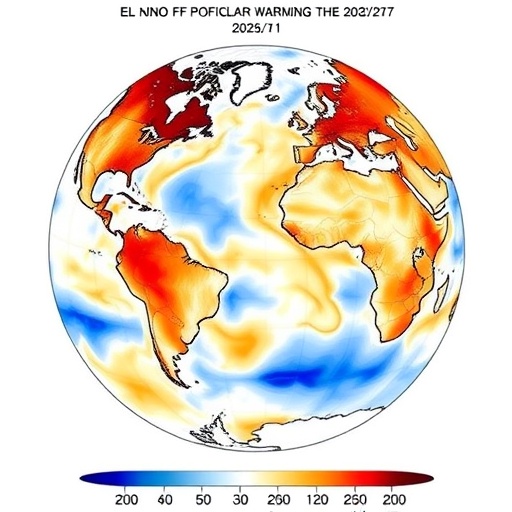
El Niño and La Niña, the dominant climate oscillations in the tropical Pacific, have long been recognized for their far-reaching impacts on global weather and climate. These oscillations typically occur every two to seven years, dynamically influencing temperature and precipitation patterns worldwide. However, in the context of accelerating climate change, these phenomena are exhibiting increased intensity and complexity, heightening the risk of extreme weather events globally. Recently, a pioneering study by a team of oceanographers and climate scientists has forecasted an extraordinary super El Niño event anticipated at the end of 2026, driven by a rare and intense annular warming pattern in the tropical Pacific Ocean.
El Niño events are characterized by anomalously warm sea surface temperatures (SSTs) in the central and eastern equatorial Pacific, which disrupt established atmospheric circulation including the weakening of trade winds. These atmospheric changes cascade through global weather systems, generally causing elevated global temperatures, drought conditions in Australia and Southeast Asia, and excessive rainfall across South America and the southern United States. Conversely, La Niña reflects cooler-than-average SSTs in the same region, often producing opposite climatic effects. The magnitude and breadth of these impacts underscore the critical importance of accurate and timely El Niño predictions.
The latest research leverages cutting-edge climate prediction models to identify an exceptional annular, or ring-shaped, warming pattern occurring in the tropical Pacific during the spring of 2026. This pattern manifests as strong positive SST anomalies concentrated simultaneously in the tropical western Pacific, northeastern Pacific, and southeastern Pacific—an anomaly formation rarely documented in the past four decades. Crucially, this annular warming integrates with an already elevated upper ocean heat content, creating conducive conditions for an intensification of El Niño beyond moderate levels.
In their investigation, the scientists utilized a sophisticated computational climate system capable of real-time forecasting, running experimental simulations to isolate the impacts of the upper ocean heat buildup versus the annular warming pattern. Their results reveal that while the elevated ocean heat content alone could trigger a standard moderate El Niño event by late 2026, the introduction of the annular temperature anomalies substantially amplifies the phenomenon, elevating it into the super El Niño category. This distinction is critical, as super El Niños historically produce more severe and widespread global climatic disruptions.
One intriguing aspect of the study is the resilience of the predicted El Niño intensity against variations in initial model conditions. This robustness suggests a high degree of confidence in their forecasts, not merely presenting an event prediction but illuminating the underlying physical mechanisms driving the emergent super El Niño signal. The authors emphasize that their findings help reconcile why multiple climate models are converging on predicting a potent El Niño event given the unprecedented Pacific warming.
Despite this optimism, the researchers acknowledge inherent uncertainties remain, particularly surrounding extratropical climatic influences and high-frequency atmospheric perturbations over the tropical Indian and Atlantic Oceans. These remote forcings, along with the stochastic nature of short-term atmospheric fluctuations, impose limits on the precision of current climate models in predicting exact El Niño characteristics. Notably, the unpredictability of these high-frequency atmospheric perturbations constrains long-range forecasts, necessitating ongoing model refinement.
The study reinforces the well-established link between upper ocean heat content accumulation in the equatorial western Pacific and El Niño onset, typically lagging six to nine months. Beyond this, it highlights the crucial modulation of El Niño intensity by off-equatorial SST anomalies, mechanisms often overlooked in conventional forecasting frameworks. The recognition of annular warming as a key amplifier in the upcoming event marks a significant advancement in understanding complex ocean-atmospheric interactions.
Importantly, the researchers documented a strong westerly wind perturbation in late March 2026, a high-frequency atmospheric event known to enhance the growth and configuration of El Niño. Such fluctuations can have outsized effects in the formative spring and early summer months, shaping the eventual strength and spatial structure of the mature El Niño. These dynamics further reinforce predictions pointing toward a super El Niño developing later that year.
Chinese oceanographer Tao Lian, lead author on the study, underscored the enigmatic nature of El Niño, stating, “El Niño never ceases to surprise us. Our forecasts are grounded in currently understood ocean-atmosphere processes, yet the system’s complexity and evolving climate context continually reveal new surprises.” This humility reflects the challenges of anticipating nonlinear climate phenomena while highlighting the progress made using integrated observational data and advanced models.
The research team comprises experts from multiple prestigious institutions, including the Second Institute of Oceanography under China’s Ministry of Natural Resources and the Southern Marine Science and Engineering Guangdong Laboratory. Their integrated approach combines satellite ocean environment observations with state-of-the-art ocean-land-atmosphere modeling, offering a comprehensive analysis of the evolving tropical Pacific climate system.
As the globe braces for potential ramifications, ranging from intensified droughts and floods to disruptions in agriculture and water resources, accurate and early warnings of a super El Niño are essential for proactive adaptation and mitigation strategies. The findings presented in the April 2026 publication of Ocean-Land-Atmosphere Research represent a significant leap forward in predictive climate science, illustrating the nuanced and emergent drivers behind one of Earth’s most influential climate patterns.
Continued monitoring and real-time refinement of these predictions throughout 2026 will be critical, as emerging atmospheric conditions and unforeseen perturbations could modulate the eventual outcome. Nonetheless, the current evidence strongly indicates that the 2026/27 El Niño could surpass all recent events in intensity, reshaping global climate impacts on an unprecedented scale.
News Publication Date: 21-Apr-2026
Web References: http://dx.doi.org/10.34133/olar.0153
References: Tao Lian et al., 2026, Ocean-Land-Atmosphere Research
Cite Scienmag News
Russell Cooper. (April 22, 2026). Pacific Annular Warming Boosts 2026/27 El Niño Forecast. Scienmag. https://scienmag.com/pacific-annular-warming-boosts-2026-27-el-nino-forecast/
Russell Cooper. "Pacific Annular Warming Boosts 2026/27 El Niño Forecast." Scienmag, 22 April 2026, https://scienmag.com/pacific-annular-warming-boosts-2026-27-el-nino-forecast/. Accessed 3 September 2026.
Russell Cooper. "Pacific Annular Warming Boosts 2026/27 El Niño Forecast." Scienmag. April 22, 2026. https://scienmag.com/pacific-annular-warming-boosts-2026-27-el-nino-forecast/


