


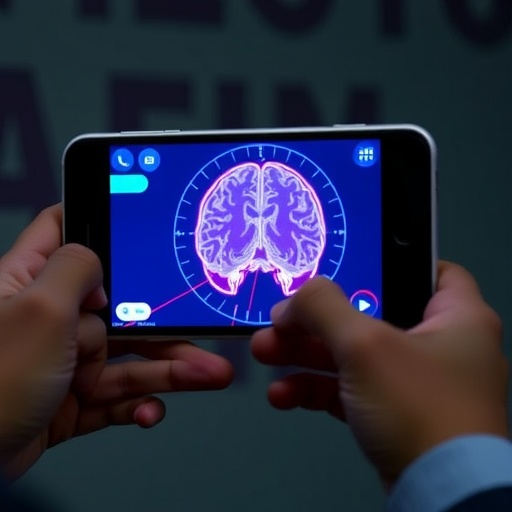
In a groundbreaking advancement poised to revolutionize the management of Parkinson’s disease, researchers have unveiled a novel smartphone-based technology designed to dramatically enhance deep brain stimulation (DBS) programming. This innovative system, known as StimVision, harnesses the powerful capabilities of modern smartphones to capture detailed video kinematic data, allowing clinicians to optimize DBS parameters with unprecedented precision and ease. The implications of this technology promise to usher in a new era of personalized neuromodulation therapy, significantly improving clinical outcomes for those living with Parkinson’s.
Parkinson’s disease, characterized by its hallmark motor symptoms such as tremors, rigidity, and bradykinesia, affects millions worldwide. DBS has emerged over the past two decades as a transformative intervention, modulating neural circuits to alleviate debilitating motor symptoms. Yet a well-known challenge persists: programming the stimulator’s myriad settings to achieve maximal therapeutic effect with minimal side effects is a complex and labor-intensive process. Traditional programming relies heavily on clinician observation and subjective patient feedback, making it both time-consuming and often suboptimal.
StimVision aims to surmount these hurdles by digitizing the assessment process through high-fidelity smartphone video analysis. This approach captures real-time movement data, translating subtle motor fluctuations into quantitative kinematic metrics. Utilizing advanced algorithms, the system deciphers patterns of tremor amplitude, frequency, and motor execution quality, offering an objective and granular picture of a patient’s motor state. This comprehensive dataset serves as an invaluable guide during DBS parameter adjustments, enabling a level of customization and refinement previously unattainable.
The development of StimVision was driven by a collaborative interdisciplinary team spanning neurology, biomedical engineering, and data science. Leveraging recent breakthroughs in computer vision and machine learning, the researchers designed an intuitive application capable of operating on commercially available smartphones. This accessibility factor is critical, as it lowers the barrier to widespread deployment and integrates naturally into existing clinical workflows. Patients simply perform prespecified motor tasks while their smartphone records video data, which is then automatically analyzed to produce actionable insights.
Beyond merely quantifying motor symptoms, StimVision’s analytical framework incorporates sophisticated neural modeling that interprets the relationship between stimulation parameters and observed kinematic outputs. This computational backbone allows the system to predict which programming adjustments will likely yield positive clinical benefits, effectively transforming DBS titration from an art to a science. This predictive capability means fewer trial-and-error sessions, reducing patient burden and streamlining clinical operations.
Initial clinical evaluations of StimVision demonstrate remarkable accuracy and reliability in correlating video-derived metrics with established clinical rating scales such as the Unified Parkinson’s Disease Rating Scale (UPDRS). Importantly, the technology also exhibits sensitivity to subtle changes in motor function that may elude subjective clinical assessment. This granular sensitivity holds the promise of detecting early shifts in disease state or therapeutic response, facilitating timely intervention adjustments.
The potential benefits of implementing StimVision extend beyond individual patient care. On a systemic level, digitized and standardized kinematic data has the capacity to be aggregated and analyzed on a population scale, offering novel epidemiological insights into DBS outcomes and Parkinson’s progression. Furthermore, the objective data streamlines communication amongst multidisciplinary care teams, enhancing coordinated treatment planning.
The advent of StimVision represents a paradigm shift toward precision neurology, where technological innovation serves as a catalyst for optimizing care delivery. By leveraging smartphone ubiquity and cutting-edge computing, this approach embodies the ideal of democratizing access to sophisticated medical technology. Especially in resource-limited settings, where specialized neurological expertise may be scarce, such tools can empower local practitioners and improve equity in Parkinson’s disease management.
As deep brain stimulation continues to evolve, complementary technologies like StimVision will be integral to unlocking the full potential of this therapeutic modality. The system’s scalability and adaptability also open avenues for integration with other digital health solutions, including remote monitoring platforms and telemedicine services, further enhancing patient engagement and convenience.
The researchers acknowledge that while StimVision marks a significant stride, ongoing refinement is essential. Future iterations aim to enhance algorithmic robustness to diverse patient phenotypes, incorporate additional motor tasks to capture a broader symptom spectrum, and validate long-term clinical outcomes in larger, multi-center trials. Incorporation of machine learning models trained on diverse datasets will further improve predictive accuracy and personalization capacity.
This advancement exemplifies the power of converging technologies—neuroscience, digital health, and artificial intelligence—to tackle complex clinical challenges. As the boundaries between traditional medical practice and technological innovation continue to blur, patients with Parkinson’s stand to benefit from increasingly sophisticated tools that transform both diagnosis and treatment paradigms.
In the broader context, StimVision aligns with the emergent vision of the “quantified self” in medicine, where continuous, objective measurement enhances understanding and management of chronic conditions. By translating ephemeral motor symptoms into durable digital biomarkers, this technology enables data-driven decision-making that can refine therapeutic strategies, tailor interventions, and ultimately improve quality of life.
The availability of smartphone-based kinematic analysis positions Parkinson’s care at the forefront of digital neurology, creating new possibilities for research, clinical practice, and patient empowerment. The ease of use and non-invasiveness of this technology also support longitudinal monitoring, providing clinicians with comprehensive temporal datasets to track disease evolution and treatment response over time.
As healthcare systems worldwide grapple with rising chronic disease burdens and constrained resources, innovations such as StimVision offer scalable solutions that optimize clinical efficiency and patient outcomes. The potential to reduce clinic visits, minimize adverse effects from improper programming, and enhance patient satisfaction underscores the transformative value of this approach.
In summary, StimVision exemplifies a remarkable leap forward in DBS programming by embracing ubiquitous smartphone technology to generate quantitative, objective, and predictive insights into motor function in Parkinson’s disease. Its integration into routine clinical practice promises to optimize neuromodulation therapy, accelerate research, and empower patients. This pioneering work heralds a future in which personalized medicine is not only a goal but a tangible reality enabled by accessible, intelligent digital tools.
Cite Scienmag News
Cassandra Pierce. (April 20, 2026). Smartphone Video Enhances Parkinson’s DBS Programming. Scienmag. https://scienmag.com/smartphone-video-enhances-parkinsons-dbs-programming/
Cassandra Pierce. "Smartphone Video Enhances Parkinson’s DBS Programming." Scienmag, 20 April 2026, https://scienmag.com/smartphone-video-enhances-parkinsons-dbs-programming/. Accessed 3 September 2026.
Cassandra Pierce. "Smartphone Video Enhances Parkinson’s DBS Programming." Scienmag. April 20, 2026. https://scienmag.com/smartphone-video-enhances-parkinsons-dbs-programming/


