


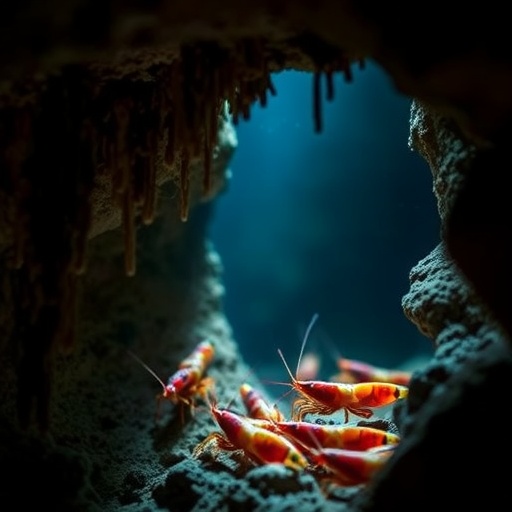
Beneath the dense and verdant rainforests of Mexico’s Yucatan Peninsula lies a concealed labyrinth of submerged sinkholes and anchialine cave systems, captivating for their extraordinary biology and geological uniqueness. These underwater ecosystems, isolated from the surface by impermeable barriers and influenced by tides and the mingling of fresh and saltwater, have persisted as evolutionary sanctuaries for millions of years. Their ecological dynamics, largely unexplored until recently, have now been illuminated through an innovative study focusing on one of the system’s keystone inhabitants: the cave shrimps of the genus Typhlatya.
When marine biologist Fernando Álvarez ventured into the depths of these cenotes — the natural sinkholes punctuating the Yucatan’s limestone bedrock — he was immediately drawn to the richness of crustacean life dwelling within. The enigmatic nature of the cave shrimps sparked fundamental questions about how life endures and interacts in total darkness without traditional surface inputs like sunlight. His curiosity fueled intensive research that combined taxonomic expertise with modern analytical tools, ultimately unraveling intricate ecological relationships hidden in these submerged twilight zones.
Unlike surface ecosystems that thrive on sunlight-driven photosynthesis, the anchialine caves operate under a radically different principle of energy acquisition. Here, chemosynthesis takes precedence, a biochemical pathway supporting life through chemical energy derived from compounds like methane rather than solar radiation. Methane, a potent greenhouse gas, traces its journey from decomposing organic matter on the rainforest floor, seeping down through porous limestone into the saturated cave environment, catalyzing a unique form of microbial productivity.
At the heart of this subterranean food web are methanotrophic bacteria that metabolize methane, producing biomass that forms the primary resource for higher trophic levels. Typhlatya shrimps have evolved specialized anatomical traits, including scraping appendages, enabling them to efficiently harvest these bacterial mats. These shrimps thus form a crucial energy bridge, converting microbial biomass into animal tissue and transferring energy upward to predators within the cave system. In ecological parlance, they serve as keystone species, foundational to maintaining the stability and diversity of the subterranean community.
To further dissect the ecological nuances of these shrimps, Álvarez and colleague Brenda Durán employed stable isotope analysis, a sophisticated technique that deciphers organisms’ dietary sources by examining carbon and nitrogen isotope ratios in their tissues. This approach unveiled that different Typhlatya species have evolved distinct feeding strategies, effectively partitioning the ecological niche within the confined cave environment. Such differentiation minimizes interspecies competition and fosters coexistence amid limited resources and space.
Specifically, Typhlatya mitchelli inhabits shallower cave sections where it preferentially consumes detrital vegetation and nitrifying bacteria thriving in oxygenated waters. Meanwhile, Typhlatya dzilamensis frequents deeper zones near haloclines — the interfaces where freshwater overlays denser saltwater — capitalizing on organic detritus trapped within this unique marine interface. Typhlatya pearsei, in contrast, exploits bacterial mats rich in methanotrophic biomass near the cave ceilings, areas marked by stable chemical gradients conducive to microbial proliferation. This finely tuned resource partitioning underscores evolutionary adaptations aligning with microhabitat conditions.
Seasonal fluctuations, often determinant in many aquatic ecosystems, surprisingly exert little influence on the shrimps’ dietary habits. The research showed remarkable isotopic stability across both dry and rainy seasons, indicating a consistent baseline of organic input and bacterial productivity. However, geographical variability within the peninsula’s cave systems introduces subtle shifts. The deep, isolated sinkholes famous as the “Ring of Cenotes” harbor different ecological dynamics compared to the extensive, interconnected passages of the “Caribbean Cave Area,” revealing spatial heterogeneity in resource distribution and community structure.
Despite their ancient lineage, surviving since the Mesozoic era and related to species scattered from the Mediterranean to Australia, these cave shrimps face unprecedented existential threats. Rapid urbanization and human encroachment across the Yucatan Peninsula have initiated a cascade of environmental degradation, including deforestation and pollution, which imperil the fragile vertical connectivity essential to sustaining these subterranean ecosystems. Since the caves depend wholly on organic matter and chemical exchanges percolating from the forest floor, disturbances above ground disrupt the delicate chemical and ecological balance below.
Álvarez poignantly warns about the “vertical integrity” that underpins anchialine caves. The collapse of this integrity, whether through contamination or habitat destruction, would unravel the ecosystem’s foundation, leading to irreversible loss of biodiversity and ecosystem services. The conservation of these hidden worlds is thus inextricably linked to the stewardship of the surface landscapes, emphasizing a holistic approach to environmental protection encompassing both visible and cryptic realms.
The study’s implications extend beyond academic interest, highlighting the interconnectedness of terrestrial and subterranean ecosystems. Protecting the Yucatan’s celebrated cultural heritage must go hand in hand with preserving its natural subterranean heritage, which harbors unique species like Typhlatya shrimps that represent ancient evolutionary experiments in survival. Through cutting-edge techniques and ecological insight, scientists now illuminate these dark aquatic realms, turning attention toward their urgent conservation needs.
In sum, the anchialine cave systems of the Yucatan Peninsula reveal a paradox of life thriving without sunlight, relying instead on chemical energy transfer mediated by specialized organisms like Typhlatya shrimp. These shrimps not only sustain the cave food web but also embody the resilience and fragility of subterranean biodiversity in a rapidly changing world. Their story challenges us to rethink how we value and protect unseen ecosystems, essential threads in the complex web of life on Earth.
News Publication Date: 12-Feb-2026
Web References: http://dx.doi.org/10.3897/subtbiol.55.164068
References:
Durán B, Álvarez F (2026) The trophic role of cave shrimps of the genus Typhlatya seen through stable isotope eyes. Subterranean Biology 55: 43-56.
Cite Scienmag News
Gavin Prescott. (April 20, 2026). How Microscopic Cave Shrimps Fuel the Hidden Ecosystem of the Yucatán Underworld. Scienmag. https://scienmag.com/how-microscopic-cave-shrimps-fuel-the-hidden-ecosystem-of-the-yucatan-underworld/
Gavin Prescott. "How Microscopic Cave Shrimps Fuel the Hidden Ecosystem of the Yucatán Underworld." Scienmag, 20 April 2026, https://scienmag.com/how-microscopic-cave-shrimps-fuel-the-hidden-ecosystem-of-the-yucatan-underworld/. Accessed 4 September 2026.
Gavin Prescott. "How Microscopic Cave Shrimps Fuel the Hidden Ecosystem of the Yucatán Underworld." Scienmag. April 20, 2026. https://scienmag.com/how-microscopic-cave-shrimps-fuel-the-hidden-ecosystem-of-the-yucatan-underworld/


