


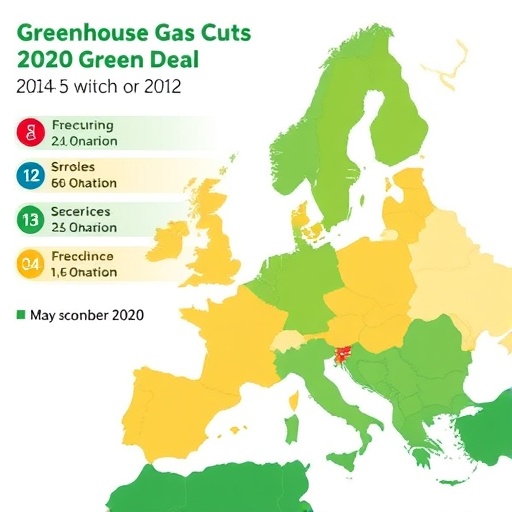
In a groundbreaking step toward climate neutrality, a recent study published in Nature Communications sheds new light on the ambitious greenhouse gas reduction targets set for 2040 across the European Union. The research offers a comprehensive analysis of energy transitions designed to align with the stringent mandates of the EU Green Deal, which aims to transform the continent into the world’s first climate-neutral economy by 2050. This intricate work delves into the multi-dimensional pathways required to achieve these targets, addressing both the technological and policy shifts necessary for a sustainable energy future.
The study meticulously evaluates the interplay between existing energy infrastructures and the projected deployments of renewable technologies, providing a nuanced understanding of how these components contribute to emissions reduction timelines. Central to the research is an exploration of the balancing act between fossil fuel phase-outs and the upscale of low-carbon energy solutions, such as wind, solar photovoltaic (PV), and green hydrogen. It highlights that meeting the 2040 targets will not only demand exponential growth in renewable generation capacity but also the widespread adoption of electrification, from transport to heating sectors.
A defining feature of the analysis is its scenario-based modeling approach, which simulates varied policy frameworks and their efficacy in driving decarbonization. By contrasting a business-as-usual scenario against proactive regulatory environments, the researchers illustrate that without ambitious policy measures, emissions trajectories will fail to meet the levels required by the EU Green Deal. This insight emphasizes the critical role of policy coherence and intensified governmental intervention to accelerate clean energy investment and infrastructure upgrades.
The paper brings to the fore the scalability challenges associated with integrating intermittent renewable sources into power grids already stretched by demand surges and electrification trends. Storage technologies and flexible energy systems emerge as pivotal enablers, offsetting variability and ensuring grid stability. The authors discuss advanced grid management protocols alongside innovations in battery storage and power-to-gas technologies that can convert excess renewable electricity into storable fuels, bridging temporal gaps in supply and demand.
The transformation envisioned also predicates a seismic shift in industrial energy use patterns. With heavy industry accounting for a substantial portion of emissions, viable decarbonization pathways necessitate the deployment of breakthrough technologies. Among these, electrification using renewable-derived electricity and the use of green hydrogen stand out. Their adoption is projected to not only reduce direct emissions but also reshape material production cycles, thereby embedding sustainability into the lifeblood of European industrial economies.
Transportation, a notoriously difficult sector to decarbonize, receives detailed attention in this research. The transition to electric vehicles (EVs) aligns synergistically with broader grid electrification trends, amplifying demand for renewable electricity. However, the study highlights that achieving 2040 targets will also require the expansion of public transit systems, modal shifts toward less carbon-intensive transport options, and the electrification of heavy-duty vehicles. The integration of these elements into urban planning and mobility policies is regarded as an essential vector for emission reductions.
One of the more innovative aspects of the study is its incorporation of socioeconomic effects, particularly the implications of energy transitions for employment and regional development. The researchers underscore the necessity of a just transition framework that safeguards vulnerable communities and fosters new economic opportunities, particularly in regions heavily reliant on fossil fuel industries. This approach aligns with the wider policy goals of social inclusivity embedded in the EU Green Deal, ensuring that climate action also becomes a catalyst for equitable growth.
The study also rigorously assesses the role of carbon pricing mechanisms and fiscal incentives in catalyzing the green transition. By quantifying the impact of varying carbon tax levels and subsidy regimes, it reveals that higher carbon prices, coupled with strategic subsidies for renewable infrastructure, exponentially increase the likelihood of meeting climate objectives. This finding calls for policymakers to harmonize market instruments effectively to stimulate both demand and supply sides of the sustainable energy equation.
Crucially, the research highlights the international dimension of the EU’s energy transition, recognizing that import dependence on critical materials such as lithium, cobalt, and rare earth elements may create supply chain vulnerabilities. The analysis advocates for intensified recycling efforts, material efficiency, and diversification of supply sources to buffer against geopolitical risks and ensure the resilience of energy technology rollouts.
Climate change mitigation strategies within the report also prioritize carbon capture and storage (CCS) technologies as complementary tools. Although direct emissions reduction remains paramount, CCS is positioned as vital for offsetting residual emissions in sectors where complete decarbonization is technologically or economically challenging by 2040. The study outlines the technology’s deployment potential alongside its current economic and regulatory barriers, urging coordinated policy support to advance CCS integration.
Environmental sustainability beyond greenhouse gases is also addressed. The ecological footprint of energy transitions, particularly land use change impacts from large-scale renewable installations, is analyzed through lifecycle assessment frameworks. The authors propose integrated planning approaches that balance biodiversity conservation with renewable energy deployment, ensuring long-term ecosystem health alongside climate goals.
The interdisciplinary nature of the research stands out as it combines climate science, engineering, economic modeling, and policy analysis to construct robust, credible future scenarios. The integration of high-resolution energy system models with socio-political assumptions creates a granular depiction of what the EU energy landscape may look like by 2040, enabling stakeholders to make informed decisions and adjustments in near-real-time.
In sum, this comprehensive study articulates that while the road to 2040 is fraught with challenges, the outlined pathways remain technologically feasible and economically viable, contingent upon timely and coordinated action across multiple sectors. The EU Green Deal is presented not just as a set of aspirational policy targets but as a detailed blueprint guiding Europe’s transformation towards a resilient and sustainable energy future, offering insights that carry global resonance.
The findings underscore urgency and optimism in equal measure, illuminating the multifaceted pathways that countries must navigate to meet the pressing demands of climate change. They serve not merely as projections but as a call to arms for governments, industry, and society to coalesce around science-driven, inclusive strategies that will secure the planet’s future for coming generations.
Cite Scienmag News
Violet Maxwell. (April 16, 2026). 2040 Greenhouse Gas Cuts Align with EU Green Deal. Scienmag. https://scienmag.com/2040-greenhouse-gas-cuts-align-with-eu-green-deal/
Violet Maxwell. "2040 Greenhouse Gas Cuts Align with EU Green Deal." Scienmag, 16 April 2026, https://scienmag.com/2040-greenhouse-gas-cuts-align-with-eu-green-deal/. Accessed 5 September 2026.
Violet Maxwell. "2040 Greenhouse Gas Cuts Align with EU Green Deal." Scienmag. April 16, 2026. https://scienmag.com/2040-greenhouse-gas-cuts-align-with-eu-green-deal/


