


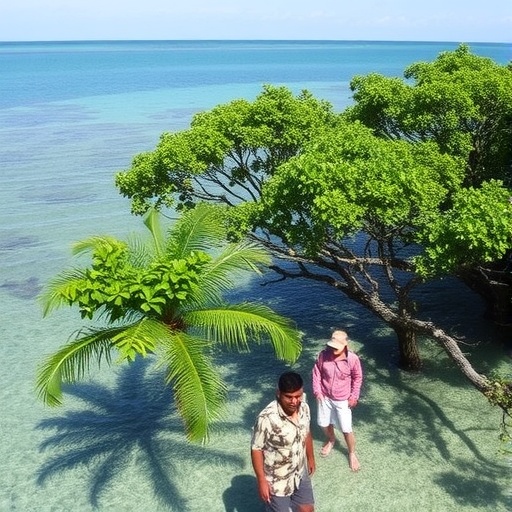
Mangrove ecosystems, celebrated for their critical role in coastal protection, carbon sequestration, and biodiversity maintenance, are increasingly threatened by human activities. Researchers from the University of California San Diego’s Scripps Institution of Oceanography in collaboration with Mexico’s Centro para la Biodiversidad Marina y la Conservación have pioneered a novel analytical tool that quantifies the risk of degradation to mangrove patches worldwide, transforming the paradigm of conservation from reactive to proactive. This tool, termed the Mangrove Threat Index, synthesizes spatial data relating to human encroachment and offers a predictive metric for prioritizing conservation interventions before irreversible damage ensues.
Mangroves, ubiquitous in tropical and subtropical coastlines, function as natural buffers against storm surges, serve as crucial nursery habitats for fish populations, and are significant carbon sinks mitigating climate change impacts. Nevertheless, approximately fifty percent of the planet’s mangrove forests face imminent collapse due to anthropogenic pressures including urban sprawl, agricultural expansion, and infrastructure development. Existing climate models, while effective in projecting long-term threats such as sea-level rise and ocean warming, often fail to capture localized, immediate pressures that precipitate mangrove loss.
Traditionally, conservation research has been characterized by retrospective assessments documenting hectares of mangrove lost annually. Recognizing the limitations of this approach, Octavio Aburto Oropeza and colleagues sought to invert the paradigm by developing an index aimed at proactively identifying mangrove areas most vulnerable to degradation. Their objective was to equip planners and communities with quantitative, actionable data to facilitate interventions that protect ecosystems before substantial damage occurs.
To construct the Mangrove Threat Index, the researchers employed a geospatial analysis framework, meticulously delineating 530 mangrove patches across 13 global regions. Using high-resolution satellite imagery from 2010, they manually mapped the exact boundaries of each patch and calculated proximity metrics relative to roads, settlements, and agricultural land—human activities known to exert degradative pressures. These variables were integrated into a normalized index ranging from 0 (indicating minimal risk) to 1 (highest risk), providing a singular, interpretable figure representing the likelihood of future degradation.
Validation of the index’s predictive power was conducted by comparing the 2010 risk scores with satellite data from 2020. Remarkably, 78% of mangrove patches flagged as medium-high or high risk experienced measurable area loss within this decade. Furthermore, nearly half of these degraded patches lost over half a hectare (1.2 acres), implicating significant ecosystem deterioration. Statistical models elucidated a strong correlation between the index score and degradation extent, with each incremental increase in the index associated with a 58% elevation in degradation probability.
The implications of these findings are profound. Mangroves are foundational ecosystems whose ecological services underpin coastal resilience, fisheries productivity, and global carbon budgets. Recovery from degradation spans decades, necessitating early and targeted conservation actions. Valentina Platzgummer, the study’s lead author, emphasizes that the Mangrove Threat Index serves as a science-driven compass, enabling stakeholders to detect accumulating pressures and intervene with precision before ecological and socioeconomic costs escalate.
Pragmatically, the index’s reliance on accessible spatial datasets and straightforward computational methods ensures its applicability by local governments, conservation organizations, and community groups even in resource-limited contexts. For instance, planners can mandate environmental assessments for proposed developments situated within high-risk mangrove zones as identified by the index, thereby embedding ecological risk considerations into urban and rural planning protocols.
Analogous to insurance underwriting, where premiums reflect asset value combined with anticipated risk, the Mangrove Threat Index quantifies not only the intrinsic worth of mangroves but also the probability of degradation, providing a tangible rationale for allocating conservation resources. Without such risk assessments, conservation expenditures may lack compelling justification despite the recognized ecosystem services at stake.
Demonstrating its real-world utility, the index was applied to 17 mangrove sites surrounding La Paz, Mexico. A particular site, El Comitán, located at an interface of urban and undeveloped lands, was deemed highly vulnerable. This risk identification galvanized a community-driven restoration initiative incorporated with municipal support, exemplifying how empirical risk metrics can underpin effective, localized conservation actions.
Beyond mangroves, the researchers envision the index framework extending to other ecosystems where degradation correlates with human proximity, such as seagrass beds, saltmarshes, and freshwater wetlands. By openly sharing their data and analytical code, they foster reproducibility and adaptation of the approach, paving the way for widespread adoption of proactive ecosystem risk assessment and governance.
This pioneering work marks a critical advance in conservation science, shifting from the historically pessimistic or optimistic outlooks that respectively emphasize inevitable loss or unquantified hope, to a data-driven, risk-based governance model. As coastal populations continue to grow and climate change accelerates, tools like the Mangrove Threat Index are indispensable for safeguarding ecological integrity and human well-being alike.
In conclusion, the Mangrove Threat Index exemplifies the integration of remote sensing, spatial statistics, and ecological insight to preemptively identify vulnerable mangrove patches. By enabling timely interventions, it offers a beacon of hope amidst global conservation challenges, ensuring that these invaluable coastal forests persist for generations to come.
Cite Scienmag News
Margaret Porter. (April 16, 2026). Innovative Metric Detects Vulnerable Mangroves Ahead of Disappearance. Scienmag. https://scienmag.com/innovative-metric-detects-vulnerable-mangroves-ahead-of-disappearance/
Margaret Porter. "Innovative Metric Detects Vulnerable Mangroves Ahead of Disappearance." Scienmag, 16 April 2026, https://scienmag.com/innovative-metric-detects-vulnerable-mangroves-ahead-of-disappearance/. Accessed 3 September 2026.
Margaret Porter. "Innovative Metric Detects Vulnerable Mangroves Ahead of Disappearance." Scienmag. April 16, 2026. https://scienmag.com/innovative-metric-detects-vulnerable-mangroves-ahead-of-disappearance/


