


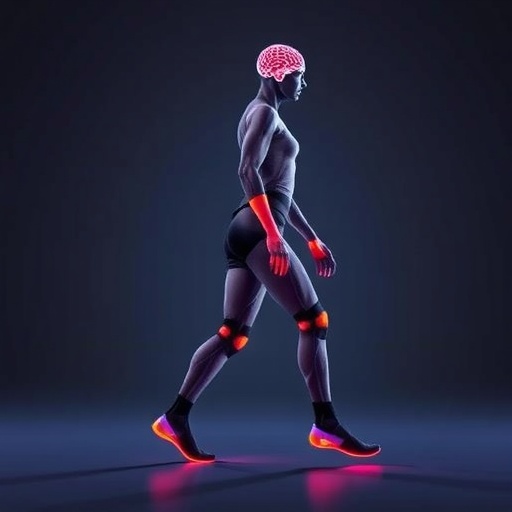
In a groundbreaking convergence of neuroscience and robotics, researchers from the Keck School of Medicine of USC, the University of California, Irvine (UCI), and the California Institute of Technology (Caltech) have propelled the ambitious quest to restore walking and sensation in patients with paraplegia forward. Their innovative work harnesses the power of a fully implantable brain-computer interface (BCI) integrated with a wearable robotic exoskeleton, marking a significant leap towards reestablishing natural, bidirectional communication between the brain and limbs once paralyzed.
Leveraging an $8 million grant from the National Science Foundation’s Cyber-Physical Systems program, this interdisciplinary team has engineered a sophisticated system that goes beyond traditional BCIs. Where previous devices have largely been unidirectional—translating brain signals to control external devices—their design introduces a sensory feedback loop that allows signals to travel from the robotic limbs back to the brain. This closed-loop communication is critical for mimicking the natural sensorimotor integration necessary for truly autonomous movement.
Central to this achievement is the implantable BCI, which resides on the brain’s surface over the motor cortex. This cortical region houses the neural representations of leg movements, and the implant’s electrodes capture the neural activity correlated with the patient’s intent to walk. Advanced signal processing algorithms decode these neural patterns in real time, translating them into actionable commands for the robotic exoskeleton. Crucially, the system operates fully on an implantable computer chip, eliminating reliance on bulky external hardware and dramatically improving the patient’s mobility and comfort.
Complementing this motor control is an intricately timed sensory feedback mechanism. Electrodes implanted in the sensory cortex are stimulated to recreate the tactile and proprioceptive signals associated with walking. These artificial sensations, synchronized precisely with the robotic exoskeleton’s movements, provide the patient with an embodied experience of walking. This bidirectional interface not only enables voluntary movement restoration but also addresses a critical aspect often overlooked: the perception of limb position and movement, which is essential for balanced and fluid locomotion.
A pivotal proof-of-concept study involved a patient with epilepsy, who consented to temporary electrode implantation as part of their clinical treatment. During this study, the patient was tasked with imagining walking movements, which the implanted BCI successfully decoded with 92% accuracy to trigger steps in a robotic exoskeleton worn by a researcher. Moreover, the sensory cortex stimulation allowed the patient to accurately perceive the walking steps with 93% precision, despite being visually occluded from the researcher’s movements. Remarkably, this high-level performance was achieved without prior training, underscoring the intuitive nature of the control and feedback loops.
The implications of this research are profound. Current exoskeleton technologies available to paraplegic patients provide mobility but typically depend on visual or external feedback, limiting autonomy and natural control. By creating a system where the brain both sends motor commands and receives sensory input directly, this technology promises a restoration of walking that feels more natural and instinctive—a true sensorimotor integration rather than an external aid.
Ensuring patient safety has been a paramount consideration throughout this work. The researchers waited for an ideal clinical opportunity involving electrode implantation in a consenting epilepsy patient, ensuring that the system’s testing did not add any additional surgical risk. Their success in this setting has paved the way for FDA approval to conduct clinical trials in patients with spinal cord injury, initially focusing on transient 30-day electrode implants to further validate and optimize the system’s functionality.
Future research aims to refine the sensory feedback, making it more nuanced and akin to natural tactile sensations, and to miniaturize the entire BCI-exoskeleton system for completely internal implantation. This miniaturization is critical for transitioning from clinical prototypes to commercially viable medical devices that can seamlessly integrate into patients’ daily lives without visible or cumbersome external components.
Beyond walking restoration, the research team is exploring complementary technologies that blend brain-computer interfaces with regenerative medicine approaches, such as stem cell therapies. These efforts hold the potential to repair underlying neurological damage while enhancing functional recovery through advanced neuroprosthetics, heralding a new era where lost abilities from brain injury or disease could be reclaimed more fully.
The collaborative project brings together pioneers in neurosurgery, biomedical engineering, and neuroscience, including principal investigators Charles Liu, Richard Andersen, and Zoran Nenadić. Liu emphasizes the novelty of integrating sensory stimulation triggered by the exoskeleton itself, a technological advancement that brings the concept of a “neuroprosthetic loop” into practical reality. Andersen underscores the significance of replacing visual feedback with neural sensation, potentially transforming the user experience and efficacy of robotic walking aids.
This landmark experiment and the ongoing development represent a visionary step toward overcoming the long-standing challenges of paralysis. By enabling the brain to not only command movement but also perceive it, the team has showcased how engineering innovation combined with deep neurophysiological insight can open up new horizons for restoring human mobility. The work, published in the journal Brain Stimulation, signals a hopeful future where paralysis may no longer be a life sentence but a condition amendable through cutting-edge interfaces blending mind, machine, and sensation.
Cite Scienmag News
Cassandra Pierce. (April 16, 2026). Scientists Develop Two-Way Brain Interface with Wearable Robotic Legs to Restore Walking and Sensation After Paralysis. Scienmag. https://scienmag.com/scientists-develop-two-way-brain-interface-with-wearable-robotic-legs-to-restore-walking-and-sensation-after-paralysis/
Cassandra Pierce. "Scientists Develop Two-Way Brain Interface with Wearable Robotic Legs to Restore Walking and Sensation After Paralysis." Scienmag, 16 April 2026, https://scienmag.com/scientists-develop-two-way-brain-interface-with-wearable-robotic-legs-to-restore-walking-and-sensation-after-paralysis/. Accessed 4 September 2026.
Cassandra Pierce. "Scientists Develop Two-Way Brain Interface with Wearable Robotic Legs to Restore Walking and Sensation After Paralysis." Scienmag. April 16, 2026. https://scienmag.com/scientists-develop-two-way-brain-interface-with-wearable-robotic-legs-to-restore-walking-and-sensation-after-paralysis/


